Lech Lecho: The 3 Nations and Geuloh

Lech Lecho: The 3 Nations and Geuloh

We present this worked-over translation of a maamer of the Tzemach Tzedek to give a deeper understanding of the land of the 3 nations mentioned in Dvar Malchus and the connection to Geuloh.

The Borders of the Land of Israel in the Future

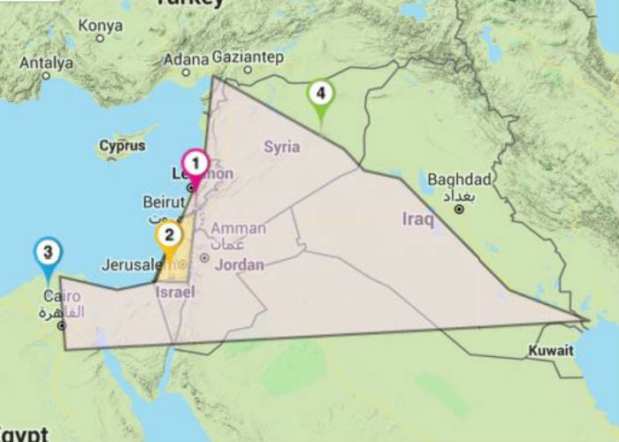
We are promised in the Torah that in the time to come the Jewish people will receive the land of Israel consisting not only of the land of the 7 nations of Canaan but also the land of the three nations of Edom, Moav, and Amon (the Keni, Kenizi and Kadmoni).

This being so, we are confronted with a question: The prophecy of Yechezkiel describes the borders of the land of Israel as they will be in the time to come, but in his prophecy they are clearly defined as being the same borders as were conquered by Yehoshua ‐‐ the land of only 7 nations. His prophecy is about the time to come: why doesn’t he mention the lands of the other 3 nations?

This is also connected to the additional three refuge cities (arei miklat) which we are instructed to establish in those lands. These refuge cities are, in turn, associated with the rectification of Hevel.  Kayin was able to kill Hevel because Hevel was already condemned to death (“chayav misa“) for having “gazed at the shechina” while offering his sacrifice.

Chazal (Sanhedrin, 98a) explain Continue reading

Noach “Saw a New World”

Noach “Saw a New World”

The opening verse in Parshas Noach says that “נֹ֗חַ אִ֥ישׁ צַדִּ֛יק תָּמִ֥ים הָיָ֖ה בְּדֹֽרֹתָ֑יו” “Noach was a righteous man, he was perfect in his generations”.  The Midrash on this posuk (Midrash Rabba Noach, 30:8) says in the name of R’ Levi: “Whoever it is said about them ‘he was’ saw a new world.”  The Midrash then enumerates five individuals, the first being Noach, citing that when he and his family exited the ark, they saw a new world.

In what sense did Noach see a new world?  Obviously, it was the same Earth, although following the waters of the flood surely the surface of the Earth looked different than it did previously.  And of course, the evildoers who populated the Earth previously were no longer around.  But can we really say that this is what it means to see a “new world”?

The Rebbe, in the sicha of Noach 5752, clues us in to what is being implied here according to pnimiyus haTorah:

In the creation of the world, the Torah refers to Hashem using two names: Continue reading

Re’eh: It’s All Good, Including the Curses!

Re’eh: It’s All Good, Including the Curses!

Our parsha begins with the verse “Behold (re’eh), I am placing before you today a blessing and a curse.”  The Rebbe, very noticeably, does not include that last word (“curse”) when discussing the verse in our Sicha.  The point will become clear as we examine how the Rebbe illustrates this with a story from the gemora.

In tractate Moed Koton the gemora tells how Rebbi Shimon, the famous Rashbi, instructed his son Elazar to approach two sages they encountered and to request their blessings.  Elazar obeyed his father and asked them for their blessings.  The two sages were happy to oblige, but their blessings don’t sound like blessings at all!  Among their choice words: “You should sow but not reap… confusion should reign at your table…” — These are blessings?!

Elazar returned to his father and complained that not only didn’t these sages give him blessings, but their words left him disturbed!  Rashbi asked him Continue reading

Golus — Even While the Light of Geuloh is Shining?


The human eye can perceive light.  But only when it has a wavelength between approximately 380 nanometers (seen as violet) and 750 nanometers (seen as red). But these light rays are only a small fraction of the very broad spectrum of rays that exist, from 0.0001 nanometers in wavelength to a full meter.  This covers Gamma rays, x-rays, ultraviolet, infrared, microwaves, and radio waves — none of which the human eye can perceive.

But this is not a science lesson — what does it have to do with Geuloh?

We will see that it is a basis for understanding how the Rebbe can say that the Geuloh is here, all the end times have passed, and yet we remain in golus.  On the face of it, there is no logical basis to say that Continue reading

28 Sivan a Preparation for Gimmel Tammuz?

We find that the Rebbe teaches a firm principle: the flow of the year is a continuum.  This means to say that each holiday or commemoration day is a preparation for the one that follows it on the calendar.  For example: Pesach (coming out of Egypt) is a preparation for Matan Torah on Shavuos; the day of Yud Kislev (the redemption of the Mitteler Rebbe) is a  preparation for Yud-Tes Kislev (the day of redemption 29 years earlier of his father, the Alter Rebbe).  The year that things happened in history is of much less significance than the order that they happen on the calendar.

From this we understand that since 28 Sivan precedes Gimmel Tammuz by 5 days — according to the Rebbe’s principle it serves as a preparation for Gimmel Tammuz.  In what do we see this?  On 28 Sivan we celebrate the Rebbe coming to America, being miraculously saved from the “valley of tears” of war-torn Europe.  Gimmel Tammuz is marks the end of the era (until now, at least) when we could see and hear the Rebbe in the usual ways.  What sort of preparation is this one for that one?

The day of 28 Sivan is noted in the “Shalsheles Hayachas” printed (at the Rebbe’s behest) at the beginning of the sefer Hayom Yom.  It begins with the Maharal of Prague, indicating the 7 generations to the Alter Rebbe.  Then it lists by year the major events and accomplishments of each of the Rebbeim of Chabad, concluding with the Rebbe.  For the Rebbe it states (after the year he was born and married) that in “5701 — Sivan — came to the city of New York”.  Not “arrived” (as a refugee) but “came” (purposefully).  A few comments about the Rebbe’s coming to New York:

Firstly, in the farbrengen of Shavuos 5701, about 10 days before the Rebbe and the Rebbetzin would set sail for America, the Previous Rebbe said:

According to universal custom, preparations for an important guest begin well in advance.  Every corner in the house is cleaned two weeks in advance, the family talks about the upcoming visit, and the neighbors are duly updated. He’s arriving soon. It’s now close to the time when Mashiach will come. It’s time to prepare for his arrival….  

Many see in this a hint to the arrival to America of the Rebbe, Melech HaMoshiach.  The old-timers who were in New York at the time tell that from the moment the Rebbe arrived, “everything changed”.  In fact, the Rebbe even testified on himself that something changed when he arrived to the USA.  At a farbrengen (Chol haMoed Pesach, 5748), the Rebbe addressed his arousal to cry out “Ad Mosai” (“until when” must we remain in golus):

I never heard this from my father, and certainly not from my grandfather. Even from myself, I never heard such talk before I arrived here in the United States…

So even the Rebbe’s impatience for Geuloh started when the Rebbe came to America (on 28 Sivan)!

We could say that 28 Sivan is an aspect of Moshiach being revealed.  Revealed to the Chassidim in America, revealed to the Rebbe himself, revealed in the new activities of Lubavitch that began only after the Rebbe’s arrival.

Based on this, we can see how 28 Sivan is a preparation for Gimmel Tammuz: on 28 Sivan Moshiach is revealed, on Gimmel Tammuz Moshiach is concealed.  As Rashi brings from on Daniel 12:12:

“in the future our Moshiach will be concealed after he has been revealed and will return and be revealed [again]” (שעתיד משיחנו להתכסות אחר שנגלה וישוב ויתגלה)

In order to fulfill the second step of being concealed (with the great value of the Divine service of the period of concealment, as discussed, for example, in the Kuntres of Rosh Chodesh Kislev, 5751 which addresses the concealment of Erev Rosh Chodesh), there must be the preparation of Moshiach being revealed.  The aspect of revelation of 28 Sivan precedes and prepares for the aspect of concealment of Gimmel Tammuz (and it’s connected to Erev Rosh Chodesh, which is the day after 28 Sivan).  Of course Gimmel Tammuz is not an end in itself — it leads to the ultimate redemption of 12-13 Tammuz.  And as the Rebbe says many times: the Geuloh of 12-13 Tammuz showed in retrospect how Gimmel Tammuz itself was “the beginning of the Geuloh”.  May we bring it about now!

The Decree is Nullified? But…

The Decree is Nullified? But…

What does it mean that a decree has been nullified?

In various sichos*, including the Dvar Malchus sicha of Tetzaveh, the Rebbe uses the expression that Haman’s decree was nullified (ביטול גזירת המן).  This expression is actually quite surprising: where in the Megillas Esther do we see that the King’s order containing Haman’s evil decree was rescinded?  The Megillah actually tells us the opposite: Haman’s decree was sealed with the King’s ring, and “a writ that is written in the name of the king and sealed with the king’s ring cannot be rescinded.”**  What actually happened was that the a follow-up decree was issued: the right of the Jews “to assemble and to protect themselves, to destroy, to slay, and to cause to perish the entire host of every people and province that oppress them.” (Esther 8:11).  The original decree of Haman remained in full force (“cannot be rescinded”), and still the Rebbe calls this the nullification of Haman’s decree?

If we examine this, we will see how it is very relevant to the Geuloh and the sichos of Dvar Malchus.

The question is: how can Haman’s decree be considered to have been nullified?  There are two aspects to the answer.

Firstly, the intention behind Haman’s decree was nullified via the issuing of the second decree.  By giving the Jews in his Kingdom the right to defend themselves and despoil their oppressors, the original intent of Haman’s decree has been nullified and replaced (even though the decree itself could not be rescinded).  The second way of explaining it is that nothing changed until the actual fighting and victory of the Jews on 13 Adar — up until that point it was all “theoretical”.  We look at the reality on the ground.

The greatness of Purim is explained by the Alter Rebbe in Torah Ohr as connected with the self-sacrifice (mesirus nefesh) of the Yidden over the course of an entire year.  Haman’s decree to “to destroy, kill, and cause to perish all the Jews” was decreed to take place “on one day, on the thirteenth day of the twelfth month, which is the month of Adar”.  From the time Haman’s decree was issued (in Nissan) until the following 13th of Adar was almost a full year.  The sword of destruction was held over their heads for full year, and yet nobody thought to deny his Jewishness in order to save himself — this mesirus nefesh is what the Alter Rebbe praises.

However, the “nullification” of Haman’s decree took place only two months after the original decree was issued: Continue reading

Lech Lecho: The 3 Nations and Geuloh

Lech Lecho: The 3 Nations and Geuloh

We present this worked-over translation of a maamer of the Tzemach Tzedek to give a deeper understanding of the land of the 3 nations mentioned in Dvar Malchus and the connection to Geuloh.

The Borders of the Land of Israel in the Future

We are promised in the Torah that in the time to come the Jewish people will receive the land of Israel consisting not only of the land of the 7 nations of Canaan but also the land of the three nations of Edom, Moav, and Amon (the Keni, Kenizi and Kadmoni).

This being so, we are confronted with a question: The prophecy of Yechezkiel describes the borders of the land of Israel as they will be in the time to come, but in his prophecy they are clearly defined as being the same borders as were conquered by Yehoshua ‐‐ the land of only 7 nations. His prophecy is about the time to come: why doesn’t he mention the lands of the other 3 nations?

This is also connected to the additional three refuge cities (arei miklat) which we are instructed to establish in those lands. These refuge cities are, in turn, associated with the rectification of Hevel.  Kayin was able to kill Hevel because Hevel was already condemned to death (“chayav misa“) for having “gazed at the shechina” while offering his sacrifice.

Chazal (Sanhedrin, 98a) explain the verse “in its time I will hasten it” (“B’itah Achishena“) as referring to two distinct end times (ketz, plural: kitzin): “if they merit, I will hurry it (Achishena), if they don’t merit, [Hashem will bring the Geuloh] in its time (B’itah)”. If the ketz comes in its last possible moment ‐‐ B’itah ‐‐ all the descendants of Hevel will be rectified. But, if the Jewish people will merit to the redemption before the ketz of the rectification Hevel is completed, then there will be need for refuge cites (arei miklat) for those (descendants of Kayin) who will kill accidentally (but not intentionally).

[Important to note what is explained in Chassidus: that the rectification of the souls that derive from Hevel are the basis of “refining the sparks of holiness”, the “avoidas habirurim“, which the Jewish people accomplish during the time of golus. See also Toras Chayim, Shemos II, 277a.]

Achishena — An Awakening from Below

In order to understand this matter of B’itah and Achishena, we find that chazal say “the woman conceives first and a male is born; the man conceives first and a female is born.” This means that when Knesses Yisroel (the collective soul of the Jewish people) will “conceive first”, which is the aspect of “elevating the feminine waters” (hala’as ma”n) from below to above, like the yearning of the woman for her husband, then this awakening from below will generate the awakening from Above which draws down the masculine waters (hamshachas ma”d) from a very lofty level so that a male will be born, meaning a higher level [than a female].

We are talking here about the avoidah that gives birth to love in the Jewish people, a male child representing “great love” (ahava raba). But, if the man (Hashem) will conceive first, then a female will be born, meaning the aspect of love [of Hashem] in order to receive a reward in Gan Eden (see Likkutei Torah, Tazria, “Sos Tasis“).

So, too, in our case: if the ketz will be via the awakening of Knesses Yisroel, meaning that through the awakening from below there will be an awakening from Above to speed up the matter before its time, which is the aspect of Achishena, then Hashem will widen the borders and we will inherit the land of the Keni, Knizi and Kadmoni. But, if it will be the man conceiving first, meaning the ketz will come due to an awakening from Above in its (pre‐determined) time, then the borders of the land will remain unchanged, as in the prophecy of Yechezkiel, and the lands of the three nations will be left a desolate wasteland.

Refining the Sparks (Avodas Habirurim)

To explain this matter: the shattering of the vessels occurred primarily in the 7 midos of Tohu (the emotions), but not so much in the Kesser, Chochma and Bina (intellect and super‐intellect) of Tohu.  Thus, as regards their rectification, which is the avoidas habirurim performed by the Jewish people down in this world via Torah and Mitzvos, this is performed on the 7 midos.  At the same time, the three dimensions of Kesser, Chochma and Bina of Tohu are being rectified together with them.

According to this, it would be fitting that the Jewish people should inherit these lands when they finish the task of refining the 7 midos of Tohu; however, this depends on the actions of the Jews in this world, whether it will be “in its time” or “I will hasten it” (B’itah or Achishena, which was explained above as dependent on whether there is first an awakening from below). The expression “inheriting these lands” means the revelation of the good found in the aspect of Kesser, Chochma and Bina of Tohu.

[In other words, we have two factors: the avoidas habirurim and the awakening from below. If the avoidah is finished before there is an awakening from below, this is called B’itah. If the awakening occurs before the avoidah is completed, this is called Achishena. This determines the inheritance of the land.]

Inheriting the Land of the 7 or the 10 Nations?

If the good that is in them will be revealed in a tangible way in the Jewish people, then these lands will be considered part of the Land of Israel and this will take place in the simple sense as well. But, if we will not inherit these lands, then the gentiles in those places will (as stated in the prophecies) be wiped out along with the evil that is there, however, the lofty good that is there will not be revealed directly; rather, it will only be revealed through being enclothed in the 7 midos (the land of the 7 nations of Canaan). Which case will take place depends on the actions of the Jewish people down in this world.

If we bring about Achishena, an awakening from below (hala’as ma”n), the woman conceives first: this will cause a drawing down from below (hamshachas ma”d) and the inheriting of the 3 lands of Kesser, Chochma and Bina of Tohu, and the good that has been refined from them will actually shine forth there. Those lands will be considered as part of the land of Israel, and physically the borders of Israel will reflect this.

However, if it will be B’itah, from Above, even though the spirit of impurity will be removed, nonetheless the good in them will not be revealed; rather, it will only appear through being enclothed in he midos, the land of the 7 nations. In such a case, the lands of the 3 nations will be left desolate.

[We could explain that these revelations will not have a vessel in which to be revealed. These levels of lofty understanding cannot be revealed in the regular vessels of intellect which we presently possess.  Thus, they will only be revealed in the midos, like a person who feels strongly attracted to something or feel vehemently against something without understanding the reason.]

Why Yechezkiel Saw a Future of the Land of 7 Nations

Since the expansion of the land of Israel to include the 3 lands is dependent on the ketz being in a way of Achishena (love that derives from an awakening from below, as explained above), this is why Yechezkiel’s prophecy describes only the land of the 7 nations: because he prophesied about the final ketz which is the ketz B’itah where the borders of the land of Israel remain as they were in the days of Yehoshua.

We notice that in the prophecy of Yechezkiel, the land is divided into 13 sections. The question is: how do we arrive at the number 13 when there are only 10 sefiros? The answer is that the 7 midos each possesses 3 moichin (the Chabad of the midos, bringing to 10) and further the Kesser, Chochma and Bina of Tohu are enclothed in them in a hidden way (bringing to a total of 13).

Thus, we see that the prophecy of Yechezkiel is on the ketz B’itah wherein Kesser, Chochma and Bina will be enclothed in the 7 midos in a hidden way, because the awakening is from Above, that the supernal Man conceives first and there will not be an actual inheritance of the 3 lands. But, afterwards, in the days of Moshiach, through the avoidah of Yisroel they will arrive and merit after several years to the aspect of Achishena, inheriting the 3 lands as part of the land of Israel, until the good in Kesser, Chochma and Bina of Tohu will be actually revealed there.

We see from this maamar of the Tzemach Tzedek that if the Jewish people finish avoidas habirurim but still have not had an “awakening from below” on their own, then the Geuloh arrives but they lack the vessels to perceive the lights of Tohu that have been refined from level of Kesser, Chochma, and Bina of Tohu. If this occurs, then they will have to do the avoidah in Yemos Hamoshiach in order to reach the level where they will “inherit the land of the Keni, Kenizi and Kadmoni”, meaning a revelation of the lights of Tohu in a revealed way.

This explains the assertion of the Rebbe that:

  1. Avoidas habirurim has been completed,
  2. We only need shout “ad Mosai”, to open our eyes to see that the Geuloh is here, and
  3. That we are presently found in Yemos Hamoshiach.

Based on the maamor of the Tzemach Tzedek printed in Ohr HaTorah, Bereishis, page 1167 תתשסז

This article in downloadable PDF format
Noach “Saw a New World”

Noach “Saw a New World”

The opening verse in Parshas Noach says that “נֹ֗חַ אִ֥ישׁ צַדִּ֛יק תָּמִ֥ים הָיָ֖ה בְּדֹֽרֹתָ֑יו” “Noach was a righteous man, he was perfect in his generations”.  The Midrash on this posuk (Midrash Rabba Noach, 30:8) says in the name of R’ Levi: “Whoever it is said about them ‘he was’ saw a new world.”  The Midrash then enumerates five individuals, the first being Noach, citing that when he and his family exited the ark, they saw a new world.

In what sense did Noach see a new world?  Obviously, it was the same Earth, although following the waters of the flood surely the surface of the Earth looked different than it did previously.  And of course, the evildoers who populated the Earth previously were no longer around.  But can we really say that this is what it means to see a “new world”?

The Rebbe, in the sicha of Noach 5752, clues us in to what is being implied here according to pnimiyus haTorah:

In the creation of the world, the Torah refers to Hashem using two names: YKVK and Elokim.  YKVK is G-dliness that is above the world.  Elokim is the name which indicates concealment, allowing independent-feeling worlds to come into existence.  In the words of Tehillim: “The Sun and a shield [these are the names] YKVK [and] Elokim”.  The name YKVK is the emanation of worlds, the infinite “light” of the worlds, and Elokim is the “shield” or “filter” that conceals the light in order that finite worlds can come into existence.

“That in the reality of the world as it is created via the name Elokim is revealed the name YKVK, until it is recognizable in a revealed way that “YKVK is Elokim” (הוי’ הוא האלקים), that in truth the contraction and concealment (Elokim)  are really the name YKVK. הצמצום וההסתר (אלקים) הוא לאמיתתו שם הוי-ה

(Sicha Parshas Noach, 5752)

Meaning that the world is still the same world that was created via the name Elokim, only that it becomes revealed that really even this name Elokim is just a reduction of the light of YKVK, but not something independent or separate.

So the “new world” that Noach saw was not a new form of creation, but a new perception: he could now perceive how the world of Elokim is really a world of YKVK.  It was recognizable and revealed to him.  He saw the same world but in an entirely new way, thus he saw a “new world”.

We can use this to understand many things the Rebbe is trying to tell us in these Dvar Malchus sichos, giving us the tools to “open our eyes”, including the subject of last week’s sicha regarding “servitude to the nations”.  Over there the Rebbe explains how there is servitude to the nations in the time of Golus, but that this servitude does not extend to our neshomas, nor to our bodies as regards matters of Torah and mitzvos.  And even those things where we must follow the law of the land because “dina d’malchusa dina” (the law of the land is the law) is not because we are in servitude to the nations of the world, but because this is how Hashem wants it to be in the time of Golus.

In those short paragraphs, the Rebbe has opened our eyes to a “new world”: a world where there is no servitude to the nations, which is the definition of (the first period of) the Days of Moshiach!  In other words, if one is in a personal Golus and in fact believes that the Jewish people is in servitude to the nations, then in fact he is in such a state, r”l.  But when one internalizes what the Rebbe says there, he discovers that not only our neshomas and our bodies (as regards performing Torah and Mitzvos) are not in servitude to the nations, even those areas where we do go according to their decisions (monetary matters and the like) — this is not due to any form of “servitude” but rather it is Hashem’s will!  So by following civil monetary law, we are in fact fulfilling Hashem’s will no less than in other halachic matters!  Externally, it is the same Golus, but the Rebbe has given us the tools to “see through” the darkness of Golus and realize that the concealment of the name Elokim (Golus) is really coming from YKVK — a new world!

This is one example of many to be found in Chassidus in general, the Rebbe’s teachings in particular, and the Dvar Malchus sichos most especially.  By making these changes in our perception and understanding of the world, we place ourselves in a state of Geulah even while the world “continues in its natural way”.  This is the beginning of Yemos Hamoshiach, each one coming to the realization based on his own efforts to internalize these concepts.

Re’eh: It’s All Good, Including the Curses!

Re’eh: It’s All Good, Including the Curses!

Our parsha begins with the verse “Behold (re’eh), I am placing before you today a blessing and a curse.”  The Rebbe, very noticeably, does not include that last word (“curse”) when discussing the verse in our Sicha.  The point will become clear as we examine how the Rebbe illustrates this with a story from the gemora.

In tractate Moed Koton the gemora tells how Rebbi Shimon, the famous Rashbi, instructed his son Elazar to approach two sages they encountered and to request their blessings.  Elazar obeyed his father and asked them for their blessings.  The two sages were happy to oblige, but their blessings don’t sound like blessings at all!  Among their choice words: “You should sow but not reap… confusion should reign at your table…” — These are blessings?!

The son returned to his father and complained that not only didn’t these sages give him blessings, but their words left him disturbed!  Rashbi asked his son what they said, and he told him.  Rashbi then proceeded to “translate” for his son the blessings hidden behind the words (“you should bear sons and they should not die… Confusion should reign at your table due to being blessed with many children.”)

This episode serves as an example for how the Rebbe is interpreting the verse in our parsha:

First of all, we must appreciate and understand that everything that Hashem places before us is actually blessing, including those things that appear to us as the opposite of blessings.  Additionally, we need to appreciate that when we don’t see the blessing it doesn’t mean that it doesn’t exist, but rather that it is concealed.  There are revealed blessings and concealed blessings. 

Why would Hashem place before us something that doesn’t appear like a blessing? 

The Rebbe answers that this is because concealed blessings are actually much greater!  (As we will declare in the time of the Geuloh — “thank You Hashem that you displayed anger with me”, Yeshayahu 12:1)   Revealed blessings are given from Above to below, like a free gift.  But there is a higher level of blessing that comes through transforming the “curse” to a “blessing” — via the avoidah of the Yid down below.  The Rebbe brings the words of the Tzemach Tzedek: “…just as tshuvah is higher than the aspect of a Tzaddik, [so, too] through this that the darkness is transformed to light [via tshuvah]…this that the evil is transformed to good this is higher than the level of good itself.”  Although it appears as darkness and evil — a curse — this is only externally; its true inner dimension is actually a blessing.  So, in fact, there are no real curses — only concealed blessings that need to be transformed externally to reveal their inner, hidden intent.

This might not sound new to those who have learned the 11th epistle in Igeres Hakodesh in sefer haTanya.  There, the Alter Rebbe writes: 

In fact, however, no evil descends from above and everything is good, though it is not apprehended because of its immense and abundant goodness. And this is the essence of the faith for which man was created: to believe that “There is no place void of Him” and “In the light of the King’s countenance there is life,”… By believing this truly, everything becomes good even in appearance.

It seems that the Rebbe is just offering us an additional explanation of concepts that we have been learning for over 200 years.  There is, however, a small but very significant change in wording between the Alter Rebbe in Tanya and the Rebbe in Dvar Malchus.  The Alter Rebbe uses the terminology of “belief”: “the faith for which man was created, to believe….  By believing this….”.  Belief, emunah, is a lofty power of the soul, higher than intellect.  By definition one believes in something when he does not have knowledge of that thing and does not understand it (knowledge and understanding — powers of the intellect).  The Alter Rebbe teaches how a Jew must believe that everything is good because he cannot know or understand this intellectually.  The Rebbe, however, takes us on a quantum leap:

It is possible and is necessary that it be not only on the level of “hearing”, but also on the level of “seeing”… all the aspects of blessings, both revealed blessings and also the most concealed blessings…  This means to say that the approach to the general avoidah of the person is with a knowledge and recognition [emphasis added] that in his inner dimension he is given the revelation of the aspect of “I am Who I am” [Hashem’s essence, enabling him to serve Hashem without limitation, such as the apparent limitation of concealed blessings]… 

The Rebbe is telling us a tremendous chiddush in fitting with the general tone of the Dvar Malchus sichos and the crucial message that avoidas habirurim has been finished.  The chiddush is as follows:

It has always been true that everything is good and no evil descends from Above.  However, at the time the Alter Rebbe wrote the Tanya the human intellect was not yet able to truly grasp this.  Thus, we were instructed to simply believe that the apparent “curses” were in fact blessings.  In our generation, the Rebbe informs us that we already have “a heart to know, eyes to see, and ears to hear”, and demands of us not only to believe but to know and recognize that the “curses” are actually concealed blessings.  And even more than that: to see that the concealed blessings are not really curses.  (Based on the opening word of the verse: re’eh = “behold”). 

What was not possible for the generation of the Alter Rebbe (and thus was not demanded of them) is possible for us, and thus demanded of us!  And the Rebbe has already explained that the “direct way” to accomplish all of these things is by learning Chassidus, the inner dimension of Torah (which opens our eyes to the inner dimension of reality), and particularly the subjects of Moshiach and Geuloh which draw the light of Geuloh into the vessels of our intellect (as noted in Kuntres 15 Menachem Av).  Fulfill the Rebbe’s instructions and you yourself will see only blessings, and you will succeed to transform even the most deeply concealed blessings to revealed good!

Golus — Even While the Light of Geuloh is Shining?

The human eye can perceive light.  But only when it has a wavelength between approximately 380 nanometers (seen as violet) and 750 nanometers (seen as red). But these light rays are only a small fraction of the very broad spectrum of rays that exist, from 0.0001 nanometers in wavelength to a full meter.  This covers Gamma rays, x-rays, ultraviolet, infrared, microwaves, and radio waves — none of which the human eye can perceive.

But this is not a science lesson — what does it have to do with Geuloh?

We will see that it is a basis for understanding how the Rebbe can say that the Geuloh is here, all the end times have passed, and yet we remain in golus.  On the face of it, there is no logical basis to say that Continue reading