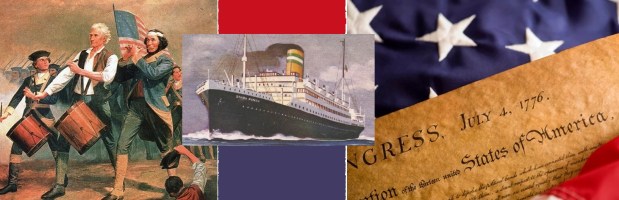
The Hidden Connection: 28 Sivan and July 4th

The Hidden Connection: 28 Sivan and July 4th

The year 5751 marked the 50th anniversary of the Rebbe’s arrival to the United States (together with the Rebbetzin).  That year, the Rebbe received well-wishes from then-President of the United States, George Bush, in honor of the anniversary of the Rebbe’s arrival.  We have the Rebbe’s response to President Bush, dated the 3rd of Elul, 5751 (13 August, 1991)1.  After the formal pleasantries, the Rebbe writes something that perhaps conceals more than it reveals.  The Rebbe writes:

“By Divine Providence your kind letter was dated on the morrow of the anniversary of the Nation’s birthday.  It is well to remember that the founders of this Nation considered Independence Day as ‘a day of deliverance, by solemn acts of devotion to G-d Al-mighty.’  By Divine Providence also my arrival in the United States in 1941 coincided with the declaration by Congress that year, making July 4th a legal public holiday.”

“The Nation’s birthday” is considered July 4th, the day in 1776 that the original 13 British colonies in America declared independence from the British Crown.  Unlike the famous story of the Pilgrims who came to America for freedom of worship, the Declaration of Independence presents a list of grievances against the British rulership of the colonies, completely political and economic in nature.  It speaks of liberty and freedom and happiness, without mentioning the matter of religion at all.  Nonetheless, the Rebbe chooses a quote from one of the “founders of this Nation”2 that does speak in religious terminology: “a day of deliverance, by solemn acts of devotion to G-d Al-mighty”.3

Here it is interesting to note that this quote is not from any official declaration.  It was written by John Adams (later to serve as the 2nd President of the United States) in a personal letter to his wife.  The Rebbe seems to have chosen to quote it because of its open expression of devotion to G-d Al-mighty. 

FIRST THE FACTS

Let’s examine the next statement in the Rebbe’s letter: 

By Divine Providence also my arrival in the United States in 1941 coincided with the declaration by Congress that year, making July 4th a legal public holiday.

We need to understand what is meant by referring to 1941 as the year that July 4th became a legal public holiday.  Let’s look at the historical facts:

Public records show that in 1870 Congress already established the July 4th as a holiday for the District of Columbia.4  It became a paid holiday for Federal employees in 1938.5  All this occurred in earlier years – why does the Rebbe say it became a legal public holiday in 1941?  The answer might give us deeper insight into the way the Rebbe views things.

In early 1941 it was brought to the attention of the responsible authorities that the resolution of Congress in 1938 (which made July 4th a paid holiday for employees of the Federal government) did not mention municipal employees of the District of Columbia.  (Unlike every other city in the United States which is under state law, the District of Columbia (aka Washington, DC) is not part of any state and is thus subject directly to Federal law.)  Meaning that a postal worker in California or South Dakota (employees of the Federal government) would have a paid day off on July 4th, but a Washington, DC schoolteacher or clerk still had an unpaid holiday.  A corrective resolution (adding a few words to the 1938 resolution) was passed in May, 19416 to include employees of the District of Columbia.  How many people were affected by these resolutions?

Public records indicate that in 1940 there were 1 million Federal employees nationwide7, who received July 4th as a paid holiday in 1938.  The number of municipal employees in the District of Columbia at that time was 9,7858.  Less than 1% of the total people affected by the resolution.  And when looking at the entire American workforce of the time – approximately 45 million9 (who were under state laws and not affected by these resolutions) – the resolution of 1941 affected merely 0.022% of the entire workforce.  That’s less than ⅕ of 1%!  And this the Rebbe refers to as a “declaration by Congress making July 4th a legal public holiday”!

INSIGHTS INTO THE REBBE’S WORDS

Most probably, the Rebbe did not intend for President George Bush to delve into the deeper meaning of the Rebbe’s words.  But from Chassidim it is expected that every expression of the Rebbe, even in a protocol letter to a gentile leader, should be “turned over and turned over”.  As our sages tell us, even mundane things mentioned by Talmidei Chachomim need to be learned10, so let us now examine what the Rebbe might be trying to teach us.

To review the events: 

  1. In 1870 there was a resolution of Congress to make July 4th a holiday (without pay) in Washington, DC; 
  2. In 1938 a resolution to make it a paid holiday for a million Federal employees;
  3. In 1941 a resolution to include another 9,000 DC municipal employees in the paid holiday.

“PUT YOUR MONEY WHERE YOUR MOUTH IS”

The resolution of 1870 doesn’t seem to interest the Rebbe at all.  The Rebbe considers July 4th to have been declared a legal public holiday by the fact that it became a paid holiday.  A case of “put your money where your mouth is”?  Or perhaps connected with the ruling of the Alter Rebbe regarding Birkas Cohanim11: according to Ashkenazi custom the Cohanim do not bless the congregation on Shabbos because they are troubled from losing a day’s income.  If Cohanim are troubled because they are missing the profits in the marketplace, so certainly, lehavdil, a gentile employee (and surely there were a few Jewish employees here, as well) could feel like it’s raining on his July 4th parade.12

RESOLUTION OF DECLARATION?

This may be connected with the Rebbe’s choice of expression: a “declaration by Congress”.  In fact, this was a “resolution” and not a “declaration”.  But, if we follow the Rebbe’s emphasis that “the action is the main thing” and that a person must be a “living example”, then we understand that only concrete action serves as a meaningful declaration.  Words without action, especially in the political arena, are generally dvorim bateilim.  Practical action is the true declaration.  Thus, the Rebbe terms this resolution of Congress (backed by a day’s pay) to be a “declaration”.

IT AIN’T OVER ‘TIL IT’S OVER

The resolution of 1941, as pointed out, resulted in a minor correction of less than 1% of workers who were left out of the 1938 resolution.  Yet the Rebbe refers to it not as a correction but as the act itself.  Perhaps along the lines of “everything follows the sealing”13 or “the end of the action was in the initial thought”14.

This also shows the Rebbe’s approach that even if 99% has been achieved – the task has not been accomplished.  There is no such thing as “almost finished”.  Such as a kli that is not subject to tuma’a until it is completed (gmar melacha).15

THE EDICT WAS GIVEN IN SHUSHAN THE CAPITAL16

The final element of interest is that the significance of the 1941 resolution is that it affected only Washington DC municipal employees.  The million Federal employees who received a paid holiday in 1938 didn’t qualify in the Rebbe’s eyes as declaring it a legal public holiday.  The fact that even after the resolution of 1941 there remained about 45 million workers nationwide most of whom did not yet receive this benefit from their state and local governments – not a concern.  But a few thousand municipal employees of the capital city of Washington, DC – this is what tilted the scale for the Rebbe.  From this we can perhaps see a hint to the significance of a nation’s capital in ruchniyus.  

For example: by a farbrengen in 575217 the Rebbe made mention of “the state of Russia had a revolution and collapse, with the change of the capital city”.  A few months later18 the Rebbe refers to the significance of the name “Shushan Purim”  – that it indicates \the refinement of “the capital city of the le’umas zeh”.  A paid holiday for employees of the capital of the USA seems to tilt the scales against all the other millions of American workers.

WHAT REALLY HAPPENED IN 1941

On a deeper, and more speculative note, it seems that the Rebbe is hinting at something even more substantive.  According to what we have seen, 150 years of July 4th celebrations (whether solemn or otherwise) did not qualify to make July 4th a legal public holiday in the Rebbe’s eyes.  Nor did the Congressional resolutions of 1870 and 1938.  If we will read the Rebbe’s words with a slightly different teitch, perhaps we can understand what the Rebbe is really saying here:

By Divine Providence also my arrival in the United States in 1941 coincided with the declaration by Congress that year, making July 4th a legal public holiday.

It was not the “declaration by Congress that year” that made July 4th (celebrating the establishment of the USA as a nation) into a legal public holiday.  Read it again.  It was the fact that it coincided with “…my arrival in the United States in 1941…” – this is what gave the celebration of July 4th legal status!  (And also halachic status, since dina d’malchusa dina in monetary matters.)  Meaning that celebrating the establishment of this particular nation is given its kiyum and tokef only when, in 194119, it fulfilled its tachlis by opening its doors to Melech HaMoshiach!20

To strengthen that concept, we will bring something told in the name of R’ Yehuda Leib Hoffman (a highly-esteemed Chosid of the Rebbe Maharash and Rebbe Rashab who was considered a master of Kabbalah) which relates to the statement of the Alter Rebbe that the Western Hemisphere (America – chatzi kadur hatachton) did not experience Matan Torah:

R’ Leib foresaw that the Rebbeim would one day end up in the Western Hemisphere. He explained that matan Torah did not occur there since that hemisphere is related to the highest of spiritual levels that cannot be ordinarily related to. However, since Moshiach will reveal these lofty levels, one of the Rebbeim would surely end up there.21

From this it would seem that in addition to a freilechen and shturemdik farbrengen on 28 Sivan, it might be appropriate also to say lechayim on July 4th22.  Since we see that the founding of the United States was a preparatory step in enabling Melech Hamoshiach to come to fulfill his shlichus of making a dira b’tachtonim and bringing the true and complete Geuloh! 

Lechayim!

יחי אדוננו מורנו ורבינו מלך המשיח לעולם ועד!

  1.  Attached as appendix I. ↩︎
  2. See farbrengen of 19 Kislev, 5747 (1986) which came out on “Thanksgiving” – the Rebbe speaks in strongly positive terms about the Pilgrims (the Rebbe refers to them in English as “founding fathers”) who came to America to worship the Creator without government or church interference.  Generally, American history does not refer to the Pilgrims as the “founding fathers” but rather reserves that title for the political and ideological founders of the United States (such as John Adams, author of the words the Rebbe quotes), who were active 150 years after the Pilgrims came.  The Rebbe evidently does not want to distinguish between the religious goals of the Pilgrims and the national goals of the signatories of the Declaration of Independence. ↩︎
  3. Also interesting to note that the letter is dated July 3rd, 1776, the day after he and most of the colonial delegates signed the Declaration of Independence.  The next day, the 4th of July, it was officially ratified.  In his letter Adams refers to celebrating the 2nd of July, as that was the day of the signing.  The Rebbe refrains from mentioning the continuation of Adam’s letter: “It ought to be solemized [sic] with pomp and parade, with shows, games, sports, guns, bells, bonfires, and illuminations, from one end of this continent to the other.“ ↩︎
  4. Resolution of Congress (16 Stat 168 CH.167), approved June 28, 1870 (29th of Sivan, 5630).  Appendix 2. Click to view Statue 16 ↩︎
  5. Resolution of Congress (52 Stat. 1246), approved June 29, 1938 (30 Sivan, 5698). Appendix 3. Click to view Statute 52 ↩︎
  6. Appendix 4. ↩︎
  7. …wiki/United_States_federal_civil_service ↩︎
  8. Click to view 1940 census detail ↩︎
  9. Click to view 1940 labor detail ↩︎
  10. Sukkah 21b:  אמר רב אחא בר אדא אמר רב המנונא אמר רב מנין שאפי’ שיחת תלמידי חכמים צריכה לימוד שנאמר (תהלים א, ג) ועלהו לא יבול.  רש”י שם (ד”ה משיחתו) לשון שיחת חולין ↩︎
  11. Alter Rebbe’s Shulchan Aruch, Hilchos Birkas Cohanim 128:57: “The custom in all these lands is that the Priestly Blessing is conferred only on a Yom-Tov, because then people are in a joyful and festive mood — and “only one who is glad of heart shall bless.”  On other days, by contrast, even on Shabbos, [the kohanim] are preoccupied with their livelihood and their loss of working hours and they are not in a happy state of mind.” ↩︎
  12. See Hayom Yom for 28 Sivan that by helping a Jew in his parnosa (“even 70 Russian kopeks”) all the supernal chambers are opened before him. ↩︎
  13. הכל הולך אחר החתום, Brochos 12a ↩︎
  14. סוף מעשה במחשבה תחילה from piyut kabbolos Shabbos “Lecho Dodi”, R’ Shlomo Alkabetz. ↩︎
  15. Hilchos Keilim, 8:1.  כָּל כְּלֵי מַתְּכוֹת – אֵינָן מְקַבְּלִין טֻמְאָה עַד שֶׁתִּגָּמֵר מְלַאכְתָּן כֻּלָּהּ, וְלֹא יִהְיֶה הַכְּלִי מְחֻסַּר מַעֲשֶׂה כְּלָל ↩︎
  16. Esther 3:15 וְהַדָּ֥ת נִתְּנָ֖ה בְּשׁוּשַׁ֣ן הַבִּירָ֑ה. ↩︎
  17. Shabbos Vayigash, 7 Teives, 5752, footnote 85: “נעשית המהפכב והנפילה של מדינת רוסי’ת בשינוי עיר הבירה וכו’” ↩︎
  18. Ki Sisa, 5752, footnote 166. ↩︎
  19. As the Midrash says that Hashem made a condition when He created the sea, that it would split for Moshe Rabbeinu (Shemos Rabba, 21:6). ↩︎
  20. See Hayom Yom for 3 Elul, the date of the Rebbe’s letter: “a soul needs to refine and rectify a certain place, or also from the time of the creation of the world – the item needing refinement or rectification is waiting for that very neshoma to come and refine it or rectify it.  And also this neshoma since it was emanated and created it is waiting for the time of its descent to refine and rectify that which it has been assigned.” (!) ↩︎
  21. The Weekly Farbrengen #815, Merkaz Anash (from Reshimas Devorim (Chitrik)). In original (free translation): “HaRav HaTomim R’ Yisroel Levin heard from the Chosid R’ Leib Hoffman from Tsasnik: It’s known that the letters in the Torah are ‘ohr haKav’ which is drawn down after the tzimtzum, and the parchment is the unlimited Divine light which is before the tzimtzum. Being that the Torah was given in the upper half of the world, meaning that that the revelation that occurred in the upper half of the world is only a revelation of the “kav” which is after the tzimtzum. And in the lower half of the world [=western hemisphere], where the Torah was not given — this is like the parchment, which is the infinite Divine light from before the tzimtzum. Being that Moshiach will reveal the infinite Divine light from before the tzimtzum — it will be necessary for one of the Chabad Rebbeim to come to the United States, to America, because there the infinite Divine light from before the tzimtzum will be revealed.” ↩︎
  22. Note that July 4th, 1776 fell on the day of the fast of 17 Tammuz!  But see the sicha of Shlach, 5749 (ois 10) where the Rebbe states that 28 Sivan gives power to transform the entire month of Tammuz to be a chodesh hageuloh. ↩︎

The Fall of Iran and the Rise of Moshiach

The Fall of Iran and the Rise of Moshiach

War with Iran is approaching round two – could this be the final groan of golus, the cracking of the shell, the spilling forth of the light of Geuloh that the world is longing for? After all, Iran is simply the preferred modern name of ancient Persia – the very same nation. And we have the testimony of the sages of the Gemara that before Moshiach comes Persia will fall at the hands of Rome![1]

Evidently, we are describing an event of global proportions. But the chess-board of world politics is merely the playing out of an internal spiritual drama of the Jewish people, as Chassidus explains the verse “He gave the world over to their hearts”[2] (גם את העולם נתן בלבם). How should we understand this drama – especially since it is described as being intertwined with the coming of Moshiach?

By attempting to analyze both aspects – both the worldly external events and the inner service of Hashem – based on the words of our sages and the teachings of Chassidus, we will, with Hashem’s help, find them even more significant than we might have thought.

The Fall of Paras: the External Dimension

We will start by mentioning words spoken by the Lubavitcher Rebbe in order to establish the significance of this matter in our generation. The Rebbe told Ron Nachman, mayor of the Israeli city of Ariel, to explain to the Americans that “it is imperative that there be a strong Israel in order to check the spread of the influence of Syria, Iran, and so forth, for they are against the US no less than they are against Israel and maybe moreso.”[3] Clearly, the Rebbe was not discussing with him a sugya in the gemara or esoteric ideas of Chassidus – this is practical advice which even the gentile government in the United States is expected to understand.

Additionally, former Israeli Ambassador Yehuda Avner was interviewed a number of years ago and shared that the Rebbe in the mid-1970s told him (years before the Iranian revolution) that “the emergence of an Islamic Iran carries with it the seeds of jihadism that will spread across the Middle East, threaten Europe, and ultimately the whole of Western Civilization.[4] We understand clearly that the military threat from Iran is a pressing contemporary issue which in the Rebbe’s view is of the gravest consequence.[5]

Today, it is unfolding before our eyes.

We will now look at the relevant sources in Torah, with hope to gain some small insight into the gravity with which the Rebbe views the developments in Iran (Persia).

The gemara, Yoma 10a, states as follows:

Rebbi said that in the future Rome will fall at the hands of Persia…. Rav said that Persia will fall at the hands of Rome. Rav Kahana and Rav Asi said to Rav: Can the builders [Persia, who permitted the rebuilding of the Holy Temple] fall before the destroyers [Rome, who destroyed the Temple][6]?! He said to them: Yes, it’s a decree of the King.[7]

The commentary of Tosefos[8] clarifies that Persia is the nation destined to fall and adds a critical element: “We were told that in the future Persia will fall at the hands of Rome, that is, in immediate proximity to the coming of Moshiach.” Meaning, it’s not just one of many future events, but an event immediately preceding (-סמוך ל) the coming of Moshiach!

Rome, as we know, is Edom.[9] Edom is commonly understood to mean the Western world in general, and Rome is the center of its financial and military power. Just as Rome was the mightiest and wealthiest world power of its time, so, too, the United States today.

One could, however, ask a question on the relevance of this gemara to our times: Following the first Persian Gulf War, the Rebbe referenced the midrash Yalkut Shimoni that refers to a war in the year Moshiach is revealed and stated that it had been fulfilled that year – what need do we have for Persia to fall at the hand of Rome?! We can answer that the Yalkut Shimoni itself states the difference between “the year Moshiach is revealed” and “the hour Moshiach comes”. The Rebbe stated[10] that the first part – Moshiach was revealed – took place in 5751, and since then we are standing on the cusp of “the hour Moshiach comes”. And further, the Rebbe declares numerous times in these sichos that “kolu kol hakitzin” — “all the end times have passed”!  The task of refining the fallen sparks of holiness (avoidas habirurim) has been completed!  Consequently the Rebbe expresses his astonishment that “Moshiach still hasn’t come!”

In light of this, we can bring an amazing statement from the sefer Yaaros Dvash:[11]

The gemara states that [Moshiach] ben Dovid doesn’t come until the Persians will fall at the hands of the Romans. And the commentators note that it doesn’t state “before [Moshiach] ben Dovid comes” the Persians will fall at the hands of the Romans, but [rather the exclusionary language of “doesn’t come until”] to teach that even if the end-time will arrive, nevertheless it will be delayed until the Persians will fall at the hand of the Romans…[12]

He is describing a time when the final ketz has arrived (as the Rebbe has stated) and there is a perplexing delay in Moshiach’s coming – exactly our situation as per the Rebbe’s description. And the reason, according to Yaaros Dvash, is the matter of the fall of Persia (Iran) at the hands of the Romans (the most powerful of the Western nations).

However, one could protest that the Rebbe responded to the situation (that all the end times have passed and still Moshiach hasn’t come) with astonishment – not an explanation from the Yaaros Dvash! What connection do we find here to the Rebbe’s astonishment and disbelief?!

With a deeper look at the “fall of Persia”, and how it relates to the Rebbe’s declaration that avoidas habirurim has been completed, and especially the gemara’s expression that the fall of Persia is “a decree of the King” – we may find an answer….

Read the rest in the complete PDF:


The Fall of Iran and Rise of Moshiach


Footnotes:

  1. Yoma 10a. The sages also quote an opposite opinion: Rome will fall at the hands of Persia, but that opinion is considered to have been rejected.
  2. Koheles 3:11, and see Sicha Bo, 5751 (ch. 9) and Bamidbar, 5750 (ch. 7).
  3. Free translation from video at the distribution of dollars on 28 Tishrei, 5752 (6 October 1991).
  4. Interviewed by JEM for the video presentation “Faithful and Fortified”.
  5.  Let us note that “an Islamic Iran” is a combination of Paras (the nation) and Yishmael (the religion of Yishmael). The Mitteler Rebbe (Shaarei Teshuva, ch. 23, p. 91a) writes that “the main aspect of the Geuloh is dependent upon the fall of the Sar (spiritual source) of Yishmael davka, as stated in the Zohar”. The Maharal writes (Netzach Yisrael, ch. 21) that “malchus Yishmael and malchus Paras are all one malchus.” Furthermore, the expression used is that the Sar of Yishmael must “fall”, which matches the gemara that Paras “falls” at the hands of Rome, and Bereishis 25:18 regarding Yishmael: “before all his brothers he will fall.”
  6. The Persian kings who ruled at the end of the Babylonian exile gave permission for the rebuilding of the Second Beis Hamikdosh (see Rosh Hashana 3b/4a). Four centuries later, the Roman general Titus destroyed it. In another sense, the spiritual power of Persia (explained below) allows for the construction of the Mikdosh, whereas the power of Rome destroys it.
  7. Rebbi Yehuda Hanosi was the redactor of the Mishnah. Rav was his student. We must ask why his student rules differently, and specifically why does Rebbi rule that Rome must fall whereas Rav rules that it is Paras that must fall. We might suggest as follows: the gemara in numerous places describes the friendly relationship between Rebbi and the Roman ruler Antoninus. The Yerushalmi (Megillah 1:11) debates whether or not Antoninus actually converted to Judaism (and even if not, “he will be at the head of those who will come to convert in the time to come”). So we see that Rebbi not only lived under Roman rule, but his avoidah included transforming the aspect of Rome from an oppositional force to a friendly force which eventually rejoins the Jewish people (“rejoins” because the ancestor of Rome was Esav, who was a Jew). Rav not only lived in Bavel most of his life, but more importantly he was from the generation that followed the avoidah of Rebbi. His task was to continue to the next stage: the fall of the aspect of Paras as will be explained.
  8. Tractate Avodah Zora 2b, משכא מלכותייהו. Based on the statement that Moshiach comes only after Rome rules the entire world for 9 months. Maharsha on Yoma 10a also accepts this as the final ruling.
  9. Rashi on Bereishis 36:43: “Aluf Magdiel, Aluf Iram, these are the chieftains of Edom…” Rashi: “Magdiel this is Rome”. Pirkei d’Rebbi Eliezer ch. 38. Also Radak on Ovadia 1:1 – “What the prophets said regarding the destruction of Edom at the end of days they said about Rome. Radak on Yeshaya 34:1 – “..the kingdom of Rome they are all Edomim who adhere to the xtian religion, Ibn Ezra on Yeshaya 61:1, and the Ramban “Sefer Hageuloh”.
  10. Dvar Malchus, Parshas Naso 5751.
  11. Yaaros Dvash chelek 2, 162b, drush 7 Adar.
  12.  Also based on the statement that Rome rules the world for 9 months.