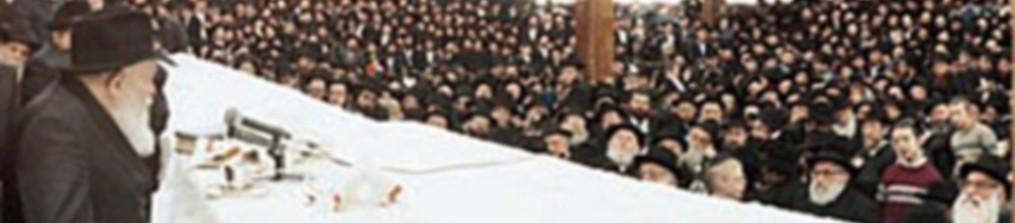
The year 5751 marked the 50th anniversary of the Rebbe’s arrival to the United States (together with the Rebbetzin). That year, the Rebbe received well-wishes from then-President of the United States, George Bush, in honor of the anniversary of the Rebbe’s arrival. We have the Rebbe’s response to President Bush, dated the 3rd of Elul, 5751 (13 August, 1991)1. After the formal pleasantries, the Rebbe writes something that perhaps conceals more than it reveals. The Rebbe writes:
“By Divine Providence your kind letter was dated on the morrow of the anniversary of the Nation’s birthday. It is well to remember that the founders of this Nation considered Independence Day as ‘a day of deliverance, by solemn acts of devotion to G-d Al-mighty.’ By Divine Providence also my arrival in the United States in 1941 coincided with Continue reading →
This discourse of the Rebbe was edited and printed for distribution for the Rebbe’s birthday, 11 Nissan, 5751. A lengthy and deep discourse, we mention here only the main points, reflecting the themes of the Dvar Malchus sichos from the same period.
“Tefilla leMoshe” is called by our sages the prayer of a rich man, and “Tefilla leDovid” is the prayer of a poor man. Since tefilla is defined as our asking for our needs, what is a rich man’s prayer? What does he need?
We find that according to Torah one must fill the needs of the poor man. This doesn’t only mean those necessities required by every person, it means we are obligated also to fill his personal needs. If he had previously been wealthy and was accustomed to a servant and a horse to run before him, then for him such a thing is lacking and we must provide it for him. One is obligated to fill what he lacks, but one is not obligated to make him rich. Thus, it comes out that even having a servant and a horse running before him (i.e. to be not lacking anything) is still not wealthy.
Wealthy, explains the Rebbe, is “superabundance”, which is more than just that nothing is lacking. Furthermore, it means that this abundance is not received from another source (and thus could be cut off or taken away); rather, it is inherently his — making him rich in essence (עשיר בעצם). This is why our sages say “there is no one wealthy except in da’as (knowledge)”. Rich (in knowledge) means that what he has learned has become unified with him and part of him as a result of his own effort (as opposed to remaining on the level of what others taught him).
Back to the question: one who is rich has superabundance — what, then, is his prayer?! The Rebbe answers: Continue reading →
This discourse of the Rebbe was edited and printed for distribution for the Rebbe’s birthday, 11 Nissan, 5751. A lengthy and deep discourse, we mention here only the main points, reflecting the themes of the Dvar Malchus sichos from the same period.
“Tefilla leMoshe” is called by our sages the prayer of a rich man, and “Tefilla leDovid” is the prayer of a poor man. Since tefilla is defined as our asking for our needs, what is a rich man’s prayer? What does he need?
We find that according to Torah one must fill the needs of the poor man. This doesn’t only mean those necessities required by every person, it means we are obligated also to fill his personal needs. If he had previously been wealthy and was accustomed to a servant and a horse to run before him, then for him such a thing is lacking and we must provide it for him. One is obligated to fill what he lacks, but one is not obligated to make him rich. Thus, it comes out that even having a servant and a horse running before him (i.e. to be not lacking anything) is still not wealthy.
Wealthy, explains the Rebbe, is “superabundance”, which is more than just that nothing is lacking. Furthermore, it means that this abundance is not received from another source (and thus could be cut off or taken away); rather, it is inherently his — making him rich in essence (עשיר בעצם). This is why our sages say “there is no one wealthy except in da’as (knowledge)”. Rich (in knowledge) means that what he has learned has become unified with him and part of him as a result of his own effort (as opposed to remaining on the level of what others taught him).
Back to the question: one who is rich has superabundance — what, then, is his prayer?! The Rebbe answers: Continue reading →