The Rambam, in his “Laws of Kings and Their Wars and Melech HaMoshiach”, declares that the coming of Moshiach and the process of redemption are not dependent upon the miraculous: “Do not expect that in the Days of Moshiach the pattern of conduct of the world will change, but rather the word will conduct itself in a normal manner…” “Our sages have taught that there is no difference between this world and the world to come other than servitude to the nations.” (Chapter 12) This means to say that even in the Messianic Era (the first stage), the world continues to go in a natural way, however the Jewish people are no longer in a state of “servitude” to the nations as they were during golus.
In this sicha, the Rebbe explains how the Jewish nation was chosen by Hashem and thus the entire Creation Continue reading →
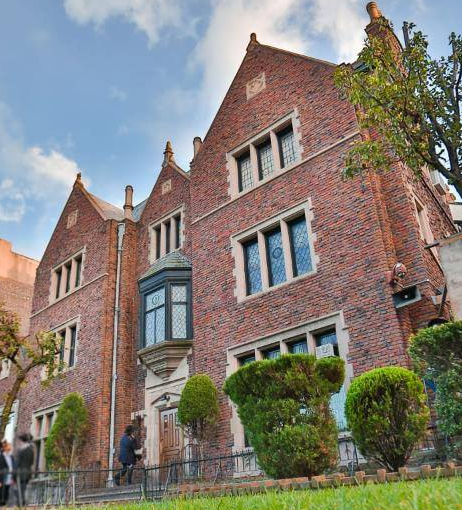
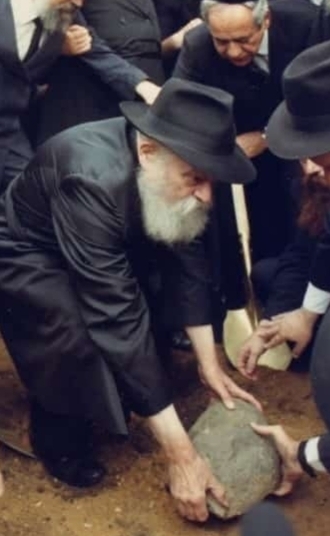
In honor of the laying of the cornerstone of the expansion of 770 Eastern Parkway on 17 Elul, 5751, we present this vital explanation of the significance of the building.
“I will be for them a small sanctuary (mikdash me’at) in the lands where they will come.” (Yechezkiel 11:16)
Our sages explain this posuk to mean that even outside of Eretz Yisroel, in the place and time of golus, there is a “small mikdash” which is a scaled-down example of the “great mikdash” in Yerushalayim. Rebbi Yitzchok in the gemora (Megillah 29a) said that this refers to the shuls and study halls in Bavel (Babylon), and Rebbi Eliezer said that this is “Beis Rabbeinu sh’b’Bavel” — “the house of our Rebbe in Bavel”.
The Rebbe, as might be expected, holds that these two sages do not have an argument, that each one surely agrees with the opinion of the other; the only difference is what they consider to be the main and most important fulfillment of the prophecy of “mikdash me’at“. Rebbi Eliezer holds that it is the study hall (place of learning) and shul (place of Tefilla) of “Rabbeinu”. Every shul possesses this quality in a small measure, but the primary and most complete manifestation of it is in the shul and study hall of the Rav whose Torah decisions are followed by the people of the city. And, in a fuller sense, there is one place which is the main “mikdash me’at” in the time of golus: the shul and study hall of the leader of the generation.
Our sages state that “Everywhere that Yisroel were exiled, the Shechina was exiled with them.” The sages in our gemora asked where in Bavel is the Shechina to be found? Abaye answered: in the shul of Hutzal and the shul of Shaf v’Yosiv in Nehardea — sometimes here and sometimes there. These were two unique shuls in Bavel, the first being close to the study hall of the revered Ezra the Sofer, the second being built from stones that were brought from the Beis Hamikdosh in Yerushalayim and “the Shechina was always found there” (Rashi). It called “Shaf v’Yosiv” (meaning “uprooted and [re]settled”) to indicate that “the Mikdash travelled and settled there”. It was literally the Beis Hamidkash of that generation, as “the revelation of the Shechina that was in the Beis Hamikdosh in Yerushalayim (and nowhere else) traveled and settled in this special place in Bavel, in place of the Mikdash in Yerushalayim.“
Of course, the Shechina dwells in every shul where Jews gather for Tefillah, and every study hall where they learn Torah, but nowhere is the Shechina more revealed than in the Beis Hamikdosh in Yerushalayim, or (in the time of golus) in these special buildings. Similarly we find that “in the future the shuls and study halls of Bavel will be established in Eretz Yisroel” — this is true of every shul and study hall, all of which will be connected to the Third Beis Hamikdosh in Yerushalayim. And when these places are relocated to Eretz Yisroel, the revelation of the Shechina will also return to Eretz Yisroel, and there will no longer be a revelation of the Shechina outside the land of Israel where the “mikdash me’at” stood. The Rebbe adds (quoting the Maharsha): Continue reading →
Our parsha begins with the words “Vayechi Yaakov” (“Yaakov lived”). And although in the parsha we read about Yaakov’s passing, nonetheless our sages teach us that “Yaakov Avinu didn’t die — just as his children are alive, so too he is alive”. Explains the Rebbe:
The life of Yaakov is eternal life through this that it is drawn to to his children and their descendants until the end of all of the generations. “His children are alive” meaning true life through learning and fulfilling the Torah. [Although we mention his children], nonetheless the name of the parsha is named after the life of Yaakov (“Vayechi Yaakov”) — since the truth of the life of Yaakov, eternal life, is expressed in the life of his children.
This means that Yaakov himself lives eternally (soul in a body, as explained elsewhere), and since the material eyes see that “they embalmed him and buried him, etc” his eternal life must therefore be expressed through the life of his children: they are alive because he is alive. (Similarly, he is alive because they are alive — he is the reason Continue reading →
The Kuntres printed for Hey Teves (ה’ טבת) in the year 5752 is a Chassidic Discourse the Rebbe said on parshas Vayigash, 5732, edited for publication under the supervision of the Rebbe himself. The discourse explains some deep concepts in Chassidus, which we will not attempt to explain here; rather, we will take one point in the discourse.
The parsha begins with Yehuda approaching Yosef. As is known, Yosef was dressed as an Egyptian, his brothers had no idea that this was their brother that they had sold into slavery so many years earlier. This “Egyptian” was demanding that their brother Binyomin remain with him as a slave, because of the “theft” of his goblet (which Yosef himself orchestrated). Yehuda fearlessly approaches Yosef and asks — and even demands — that the “Egyptian” let Binyomin return to his father (of whom he says “his soul is bound up with his soul”) and enslave one of the other brothers in his place.
This act of selflessness on the part of Yehuda represents the rectification of the original sale of Yosef, as is known. But as explained according to Chassidus, there are even loftier things occurring here.
The excitement surrounding the Rebbe’s victory of the seforim (5 Teives, 5747) is so intense that it begins even while we are still celebrating Chanukah. The day which the Rebbe referred to as “our side wins” (“Didan Notzach”) is a powerful dor hashvi’i celebration that rightly sweeps through Lubavitch. But beyond the farbrengens and the purchasing of seforim, the events of Didan Notzach and the sichos surrounding it deserve proper attention in order to understand at least something of the true magnitude of the victory. In particular, to recognize how 5 Teives represents the culmination in this physical world of the battle that has been going on since the times of the Alter Rebbe — the battle to bring the Geuloh.
The War of the Alter Rebbe
Hey Teives arrives a few days after the end of the month of Kislev, when everyone is still saturated with the story of the kitrug against the Alter Rebbe and against spreading Chassidus, Continue reading →
In our parsha we read about Yehuda approaching Yosef despite the fact that Yosef was second in command to Pharaoh (and not knowing this was really his brother). Yehuda fearlessly, but respectfully, demands that the youngest brother, Binyomin, be set free. Although he spoke respectfully, he did not ask permission to approach (as is customary) and was prepared to fight if necessary. All this in order to free Binyomin.
Who was mightier: Yosef or Yehuda? We know that Yosef was second only to Pharaoh, and everyone had to do exactly what he commanded. Yehuda, on the other hand, was a visitor with no rights, who had previously bowed in deference to Yosef. Despite this, Yehuda “broke protocol” and — recognizing that the life of Binyomin was at stake — confronted the Egyptian viceroy with mesirus nefesh (hardly imagining that this was really his brother Yosef who still loves him) .
The lofty level of the Chanukah lights, as explained in the teachings of Chassidus, is connected with the self-sacrifice of the Maccabees, and through this they succeeded to impact and “light up” the public domain (reshus harabim). We see this in the mitzvah of Chanukah candles, which are intended to publicize the miracle specifically in the public domain. (The reason that the custom is to light inside the home, not in the public domain, is beyond the scope of this post.)
But why is this only by Chanukah, and not by Purim? The miracle of Purim, also, was brought about by self-sacrifice. Furthermore, Chanukah came about through the self-sacrifice of only a small number of Jews — Mattisyahu and his children; but by Purim the entire Jewish people head self-sacrifice! So why don’t the mitzvas of Purim impact the public domain?
Chanukah commemorates and publicizes the miracle of the oil which lasted for eight days. Oil is unique in that it is an edible substance, but it is never consumed alone. We add oil to foods, and it enhances them, but oil by itself is harmful to a person. Thus, it is demands explanation why the festival of Chanukah is celebrated with oil and not with a festive meal (consisting of bread, wine, and water) as all other festivals are (including Purim, which is similar to Chanukah in many ways).
Let us examine these substances, all of which serve as a moshol for Torah:
Bread and water are a perquisite for life — a person must have bread to eat and water to drink in order to survive. This refers to the revealed Torah, which is necessary for a Jew in order to know how to fulfill the mitzvos.
Wine is a luxury, one can subsist without it. Nonetheless, it adds enthusiasm and pleasure to the meal. This corresponds to the secrets of Torah.
Oil is also not essential, but is only consumed in very small quantities that are added to other foods. The oil refers to the “secrets of the secrets” of the Torah.
This maamor, originally spoken on Yud Tes Kislev 5726, is based on the familiar posuk “Podah v’sholom nafshi“, but it provides a completely different perspective than the maamor released a week earlier (for 10-14 Kislev, 5752). Here, the Rebbe explains according to the words of our Sages that Hashem states: “whoever labors in Torah and in acts of Kindness (Gemilus Chassodim) and davens with the community, I consider it as though he redeemed me and my children from the nations of the world.”
Firstly, the Rebbe groups them as two: Torah and Gemilus Chassodim drawing down from Above, and Tefillah rising from below to Above. The Rebbe describes the difference between Brocha (drawn down from Above) and Tefillah (from below), based on the verse “Your Chassidim will bless you” חסידיך יברכוך as explained by the Rebbe Rashab: that specifically Chassidim have the power to draw down brocha in a way that the Divine light illuminates Malchus (the lowest level, which “possesses nothing of its own”).
The advantage of a brocha (generally given by Tzaddikim) is that it Continue reading →
The Rebbe begins this sicha by restating that we are the final generation of exile and, thus automatically, the first generation of Geuloh, because “we have already finished all matters of the avodah and are already standing ready for the true and complete Geuloh through Moshiach Tzidkeinu immediately.”
There is, however, a question from some quarters: the Geuloh is, after all, dependent on the whole world being ready for Geuloh, not just one person or a small number of people — but the entire world. The Geuloh depends on the gathering of the dispersed Jewish nation from all four corners of the world, and also the refinement of all the nations and all the lands. So they ask: where do we see a change in the world the indicates that the world is more ready for the Geuloh today than in previous generations?