We present this worked-over translation of a maamer of the Tzemach Tzedek to give a deeper understanding of the land of the 3 nations mentioned in Dvar Malchus and the connection to Geuloh.
The Borders of the Land of Israel in the Future
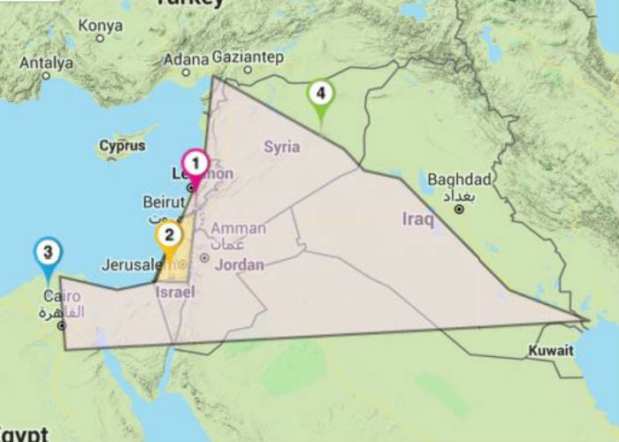
We are promised in the Torah that in the time to come the Jewish people will receive the land of Israel consisting not only of the land of the 7 nations of Canaan but also the land of the three nations of Edom, Moav, and Amon (the Keni, Kenizi and Kadmoni).
This being so, we are confronted with a question: The prophecy of Yechezkiel describes the borders of the land of Israel as they will be in the time to come, but in his prophecy they are clearly defined as being the same borders as were conquered by Yehoshua ‐‐ the land of only 7 nations. His prophecy is about the time to come: why doesn’t he mention the lands of the other 3 nations?
This is also connected to the additional three refuge cities (arei miklat) which we are instructed to establish in those lands. These refuge cities are, in turn, associated with the rectification of Hevel. Kayin was able to kill Hevel because Hevel was already condemned to death (“chayav misa“) for having “gazed at the shechina” while offering his sacrifice.
Chazal (Sanhedrin, 98a) explain the verse “in its time I will hasten it” (“B’itah Achishena“) as referring to two distinct end times (ketz, plural: kitzin): “if they merit, I will hurry it (Achishena), if they don’t merit, [Hashem will bring the Geuloh] in its time (B’itah)”. If the ketz comes in its last possible moment ‐‐ B’itah ‐‐ all the descendants of Hevel will be rectified. But, if the Jewish people will merit to the redemption before the ketz of the rectification Hevel is completed, then there will be need for refuge cites (arei miklat) for those (descendants of Kayin) who will kill accidentally (but not intentionally).
[Important to note what is explained in Chassidus: that the rectification of the souls that derive from Hevel are the basis of “refining the sparks of holiness”, the “avoidas habirurim“, which the Jewish people accomplish during the time of golus. See also Toras Chayim, Shemos II, 277a.]
Achishena — An Awakening from Below
In order to understand this matter of B’itah and Achishena, we find that chazal say “the woman conceives first and a male is born; the man conceives first and a female is born.” This means that when Knesses Yisroel (the collective soul of the Jewish people) will “conceive first”, which is the aspect of “elevating the feminine waters” (hala’as ma”n) from below to above, like the yearning of the woman for her husband, then this awakening from below will generate the awakening from Above which draws down the masculine waters (hamshachas ma”d) from a very lofty level so that a male will be born, meaning a higher level [than a female].
We are talking here about the avoidah that gives birth to love in the Jewish people, a male child representing “great love” (ahava raba). But, if the man (Hashem) will conceive first, then a female will be born, meaning the aspect of love [of Hashem] in order to receive a reward in Gan Eden (see Likkutei Torah, Tazria, “Sos Tasis“).
So, too, in our case: if the ketz will be via the awakening of Knesses Yisroel, meaning that through the awakening from below there will be an awakening from Above to speed up the matter before its time, which is the aspect of Achishena, then Hashem will widen the borders and we will inherit the land of the Keni, Knizi and Kadmoni. But, if it will be the man conceiving first, meaning the ketz will come due to an awakening from Above in its (pre‐determined) time, then the borders of the land will remain unchanged, as in the prophecy of Yechezkiel, and the lands of the three nations will be left a desolate wasteland.
Refining the Sparks (Avodas Habirurim)
To explain this matter: the shattering of the vessels occurred primarily in the 7 midos of Tohu (the emotions), but not so much in the Kesser, Chochma and Bina (intellect and super‐intellect) of Tohu. Thus, as regards their rectification, which is the avoidas habirurim performed by the Jewish people down in this world via Torah and Mitzvos, this is performed on the 7 midos. At the same time, the three dimensions of Kesser, Chochma and Bina of Tohu are being rectified together with them.
According to this, it would be fitting that the Jewish people should inherit these lands when they finish the task of refining the 7 midos of Tohu; however, this depends on the actions of the Jews in this world, whether it will be “in its time” or “I will hasten it” (B’itah or Achishena, which was explained above as dependent on whether there is first an awakening from below). The expression “inheriting these lands” means the revelation of the good found in the aspect of Kesser, Chochma and Bina of Tohu.
[In other words, we have two factors: the avoidas habirurim and the awakening from below. If the avoidah is finished before there is an awakening from below, this is called B’itah. If the awakening occurs before the avoidah is completed, this is called Achishena. This determines the inheritance of the land.]
Inheriting the Land of the 7 or the 10 Nations?
If the good that is in them will be revealed in a tangible way in the Jewish people, then these lands will be considered part of the Land of Israel and this will take place in the simple sense as well. But, if we will not inherit these lands, then the gentiles in those places will (as stated in the prophecies) be wiped out along with the evil that is there, however, the lofty good that is there will not be revealed directly; rather, it will only be revealed through being enclothed in the 7 midos (the land of the 7 nations of Canaan). Which case will take place depends on the actions of the Jewish people down in this world.
If we bring about Achishena, an awakening from below (hala’as ma”n), the woman conceives first: this will cause a drawing down from below (hamshachas ma”d) and the inheriting of the 3 lands of Kesser, Chochma and Bina of Tohu, and the good that has been refined from them will actually shine forth there. Those lands will be considered as part of the land of Israel, and physically the borders of Israel will reflect this.
However, if it will be B’itah, from Above, even though the spirit of impurity will be removed, nonetheless the good in them will not be revealed; rather, it will only appear through being enclothed in he midos, the land of the 7 nations. In such a case, the lands of the 3 nations will be left desolate.
[We could explain that these revelations will not have a vessel in which to be revealed. These levels of lofty understanding cannot be revealed in the regular vessels of intellect which we presently possess. Thus, they will only be revealed in the midos, like a person who feels strongly attracted to something or feel vehemently against something without understanding the reason.]
Why Yechezkiel Saw a Future of the Land of 7 Nations
Since the expansion of the land of Israel to include the 3 lands is dependent on the ketz being in a way of Achishena (love that derives from an awakening from below, as explained above), this is why Yechezkiel’s prophecy describes only the land of the 7 nations: because he prophesied about the final ketz which is the ketz B’itah where the borders of the land of Israel remain as they were in the days of Yehoshua.
We notice that in the prophecy of Yechezkiel, the land is divided into 13 sections. The question is: how do we arrive at the number 13 when there are only 10 sefiros? The answer is that the 7 midos each possesses 3 moichin (the Chabad of the midos, bringing to 10) and further the Kesser, Chochma and Bina of Tohu are enclothed in them in a hidden way (bringing to a total of 13).
Thus, we see that the prophecy of Yechezkiel is on the ketz B’itah wherein Kesser, Chochma and Bina will be enclothed in the 7 midos in a hidden way, because the awakening is from Above, that the supernal Man conceives first and there will not be an actual inheritance of the 3 lands. But, afterwards, in the days of Moshiach, through the avoidah of Yisroel they will arrive and merit after several years to the aspect of Achishena, inheriting the 3 lands as part of the land of Israel, until the good in Kesser, Chochma and Bina of Tohu will be actually revealed there.
We see from this maamar of the Tzemach Tzedek that if the Jewish people finish avoidas habirurim but still have not had an “awakening from below” on their own, then the Geuloh arrives but they lack the vessels to perceive the lights of Tohu that have been refined from level of Kesser, Chochma, and Bina of Tohu. If this occurs, then they will have to do the avoidah in Yemos Hamoshiach in order to reach the level where they will “inherit the land of the Keni, Kenizi and Kadmoni”, meaning a revelation of the lights of Tohu in a revealed way.
This explains the assertion of the Rebbe that:
- Avoidas habirurim has been completed,
- We only need shout “ad Mosai”, to open our eyes to see that the Geuloh is here, and
- That we are presently found in Yemos Hamoshiach.
Based on the maamor of the Tzemach Tzedek printed in Ohr HaTorah, Bereishis, page 1167 תתשסז
This article in downloadable PDF format