From Har Sinai (also called “Chorev”) to Eretz Yisroel is a journey of 11 days. The 11 days journey reflects “the aspect of One which is higher than the 10 Commandments which were given at Chorev…the aspect of Hashem’s Essence and Being (מהותו ועצמותו) which is higher than the 10 sefiros.” However, everyone knows that the Bnei Yisroel wandered in the midbar for 40 years (instead of 11 days) as a punishment for the sin of the spies. In our sicha, however, the Rebbe speaks of this as something positive. What could be positive about the same journey being drawn out over 40 years?!
The Rebbe explains that we can say that Hashem’s intention here was in order that the aspect of 11 (Hashem’s Essence) “will be drawn down and revealed in them in an internalized manner via their travels in the midbar for 40 years, in which ‘Hashem gave to you a heart to know, eyes to see, and ears to hear’.” If Hashem would have taken them directly on the 11 days journey, all of the refinement which was accomplished over 40 years would have been achieved in a manner of Above to below, something which does not so much affect that which is “below”. (Like the difference between the sense of “ownership” of a King who fought for territory and invested all his wealth and resources to conquer lands for his Kingdom, as opposed to his son who received Continue reading →
War with Iran is approaching round two – could this be the final groan of golus, the cracking of the shell, the spilling forth of the light of Geuloh that the world is longing for? After all, Iran is simply the preferred modern name of ancient Persia – the very same nation. And we have the testimony of the sages of the Gemara that before Moshiach comes Persia will fall at the hands of Rome![1]
Evidently, we are describing an event of global proportions. But the chess-board of world politics is merely the playing out of an internal spiritual drama of the Jewish people, as Chassidus explains the verse “He gave the world over to their hearts”[2] (גם את העולם נתן בלבם). How should we understand this drama – especially since it is described as being intertwined with the coming of Moshiach?
By attempting to analyze both aspects – both the worldly external events and the inner service of Hashem – based on the words of our sages and the teachings of Chassidus, we will, with Hashem’s help, find them even more significant than we might have thought.
The Fall of Paras: the External Dimension
We will start by mentioning words spoken by the Lubavitcher Rebbe in order to establish the significance of this matter in our generation. The Rebbe told Ron Nachman, mayor of the Israeli city of Ariel, to explain to the Americans that “it is imperative that there be a strong Israel in order to check the spread of the influence of Syria, Iran, and so forth, for they are against the US no less than they are against Israel and maybe moreso.”[3] Clearly, the Rebbe was not discussing with him a sugya in the gemara or esoteric ideas of Chassidus – this is practical advice which even the gentile government in the United States is expected to understand.
Additionally, former Israeli Ambassador Yehuda Avner was interviewed a number of years ago and shared that the Rebbe in the mid-1970s told him (years before the Iranian revolution) that “the emergence of an Islamic Iran carries with it the seeds of jihadism that will spread across the Middle East, threaten Europe, and ultimately the whole of Western Civilization.”[4] We understand clearly that the military threat from Iran is a pressing contemporary issue which in the Rebbe’s view is of the gravest consequence.[5]
Today, it is unfolding before our eyes.
We will now look at the relevant sources in Torah, with hope to gain some small insight into the gravity with which the Rebbe views the developments in Iran (Persia).
The gemara, Yoma 10a, states as follows:
Rebbi said that in the future Rome will fall at the hands of Persia…. Rav said that Persia will fall at the hands of Rome. Rav Kahana and Rav Asi said to Rav: Can the builders [Persia, who permitted the rebuilding of the Holy Temple] fall before the destroyers [Rome, who destroyed the Temple][6]?! He said to them: Yes, it’s a decree of the King.[7]
The commentary of Tosefos[8] clarifies that Persia is the nation destined to fall and adds a critical element: “We were told that in the future Persia will fall at the hands of Rome, that is, in immediate proximity to the coming of Moshiach.” Meaning, it’s not just one of many future events, but an event immediately preceding (-סמוך ל) the coming of Moshiach!
Rome, as we know, is Edom.[9] Edom is commonly understood to mean the Western world in general, and Rome is the center of its financial and military power. Just as Rome was the mightiest and wealthiest world power of its time, so, too, the United States today.
One could, however, ask a question on the relevance of this gemara to our times: Following the first Persian Gulf War, the Rebbe referenced the midrash Yalkut Shimoni that refers to a war in the year Moshiach is revealed and stated that it had been fulfilled that year – what need do we have for Persia to fall at the hand of Rome?! We can answer that the Yalkut Shimoni itself states the difference between “the year Moshiach is revealed” and “the hour Moshiach comes”. The Rebbe stated[10] that the first part – Moshiach was revealed – took place in 5751, and since then we are standing on the cusp of “the hour Moshiach comes”. And further, the Rebbe declares numerous times in these sichos that “kolu kol hakitzin” — “all the end times have passed”! The task of refining the fallen sparks of holiness (avoidas habirurim) has been completed! Consequently the Rebbe expresses his astonishment that “Moshiach still hasn’t come!”
In light of this, we can bring an amazing statement from the sefer Yaaros Dvash:[11]
The gemara states that [Moshiach] ben Dovid doesn’t come until the Persians will fall at the hands of the Romans. And the commentators note that it doesn’t state “before [Moshiach] ben Dovid comes” the Persians will fall at the hands of the Romans, but [rather the exclusionary language of “doesn’t come until”] to teach that even if the end-time will arrive, nevertheless it will be delayed until the Persians will fall at the hand of the Romans…[12]
He is describing a time when the final ketz has arrived (as the Rebbe has stated) and there is a perplexing delay in Moshiach’s coming – exactly our situation as per the Rebbe’s description. And the reason, according to Yaaros Dvash, is the matter of the fall of Persia (Iran) at the hands of the Romans (the most powerful of the Western nations).
However, one could protest that the Rebbe responded to the situation (that all the end times have passed and still Moshiach hasn’t come) with astonishment – not an explanation from the Yaaros Dvash! What connection do we find here to the Rebbe’s astonishment and disbelief?!
With a deeper look at the “fall of Persia”, and how it relates to the Rebbe’s declaration that avoidas habirurim has been completed, and especially the gemara’s expression that the fall of Persia is “a decree of the King” – we may find an answer….
Yoma 10a. The sages also quote an opposite opinion: Rome will fall at the hands of Persia, but that opinion is considered to have been rejected.
Koheles 3:11, and see Sicha Bo, 5751 (ch. 9) and Bamidbar, 5750 (ch. 7).
Free translation from video at the distribution of dollars on 28 Tishrei, 5752 (6 October 1991).
Interviewed by JEM for the video presentation “Faithful and Fortified”.
Let us note that “an Islamic Iran” is a combination of Paras (the nation) and Yishmael (the religion of Yishmael). The Mitteler Rebbe (Shaarei Teshuva, ch. 23, p. 91a) writes that “the main aspect of the Geuloh is dependent upon the fall of the Sar (spiritual source) of Yishmael davka, as stated in the Zohar”. The Maharal writes (Netzach Yisrael, ch. 21) that “malchus Yishmael and malchus Paras are all one malchus.” Furthermore, the expression used is that the Sar of Yishmael must “fall”, which matches the gemara that Paras “falls” at the hands of Rome, and Bereishis 25:18 regarding Yishmael: “before all his brothers he will fall.”
The Persian kings who ruled at the end of the Babylonian exile gave permission for the rebuilding of the Second Beis Hamikdosh (see Rosh Hashana 3b/4a). Four centuries later, the Roman general Titus destroyed it. In another sense, the spiritual power of Persia (explained below) allows for the construction of the Mikdosh, whereas the power of Rome destroys it.
Rebbi Yehuda Hanosi was the redactor of the Mishnah. Rav was his student. We must ask why his student rules differently, and specifically why does Rebbi rule that Rome must fall whereas Rav rules that it is Paras that must fall. We might suggest as follows: the gemara in numerous places describes the friendly relationship between Rebbi and the Roman ruler Antoninus. The Yerushalmi (Megillah 1:11) debates whether or not Antoninus actually converted to Judaism (and even if not, “he will be at the head of those who will come to convert in the time to come”). So we see that Rebbi not only lived under Roman rule, but his avoidah included transforming the aspect of Rome from an oppositional force to a friendly force which eventually rejoins the Jewish people (“rejoins” because the ancestor of Rome was Esav, who was a Jew). Rav not only lived in Bavel most of his life, but more importantly he was from the generation that followed the avoidah of Rebbi. His task was to continue to the next stage: the fall of the aspect of Paras as will be explained.
Tractate Avodah Zora 2b, משכא מלכותייהו. Based on the statement that Moshiach comes only after Rome rules the entire world for 9 months. Maharsha on Yoma 10a also accepts this as the final ruling.
Rashi on Bereishis 36:43: “Aluf Magdiel, Aluf Iram, these are the chieftains of Edom…” Rashi: “Magdiel this is Rome”. Pirkei d’Rebbi Eliezer ch. 38. Also Radak on Ovadia 1:1 – “What the prophets said regarding the destruction of Edom at the end of days they said about Rome. Radak on Yeshaya 34:1 – “..the kingdom of Rome they are all Edomim who adhere to the xtian religion, Ibn Ezra on Yeshaya 61:1, and the Ramban “Sefer Hageuloh”.
Dvar Malchus, Parshas Naso 5751.
Yaaros Dvash chelek 2, 162b, drush 7 Adar.
Also based on the statement that Rome rules the world for 9 months.
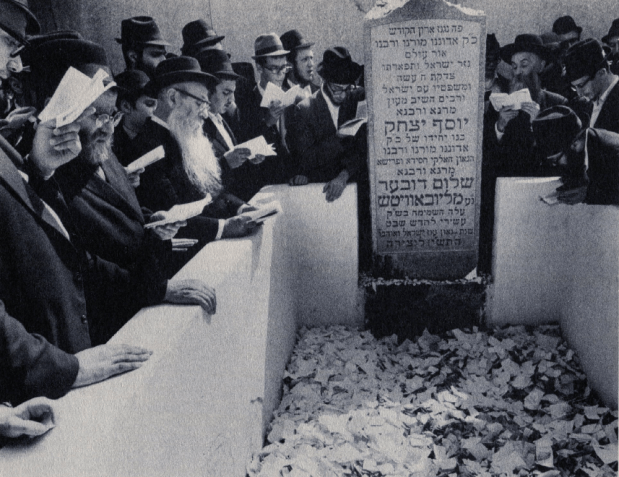
Yud Shevat marks the yohrzeit and Hillula (anniversary of the passing) of the Previous Rebbe in 5710 (1950), the father-in-law of the Rebbe MH”M. His resting place is in Montefiore Cemetery in Cambria Heights, NY, commonly referred to as “the Ohel”.
The Rebbe, MH”M, oversaw all the details, wrote the text of the gravestone, and even designed the Ohel structure itself (in a way that Kohanim could enter and avoid the halachic prohibition of being in proximity to a grave). The Rebbe visited the Ohel on a twice-weekly basis, and often more frequently than that.
At the same time, the Rebbe continued to refer to his father-in-law as “Nosi Doreinu”, the leader of the generation, and the “Moshiach of the generation“. The Rebbe asserted that “hu bachayim” (“he is alive”), like Yaakov Avinu who did not die. Each year on the Previous Rebbe’s birthday, the Rebbe spoke about his father-in-law’s new chapter of Tehillim, just like anyone else who has a birthday and begins a new year of life. The Rebbe spoke sharply that his father-in-law does not have an issue of inheritance because he is “fresher and more lively” each passing year.
Yud Shevat is the yohrzeit of a living man, the Ohel is the gravesite of a living man.
If we don’t understand, the problem is ours to ponder and to research. When we will understand how the gemora can state the “Moshe didn’t die” and “Yaakov didn’t die” and that after his passing Rebbi Yehuda Hanosi would appear at the home of his family on Shabbos night (and made Kiddush for them) — then perhaps we will begin understand the meaning of Yud Shevat. To understand how eternal life is not contradicted by a yohrzeit nor by a gravestone.
Note: This Maamor is NOT based on the chapter of Bosi Legani that we learn this year. (Unless you are reading this in the year תשצ”ב)
For 40 years the Rebbe would say a Chassidic discourse on one of the 20 chapters of the last maamor (Chassidic discourse) written by the Frierdicker Rebbe, entitled Bosi LeGani. Every year at the Yud Shevat farbrengen, the Rebbe would say a maamor (sometimes more than one) on that year’s chapter. Beginning from 5749 the Rebbe did not say a new maamor, instead an edited version of a maamor on that year’s chapter was printed. The cycle started again in 5751 (addressing chapter 1) and the maamor printed in 5752 can be expected to have added significance, as it was released during the year of Dvar Malchus sichos. In fact, when looked at in this light one indeed finds a message that fits with the unique chiddushim of 5751-52.
A general point: the edited version of a maamor is often significantly different from the way the Rebbe originally said the maamor. In some instances, the edited maamor is so different from the original that it presents a completely opposite perspective. (For example: the Rebbe once said a maamor in which the he spoke about the superiority of Torah over Mitzvos; when edited and published, the maamor addresses the superiority of Mitzvos over Torah!) In the maamor published for Yud Shevat 5752, it is noteworthy to point out that the relevant “chiddush” is not explicitly stated in the original, unedited version of the maamor which the Rebbe said in 5732 (which can be viewed here), but when edited in 5752 the Rebbe saw fit to state it clearly. The matter is as follows:
One who has been following Dvar Malchus, or has learned the Rebbe’s sichos and maamorim from all the years, is likely familiar with the concepts of the revelation from Above as opposed to the effort we make from below. In this maamor, this is associated with Matan Torah (from Above to below) and the Mishkan (the vessel for receiving the revelation of Elokus). The Rebbe explains that “this that Hashem desired to have a dwelling place down below (“dira b’tachtonim”) is that there will be a revelation of Elokus below via the avoidoh of human beings.” Thus, the main element is the Mishkan (and Mikdash), where the avoidah of korbanos takes place.
The Mishkan (and by extension, the Mikdash) has two distinct stages. The first is the making of the Mishkan (עשיית המשכן), the second is the avoidah which takes place in the mikdash — the Continue reading →
It is brought in the writings of the Arizal that the generation of the future Geuloh is a gilgul (reincarnation) of the generation that came out of Egypt, and according to this, we are redeemed in the merit of the righteous women in our generation, for they themselves are the righteous women in whose merit we came out of Egypt.
What makes our generation special? It is rooted in Nosi Hador, the leader of the generation:
The completion and perfection of the avodah (spiritual mission) of the Nosi Hador (on his Yom Hahillula [day of his passing –Yud Shevat]) is the completion and perfection of the avodah of the entire generation (for “the Nosi is everything” [Rashi on Chukas 21:21]), and since this generation is the final generation, then this is the completion and perfection of all of the avodah of Knesses Yisroel (woman) to make a dwelling place down below for Hashem, may He be blessed.
This relates to the concept of the “disappearance (סלוק) of Tzaddikim” (yahrzeit and Hillula) upon the completion and perfection of their avodah, as the verse states “My beloved went down to his garden…to collect roses”, upon which the Midrash expounds: “to hide away (לסלק) the Tzaddikim that are among Yisroel” (which means that they have completed their souls through Torah and Mitzvos [commentaries “Yafeh Kol” and “Yadei Moshe” on this midrash]). More importantly: this “disappearance” (“סלוק”) is for a much greater elevation (incomparably so) which will be in the world of the resurrection, “those who dwell in the dust arise and sing”, and the Tzaddikim (the “roses”) at their head, souls in bodies in this physical world, in the true and complete Geulah.
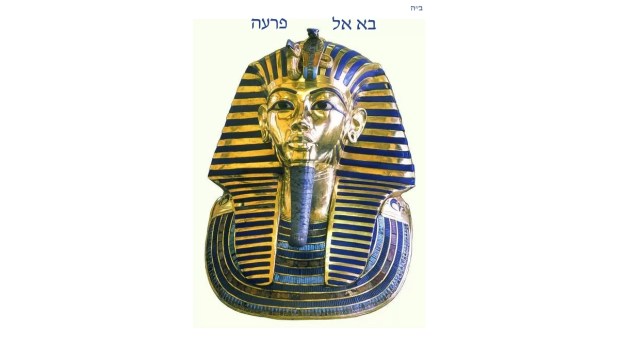
Our parsha begins with Hashem’s instruction to Moshe Rabbeinu “Come to Pharaoh”. The question is asked: why “come to Pharaoh” and not “go to Pharaoh” (as stated in other verses)? Furthermore, being that the Torah is eternal, what is the relevance of going to Pharaoh, King of Egypt, when we are standing at the end of golus — long after Egypt was rendered helpless and nothing remains of Pharaoh — at a time when the birurim of the klipah of Pharaoh are finished (as mentioned many times)?
CONFRONTING PHARAOH
The commentaries explain that Moshe Rabbeinu was afraid to go to the inner chambers of Pharaoh, and therefore Hashem said “Come [with Me] to Pharaoh” to ease Moshe’s fear of confronting Pharaoh alone.
However, our question becomes stronger when we learn, based on the Zohar, that the evil Pharaoh that we encountered in Egypt has his source in the “Pharaoh of kedusha (holiness)”, which refers to the revelation of G-dliness. Why was Moshe afraid to go to the Pharoah of holiness, so much so that he needed a direct command from Hashem to “come” together with Hashem?! Continue reading →
In addition to the radical chiddushim in the plain understanding of the second sicha of Parshas Va’era 5752, one can also find a number of hints and suggestions that give even deeper insight into the ground-shaking ideas the Rebbe is revealing.
In the explanation as to how the “good sign” of one who dies on Erev Shabbos applies to our era (the last quarter of the 6th millennium, “Erev Shabbos” of the entire creation), the Rebbe refers to the concept of “nesira” (“cutting”). This “nesira” describes what happened to Adam Harishon on the day of his creation: Hashem put him to sleep in order to separate Chava. From being a “back to back” entity they gained the ability to be “face to face”, and to bring into existence limitless future generations. While his sleep was one-sixtieth of death, it was completely a positive matter: in order to bring about an immeasurable improvement, specifically the ability to give birth to all future generations.
The Rebbe references the writings of the Arizal as a source for the Kabbalistic explanation of this concept of Nesira. In the writings of the Arizal (Shaar Hapsukim, p.17) one finds that the Arizal writes that “this matter is that the moichin (intellect) which is in the head of Z”A (the six sefiros) go out from it via this sleeping, and then they are given to the female (Malchus).” This brings about that Malchus grows from a point to her full development. Reading this, especially in the original language, seems to hint at the state of affairs after the events of 27 Adar and 3 Tammuz, when the Rebbe (the head — “Rosh Bnei Yisroel”) is not seen, and Malchus (the Jewish souls) receive and develop their potential via the intellectual power bestowed upon them by the head (“now I give it over to you, do all that you can to bring Moshiach in actuality” [sicha of 28 Nissan 5751]).
The Rebbe also brings (footnote 40) from “Kuntres Sfas Emes (at the end of Emes L’Yaakov)” that there is a “nesira” every Rosh Hashana which is the most difficult and requires Continue reading →
In the second sicha printed for parshas Va’era 5752, the Rebbe elaborates on the statement of the sages that “one who dies on Erev Shabbos, it is a good sign for him”.
The Gemara describes that when R’ Yehuda haNosi took ill, R’ Chiya visited him and found him crying. He asked him why he was crying (assuming that he was afraid of death). R’ Chiya proceeded to give him a list of signs that portend well for the fate of a person after death (and their opposite): Dying amidst laughter is a good sign, while crying is a not good; one who dies on Erev Shabbos is a good sign, after Shabbos is not good. (And several others.)
R’ Yehuda haNosi responded that he was crying (not from a fear of his fate after death, but rather) because of the Torah and Mitzvos he would no longer be able to perform. Seemingly, the list of good signs brought by R’ Chiya (several of which applied to R’ Yehuda haNosi and were meant to comfort him), do not help the reason given by R’ Yehuda for his crying, because seemingly being unable to perform Torah and Mitzvos after ones passing is not affected by the good signs of how a person passes away. (The Rebbe brings a proof for this from the story in the Gemara about Dovid haMelech, who asked to pass away on Erev Shabbos (because then one is not subject to “chibut hakever“), and Hashem refused him, telling him that even one day of his Torah learning was more dear to Him.)
Furthermore, the Rebbe asks on this whole discussion a fundamental question:
“How is it possible to truthfully say (in Toras Emes, the Torah of truth) that “one who dies on Erev Shabbos it is a good sign for him” — a “good sign” in relation to the occurrence of death, the opposite of life, the ultimate opposite of good according to Torah?!”
Since the Torah defines “good” as fulfilling the will of Hashem through the performance of Torah and Mitzvos as a soul in a body, then death is the opposite of Good, Continue reading →
This parsha, following the passing of Yaakov, Yosef, and the brothers, is the beginning of a new era in the history of Bnei Yisroel — the beginning of the Egyptian exile. “These are the names of Bnei Yisroel who came to Egypt” — the first exile.
The midrash states that the reason for the subsequent redemption from Egypt was “due to the fact that [Bnei Yisroel] did not change their names…they went down as Reuvain and Shimon and they came up as Reuvain and Shimon.” This is a comment on the name (and initial verse) of our parsha: Shemos (meaning, “names”), which refers to the beginning of the exile in Egypt, as mentioned.
The Rebbe derives from this that the verse “these are the names of Bnei Yisroel who came to Egypt” is also emphasizing the merit for which they were ultimately redeemed from Egypt (“that they didn’t change their names”). In other words — it is referring both to the beginning of the golus and also to the future Geuloh from that golus.
The whole idea of “coming to Egypt” is in truth the “Geuloh of Yisroel”. The descent which occurs in the meantime [until the Geuloh comes] is on the superficial level (בחיצוניות), but on a deeper level (בפנימיות), the descent itself is (not only for the sake that through it will come the ascent that occurs through the redemption from Egypt, but more than that–) a part of the ascent and the Geuloh itself, until we reach the ascent of the true and complete Geuloh…the future Geuloh.
In other words, not only is there a “descent for the sake of an ascent”, which makes the descent worthwhile in the end; here the Rebbe is saying something much greater: the descent itself is already part of the ultimate ascent!
At this point, the Rebbe turns to explain the familiar statement: Continue reading →
Our parsha begins with the words “Vayechi Yaakov” (“Yaakov lived”). And although in the parsha we read about Yaakov’s passing, nonetheless our sages teach us that “Yaakov Avinu didn’t die — just as his children are alive, so too he is alive”. Explains the Rebbe:
The life of Yaakov is eternal life through this that it is drawn to to his children and their descendants until the end of all of the generations. “His children are alive” meaning true life through learning and fulfilling the Torah. [Although we mention his children], nonetheless the name of the parsha is named after the life of Yaakov (“Vayechi Yaakov”) — since the truth of the life of Yaakov, eternal life, is expressed in the life of his children.
This means that Yaakov himself lives eternally (soul in a body, as explained elsewhere), and since the material eyes see that “they embalmed him and buried him, etc” his eternal life must therefore be expressed through the life of his children: they are alive because he is alive. (Similarly, he is alive because they are alive — he is the reason Continue reading →






 Dvar Malchus 770