1) Kuntres Beis Nissan 5751: To Give and To Receive

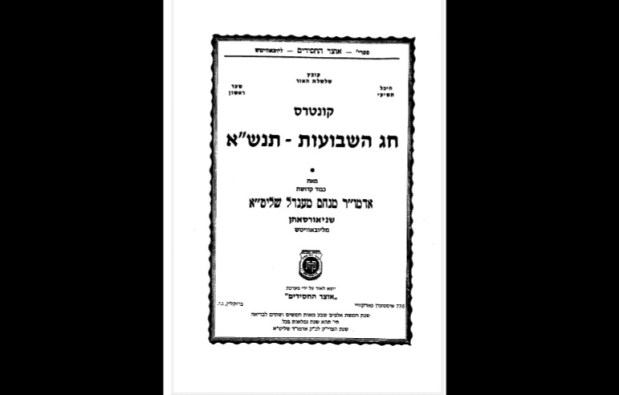
A Chassidic discourse, called a maamor, was edited by the Rebbe and published in honor of the Hillula of the Rebbe Rashab, Beis Nissan, 5751.  This was the day after Shabbos Vayikra, the very beginning of the cycle of Dvar Malchus.  We are going to extract a small section of this maamor which stands out boldly as a descriptive explanation of the sharp and shocking words of the Rebbe on 28 Nissan (a few weeks after this maamor was released): “I’ve done all I can do, now I give it over to you to do all that you can do to bring Moshiach in actuality”.

The section of the maamor we will look at states as follows:

The Rebbe Rashab explains the difference between two inyonim: “its beginning is wedged into its end and its end into its beginning” (נעוץ תחילתן בסופן וסופן בתחילתן) and [the similar expression that] “the end of the deed was first in thought” (סוף מעשה במחשבה תחילה).  The difference between them is that “it’s end” (סופן) refers to the end and completion of the thought, wedged into the beginning of that which is being given (ההמשכה).  And a moshol is brought for this from the giving of tzedaka.  That the beginning (of the giving) is the mercy (רחמים) that is awakened towards the poor man.

The concept that “its end is wedged into its beginning” is that the main intent in the awakening of mercy (“its beginning”) is

Continue reading

Introduction to the cycle of Dvar Malchus

Introduction to the cycle of Dvar Malchus

Introduction to the cycle of Dvar Malchus

“Rav Asi asked, ‘Why do little school children begin their Chumash learning with Vayikra and not with Bereishis? It is because little children are pure and unblemished, and the sacrifices are pure and unblemished. The pure ones begin their learning with the study of the pure.'” (Vayikra Rabbah, Tzav 7:3)

The cycle of Dvar Malchus refers to the twelve months of sichos which the Rebbe said between 5751-52 (1991-92), the latest words (“Mishna achrona”) that we have from the Rebbe.  Notably, the cycle begins with the sicha of Parashas Vayikra, 5751.  Although the Torah of Moshiach will only be revealed to us together with the revelations of the true and complete Geulah, these sichos are a “taste” of the “new Torah that will come forth from Me” (Yeshayahu 51:4; Vayikra Rabbah 13:3) and fittingly we start learning from parshas Vayikra.  Furthermore, the sicha describes a connection to Simchas Torah, which is the day when we begin reading the Torah anew (finishing with “V’zos Habrocha” and beginning with “Bereishis”).

Some background: The year 5750 (1990-91) was termed by the Rebbe “it will be a year of miracles” based on the letters that form the Hebrew year.  The year 1990 saw the beginning of the disintegration of the Soviet Union and the outbreak of the first Gulf War.  The year 5751 received the name “it will be year of ‘I will show wonders’”. 

By the time we reach Parshas Vayikra, 5751 (March 1991), the Gulf War has ended (on Purim, two weeks earlier); the events in the disintegration of the Soviet Union will lead, in June (Rosh Chodesh Tammuz), to the election of Boris Yeltsin and the end of the Communist Regime, effectively ceasing to exist upon the resignation of President Gorbachev in late August (Shabbos Ki Seitze).  This new reality — the defeat of Sadaam Hussein in Iraq (and the overt miracles witnessed in Israel during that war) and the collapse of the Soviet Union (bringing an end to the Cold War and the nuclear arms race) — is the background to these sichos.

As the Rebbe often explains, events in the physical world are a consequence of what occurs spiritually, the realm of the Jewish souls.  If we see the fall of the earthly “iron curtain” it is because the spiritual “iron curtain” (“mechitza shel barzel”) which separated Israel from their Father in Heaven has fallen.  If an evil dictator who threatened to annihilate, G-d forbid, Jews young and old is defeated and rendered powerless without a Jew firing a weapon, this is because the same drama is playing out spiritually.  These sichos are to guide us in this “new world order” — a new earthly world order, reflecting a new spiritual world order. Continue reading

Chof Zayin Adar: Revealing the Power of Concealment

Chof Zayin Adar: Revealing the Power of Concealment

The day 27 Adar (כ”ז אדר ראשון) is not just a date in Lubavitch — it has become a title for the dramatic day that was the beginning of a new reality for Chassidim.  This is the day that the Rebbe had what the doctors call a stroke, and since then we have not heard from the Rebbe.  Gimmel Tammuz is another step, but the “silence” began on this day, Chof Zayin Adar.

The number 27 in Loshon Hakodesh is also the word “זך”, which means refined and purified.  In fact, the Rebbe connects this with the 27th day of the month, in a sicha of Parshas Pekudei 5750 (2 years to the day before the stroke).  Here the Rebbe explains that the 27th of the month possesses the special quality of:

…scouring and clarification and purification, as is written about the time of the Geuloh “many will be clarified and whitened and purified” (Daniel 12:10).  The ultimate scouring and purification is by revealing the intent in the Tzimtzum [contraction of G-dly revelation] and concealment of the Divine name Elokim itself.

This will be understood in light of what the Rebbe explained in the earlier parts of this sicha.  To summarize:

According to Torah, there are 7 names of Hashem that one is forbidden to erase due to their Holiness.  Of them, we primarily relate to two names: YKVK and Elokim, which represent the revelation of G-dliness (the name YKVK) and the concealment of that revelation (the name Elokim).  The name Elokim is the contraction and concealment of G-dly light — in other words: darkness.  We find a verse in Tehillim “the sun and its shield, YKVK Elokim”, explained to mean that Elokim (concealment) is like a shield or a filter that reduces the G-dly revelation of the name YKVK so that the worlds are not nullified out of existence.  According to this, the name Elokim, the contraction and concealment of G-dly light (the darkness), is for the sake of being able to reveal G-dliness within the limited ability of the worlds to receive.  Like smoked glass diminishes the light of the sun but this itself allows a person to be able to gaze at the sun without being blinded.  A concealment which has the intent of actually revealing that which is being concealed.

But, explains the Rebbe, there is another dimension: the quality of Continue reading

Pekudei 5752: The Missing Parsha

The Dvar Malchus begins with Vayikra 5751, but where does it end?  The Parshas Vayakhel sicha is unfinished, and parshas Pekudei is missing (actually, “missing” is one of the definitions of the word*, as in יפקד מושבך).  What is the message?

Firstly, we could take note that the start of our Dvar Malchus cycle is parshas Vayikra.  This hints at the division of the Chasidishe Parsha, Torah Ohr and Likkutei Torah — the former covering Bereishis to Vayakhel, the latter Vayikra through the end.  In an odd turn of hashgacha protis, parshas Pekudei is absent from Torah Ohr (which covers all of Shemos) and appears in the other volume.

But more to the point, the Rebbe generally explains these two parshiyos (Vayakhel and Pekudei, which in many years are read together) as reflecting two distinct angles:

  • Vayakhel means “gathering” and speaks of unity and generality, where the individual elements are subdued in the whole.
  • Pekudei implies making an accounting of the individual elements, and in fact it is here that we learn the details: this many talents of silver, that many hooks and boards, etc.

The fact that our Dvar Malchus has Vayakhel but lacks Pekudei (when looked at in light of the content of all the sichas) implies that from the collective side of things, everything is in a state of Geulah: the aspect of Above to below, the “Nosi is everything” (הנשיא הוא הכל) which nullifies all the elements to the greater whole. You can find this expressed many times in these sichos.

What remains to be completed is the aspect of Pekudei: the completion and perfection of the parts, not as they are nullified to the greater whole but their own intrinsic importance as unique elements. Meaning our avodah, individually.  In the Rebbe’s words: “do all that you can” — you, personally and as an individual!  (Of course, merging the individual effort with the unity of Vayakhel, which is the reason that most years the two parshiyos are read together.)

What is needed now is for each one of us to reveal his spark of Moshiach through our own efforts, and not to expect someone else, not even Melech HaMoshiach, to do it for us. Avodah b’koach atzmo“, to reveal individually what has already been accomplished collectively. To bring — each one of us — Moshiach in actuality!

(Not only will this complete the aspect of “Pekudei”, but it brings about the completion and perfection of “Vayak’hel”, because the “incomplete” Sicha of Vayak’hel hints that even the aspect of “Above to below” remains incomplete as long as the “Pekudei” is lacking.  Completing the task of the mekabel (from below) adds to the perfection of the mashpia (Above).)


* Another meaning of Pekudei is connected with childbearing and the marital union, as in “Hashem remembered Sarah” (to bless her with a child) (ה’ פקד את שרה), and “a man must be intimate with his wife [before seeing out on a lengthy journey]” (יפקוד את אשתו).  In fact, this second meaning is mentioned in the Alter Rebbe’s drush on this parsha in Likkutei Torah, strengthening the connection between the parsha and these words.  This fits as a hint that although Parshas Pekudei is “missing”, and it might seem to some that the “husband” has gone on a journey leaving his wife alone — even so he must “be intimate with his wife” before departing (these Sichos of Dvar Malchus)  and even to the point of making her “pregnant” through this intimacy: pregnant with the true an complete Geuloh.

Vayakhel 5752: Ingathering of the Exiles Has Begun

The sicha that was said on Parshas Vayakhel, 5752 was never properly edited, due to the event of the following Monday,  27 Adar.  (On 27 Adar the Rebbe had a stroke while visiting the Ohel of his father-in-law, the Previous Rebbe).  Nevertheless, the brief overview (“rashei dvorim“) that was written up and presented to the Rebbe after Shabbos was (uncharacteristically) marked up by the Rebbe.  Thus, it passed before the Rebbe, and what needed correction was corrected.

In this overview of the sicha, it says:

…we see in recent years how there has been a “vayakhel” (gathering) in the simple meaning of the word — the ingathering of the exiles (“kibbutz goliyos”) of bnei Yisroel from the entire world, who are going up to Eretz Hakodesh.  This aliyah is incomparable to those that once were in the previous generations.  [To point out that Rabboseinu Nessienu were not in the Holy Land, not even for a visit, and even the trip taken by the Friedicker Rebbe was because he was unable to visit the resting places of his predecessors in Rostov, Lubavitch, and the like].

For all the prior years of the Rebbe’s leadership, the Rebbe was adamant in saying that Jews going to Israel is not the ingathering of the exiles (“kibbutz goliyos”), because the ingathering of the exiles must be done by Moshiach.  But here the Rebbe in fact calls it “kibbutz Goliyos”!?

We can say that what has changed is that now the aliyah — the Jews who were leaving the former Soviet Union, in particular — was coming about through Moshiach himself, and thus it does fulfill the requirement of Kibbutz Goliyos!

It should be noted that this expression, “Kibbutz Goliyos”, is of monumental significance.  One of the requirements of Moshiach to be identified as “certainly Moshiach” is that he gathers in the exiles.  As the Rambam says: “if he builds the Mikdash in its place and ingathers the exiles we know with certainty that he is Moshiach.”

In addition to this, the Rebbe explains in the Kuntreis Rabbeinu sh’b’Bavel that the Rambam rules that Moshiach “builds the Mikdash in its place”, a phrasing which allows itself to be read as “in his place”, referring to the small mikdash (מקדש מעט) in the time of golus, before the Geulah.  How “literally” to understand the Rebbe’s explanation there is strengthened by our sicha about Kibbutz Goliyos, because the Rebbe explains elsewhere (the Chassidic discourse “Gadol Yehiyeh Kavod Habayis Hazeh…”):

the Redemption, (the ingathering of the exiles,) will take place after building the Beis HaMikdash…this dimension comes about through the Third Beis HaMikdash…For the Third Beis HaMikdash, includes all the influences and qualities that will later be revealed.

Meaning that the Ingathering of the Exiles is fueled by the 3rd Beis Hamikdash, and if the Rebbe can say that it has begun then there must be a Mikdash built that is bringing it about.   Thus, we realize that 770 Eastern Parkway is not only the place where the Mikdash will be revealed in the future, but in fact it is presently — now — the Beis Hamidash in his place (the place of Moshiach before the Geuloh, in accordance with the halachic ruling of the Rambam)!  Because if the 3rd Beis Hamikdash was not present, there could not be Kibbutz Goliyos (as explained in the maamar quoted above).

The Decree is Nullified? But…

The Decree is Nullified? But…

What does it mean that a decree has been nullified?

In various sichos*, including the Dvar Malchus sicha of Tetzaveh, the Rebbe uses the expression that Haman’s decree was nullified (ביטול גזירת המן).  This expression is actually quite surprising: where in the Megillas Esther do we see that the King’s order containing Haman’s evil decree was rescinded?  The Megillah actually tells us the opposite: Haman’s decree was sealed with the King’s ring, and “a writ that is written in the name of the king and sealed with the king’s ring cannot be rescinded.”**  What actually happened was that the a follow-up decree was issued: the right of the Jews “to assemble and to protect themselves, to destroy, to slay, and to cause to perish the entire host of every people and province that oppress them.” (Esther 8:11).  The original decree of Haman remained in full force (“cannot be rescinded”), and still the Rebbe calls this the nullification of Haman’s decree?

If we examine this, we will see how it is very relevant to the Geuloh and the sichos of Dvar Malchus.

The question is: how can Haman’s decree be considered to have been nullified?  There are two aspects to the answer.

Firstly, the intention behind Haman’s decree was nullified via the issuing of the second decree.  By giving the Jews in his Kingdom the right to defend themselves and despoil their oppressors, the original intent of Haman’s decree has been nullified and replaced (even though the decree itself could not be rescinded).  The second way of explaining it is that nothing changed until the actual fighting and victory of the Jews on 13 Adar — up until that point it was all “theoretical”.  We look at the reality on the ground.

The greatness of Purim is explained by the Alter Rebbe in Torah Ohr as connected with the self-sacrifice (mesirus nefesh) of the Yidden over the course of an entire year.  Haman’s decree to “to destroy, kill, and cause to perish all the Jews” was decreed to take place “on one day, on the thirteenth day of the twelfth month, which is the month of Adar”.  From the time Haman’s decree was issued (in Nissan) until the following 13th of Adar was almost a full year.  The sword of destruction was held over their heads for full year, and yet nobody thought to deny his Jewishness in order to save himself — this mesirus nefesh is what the Alter Rebbe praises.

However, the “nullification” of Haman’s decree took place only two months after the original decree was issued: Continue reading

22) Kuntres Purim Koton: The Level Above Mesirus Nefesh

22) Kuntres Purim Koton: The Level Above Mesirus Nefesh

This Maamor was distributed by the Rebbe himself on Purim Koton, 5752, less than two weeks before the dramatic event of 27 Adar I (“Chof Zayin Adar“), making this the “last” Kuntres (so far) that the Rebbe distributed.  Combined with the tremendous chiddushim of the maamor, it has earned a special status as a clear guide for how to proceed in our efforts to bring about the true and complete Geuloh.

The Maamor is based on a maamor that the Previous Rebbe said in Russia (“V’kibel HaYehudim”, 5689), and comes to explain the opening verse of Parshas Tetzaveh:

:וְאַתָּ֞ה תְּצַוֶּ֣ה אֶת־בְּנֵ֣י יִשְׂרָאֵ֗ל וְיִקְח֨וּ אֵלֶ֜יךָ שֶׁ֣מֶן זַ֥יִת זָ֛ךְ כָּתִ֖ית לַמָּא֑וֹר לְהַֽעֲלֹ֥ת נֵ֖ר תָּמִֽיד

And you shall command the children of Yisroel, and they shall take to you pure olive oil, crushed for luminary, to kindle the lamps continually.

The Rebbe asks a series of questions on this verse:

  1. Why does the verse state “You (Moshe) shall command…” when Hashem is the One who commands and Moshe is only the Shliach to carry out the command?
  2. Why does it state that the Bnei Yisroel should bring the pure olive oil (for the lighting of the Menorah) to Moshe when the Menorah is lit by Aharon haCohen and not Moshe?
  3. Why does it state “crushed for the luminary”, when we would expect it to say “for the light”?
  4. Why does it state “to kindle the lights continuously” when in the very next verse it states “from evening until morning”?

In the course of answering these questions, the Rebbe will reveal some astonishing chiddushim that serve as a guidepost for our avoidah in this period.

THE ROLE OF MOSHE RABBEINU

The term Mitzvah (command) Continue reading

Ki Sisa, 5752: Lift Up the Head of Bnei Yisroel

The sicha of parshas Ki Sisa, 5752 is the last fully-edited sicha we received from the Rebbe until now.  The Rebbe also farbrenged on Shabbos Veyakhel, the following week, but due to the stroke that sicha was not edited by the Rebbe (although the Rebbe did read and, uncharacteristically, comment on the “rashei dvorim” (overview) that was written up Motzie Shabbos).*

In this sicha the Rebbe perhaps hints at the events of 27 Adar I, and later Gimmel Tammuz by speaking of the descent for the sake of ascent and mentioning the verse “for a fleeting moment I abandoned you”:

Since this descent is merely a means to lead to a greater ascent, it is brief — to borrow a phrase “for a fleeting moment I abandoned you.” The ascent which follows it, by contrast, is eternal. This pattern will be expressed in the ultimate Redemption. It has been preceded by an awesome descent, this present exile, but it will lead to a great and eternal ascent, “a redemption never to be followed by exile.”

The sicha, as the Parsha, speaks of the sin of the Golden Calf, and although the Rebbe doesn’t mention this we know that the sin came about because Moshe Rabbeinu failed to come back down from the mountain at the time the Bnei Yisroel thought he had said.  Because they lost faith in Moshe they sinned with the Golden Calf.  As mentioned in various sources, the period when Moshiach is concealed is, among other things, an opportunity to rectify this failure–by waiting for Moshiach and not losing faith.

There is also a reference to the bodily refinement that Moshe underwent on the mountain, and that once there is no need for further refining of the world (“avodas habirurim is finished”), then Moshe can “drop the mask” which he wore and reveal Continue reading

Tetzaveh: The Day the Essence is Revealed

Tetzaveh: The Day the Essence is Revealed

There are two edited Sichos for Parshas Tetzave 5752.  The first combines several talks given on the days leading up to (and including) Shabbos, whereas the second was said entirely on Shabbos.  They are very different in subject and style, but bound together by a common theme: the Essence of the soul and it’s connection to Hashem’s Essence.

The first Sicha opens with the famous fact that Moshe Rabbeinu’s name does not appear even once in our parsha.  Among the answers given by commentators are that a) it always falls it close to 7 Adar, the day Moshe passed away; and, b) it is in some way a fulfillment of Moshe’s bold statement to Hashem “erase me from Your book” (מחני נא מספרך) if He will not forgive Bnei Yisroel.  More on this later.

The Rebbe then addresses 7 Adar, which is not only the day Moshe passed away; it is also his birthday.  As the Sages tell us: when Haman’s lottery fell out in Adar he was very happy, since this was the month when the Rebbe of the Jews passed away, but he didn’t know that on 7 Adar he [Moshe] died, and on 7 Adar he was born — and the day of his birth is sufficient to rectify the day of his death (כדאי הלידה שתכפר על המיתה).  The Rebbe questions, then, using the proximity of Moshe’s passing as a reason for his name not appearing in our parsha: why should the parsha near 7 Adar contain a hint to Moshe’s passing? Why not his birth (which rectifies his death)?  The other reason (“erase me from Your book”) is also questioned: it is recorded in another parsha altogether!  But, reasons the Rebbe, since they are both given as a reason for the same event, they must Continue reading

Siyum Rambam: Halachos of Torah sh’b’al Peh Will Never Be Nullified

Siyum Rambam: Halachos of Torah sh’b’al Peh Will Never Be Nullified

What follows was compiled and edited by the Rebbe, “in conjunction with the completion of the sefer of the Rambam”, from sichos spoken over the course of Rosh Hashono, Shabbos Chol Hamoed Sukkos, and Simchas Torah 5752.

In the Mishna Torah, the Rambam gives us an orderly presentation of the entire Torah sh’b’al Peh, a sefer of “halachos halachos”.  It possesses a special importance, comparable to the importance of the Torah sh’bichsav, which we learn out from the saying of our sages: “all the seforim of the Neviim and  Kesuvim will in the future be nullified to the Days of Moshiach,” which is not the case with halachos: “Halachos of the Torah sh’b’al Peh will never be nullified.”  (Which leads to the statement of the Rebbe [footnote 17 in the printed sicha] that the study of Rambam speeds up and accelerates [ממהרים ומזרזים] the time of Yemos Hamoshiach, at which time it will be revealed that the halachos are never nullified.)

The Rebbe then raises a question (based on something explained at length in Torah Chadasha, Shavuos 5751): there us a principle of Torah that the halacha goes according to Beis Hillel, but this is only in the time of golus; in the future, when the Beis Din Hagadol will return to Yerushalayim, the halacha will be like Beis Shammai (for Beis Shammai will be the majority in the future, and we rule according to the majority).  If so, we find that the present halachos (which are in accordance with Beis Hillel) will in fact be nullified in the future?!

More than this: it is known that according to several opinions “mitzvos will be nullified in the time to come” — at Techiyas Hameisim, which is in the second stage (2nd tekufah) of Yemos Hamoshiach.  This is learned out from a debate in the gemara about permitting burial shrouds to be woven out of “kilayim” (material made from a forbidden mixture of threads).  This is permitted, according to Rav Yosef, because “mitzvos will be nullified in the time to come”.  If so, then all of the halachos of the Torah sh’b’al Peh will be nullified in the future (in the second tekufah, Techiyas Hameisim) — if the mitzvos will be nullified, then it should follow that the halachos (the ruling of how to perform the mitzvos) will be nullified?

Mitzvos Will Be Nullified or Torah is Eternal?


To say that Mitzvos will be nullified is, apparently, a contradiction to the eternality of Torah.  And if one will say that Mitzvos are an inyan of “today to fulfill them” to be followed by “tomorrow to receive their reward” when they will be nullified — this is not a sufficient answer.  Why?  Because (as explained in Chassidus) Mitzvos represent Hashem’s ratzon, His Will, which is independent of any other purpose (such as refining the person or the world and bringing them to perfection).  Based on this, we have a strong question as to how Mitzvos, which “stand eternally”, could be said to be nullified in the time to come? Continue reading