Devarim: Aquiring the Geuloh in the Closed Chest

Devarim: Aquiring the Geuloh in the Closed Chest

Several times in these talks of 5751-52 the Rebbe states that the “direct way” to bringing Moshiach is through learning the subjects of Moshiach and Geuloh.  Parshas Devarim contains the instruction “do not disturb Moav” (אל תצר את מואב, Devarim 2:9), which is the nation living in one of the three lands “beyond the Yarden river” which were promised to Avraham Avinu and will be inherited in the future.  These lands are called the lands of the Keni, Kenizi,  and Kadmoni (lands of Ammon,  Moav, and Edom (Seir)–see Rashi on Devarim 2:5).

The inheritance of these lands is explained at length in Chassidus as referring to the intellectual faculties (Chochma, Bina) and the super-intellectual level of Kesser (see Lech Lecha 5752, for example), which are part of our spiritual makeup, but we have not “acquired” them yet.  In fact, the names Keni, Kenizi and Kadmoni all contain the letters of “kinyan” (the letters ק – נ – י), acquisition, hinting that these lofty levels must ultimately be “acquired” — internalized in a way where we master them.

With that in mind, note the interesting expression the Rebbe uses in the sicha for parshas Devarim, that all matters of the Geuloh have been completed and are “as if in a closed chest”:

…all the matters have been completed, and the Beis Hamikdash stands ready Above, and similarly all the matters–“everything is ready for the feast”, everything is ready as if in a closed chest and they have given the chest and its key to every single Jew.

What makes this noteworthy is the following halacha of the Rambam in chapter 21 of the laws of Mechira (“Selling”):

If, however, a person tells a colleague: "I will sell you whatever this house contains for this and this amount," "...whatever this chest contains,..." or "whatever this sack contains for this and this amount," the purchaser agrees and performs meshichah, the transaction is not binding. For the purchaser did not make a binding commitment, since he does not know what the receptacle contains, whether straw or gold. This is no more than gambling. The same applies in all analogous situations.

The Rambam rules that one cannot acquire something if he does not know what he is acquiring!  We cannot acquire the “closed chest” which contains the Geuloh until we know what is in it!  Until we know what Moshiach and Geuloh are all about, even if “the closed chest” that contains them has been handed to us along with the keys, we need to learn about it in order to “acquire” it, to internalize it as our own.

And if you will ask: but we have the keys, why not just open the chest and we’ll know exactly what’s in it and that satisfies all requirements for kinyan (acquisition)?

Yes, this is true. But the fact is that the chest and the keys have been given over to every Jew, and yet no one has yet seen fit to open the chest and reveal the Geuloh; thus, it seems that in order to arouse a Jew to do that he has to be motivated to do so by excitement over what is inside the chest that has been given to him.  How will he be motivated to open the chest?  Through fulfilling the Rebbe’s instruction to learn the subjects of Moshiach and Geuloh, to know what is in the chest, and then certainly each one of us will realize the great treasure we have been given and we will rush to open it up — and the sooner the better!

Pinchas 5751 — A Deeper Look at a “Pnimi”

Pinchas 5751 — A Deeper Look at a “Pnimi”

In this sicha the Rebbe explains that we bring the Geuloh through the avoidah of “making ‘here’ Eretz Yisroel” (מאך דא ארץ ישראל).  This is associated with the avoidah of being a “Pnimi” — one who is completely involved in what he is doing.  The instruction of “making ‘here’ Eretz Yisroel” is explained by the Rebbe: “even when he is found ‘here’, in chutz la’aretz, and in the time of golus — one must make ‘Eretz Yisroel’ [while he is] ‘here’ — in this place and time…seemingly: according to Torah ‘here’ (chutz la’aretz) is not ‘Eretz Yisroel’!”

The way to make “here” (which is not “Eretz Yisroel”) into “Eretz Yisroel” is by being totally involved in the avoidah of the moment, without thinking about what it will lead to, whether it is the main thing or a preparation for something else.  “It is known the saying of the Rebbe Rashab — a Pnimi is one who is completely involved in everything he does.”  Even if what he is doing is a preparation for something else (such as singing the niggun as preparation for hearing a Chassidic discourse from the Rebbe), he is focused on what he is doing and not what it leads to.

A Yid must do his avoidah ‘here’ — in this place and time — with complete perfection (based on his abilities and potentials in his situation) in thought, speech, and action, as a ‘Pnimi‘ who is completely involved in whichever avoidah he is presently doing (and he doesn’t think at the time that he’s doing it about another avoidah later)…he is making in this place (and time) a land in which Yiddishkeit (Yisroel) is openly recognizable. 

Now let’s look deeper.

The repeated references to “here” as our present “time and place” draws to mind the Maamor edited by the Rebbe and published a year earlier (found in “Meluket Daled“), beginning with the words גדול יהיה כבוד הבית הזה (“Gadol Yehiyeh Kavod haBayis Hazeh“).  In that maamor (sections 6-7-8) the Rebbe explains some very deep concepts behind the miraculous phenomenon that took place in the Kodesh haKodashim space in the Beis Hamikdash: in that space the size of the holy ark (the aron kodesh) took up no space (“makom ha’Aron eino min haMida“).

First, let us examine the phenomenon: The Kodesh haKodashim itself was 20 amos wide, and the aron was 2½ amos wide.  Under normal circumstances, if one would measure the distance from the wall to the edge of the aron one would find a distance of 8¾ amos in each direction.  But in actuality the distance measured was a full 10 amos from each side of the aron to the wall!  Although the aron measured a full 2½ amos, it didn’t take up any space in the room!

The explanation is best understood from looking at the maamor itself, but to briefly summarize: time and place are generally a function of the name “Elokim”, which is tzimtzum and concealment.  This is the essence of golus: G-dliness is concealed and the divisions of time and place come into being.  Higher than the name Elokim is the name YKVK, which is essentially higher than time and place.  This is not to say that they do not exist at all, as the Rebbe explains, but rather that they exist without division and separation (התחלקות), with all moments being united (the name YKVK meaning “past, present, and future as one” — היה, הווה, ויהיה כאחד).  The same is true for the spacial dimensions: they exist in a state of unity without being divided into “here” and “there”.

[In the world of Tzimtzum created by the Divine name Elokim, there is a division of place, I can be here and you can be there.  But really, “here” and “there” are not different places but rather concepts.  Wherever I am found is “here” and wherever I am not found is “there”.  Thus, the concept of going to Eretz Yisroel is a concept of Tzimtzum and golus.  In the Geuloh, when there will be a revelation of YKVK in our present reality.  In the Geuloh we will discover that “here” includes everywhere, and thus we will find ourselves in Eretz Yisroel (and more: in the Kodesh haKodashim, where all places are unified in that one place — everywhere is “here”).  So, in actuality, we are not working “here” in order to go “there”; we are working “here” to bring about the revelation that “here” really includes “there”.]

Based on the above, we can understand the miraculous phenomenon of the aron in the Kodesh haKodashim: the “place” of the aron was not a usual “place” like the rest of the world, which is created by the name Elokim concealing the oneness of YKVK.  Rather, that place is unique in that it has a revelation of YKVK within the reality created by Elokim.  In other words: all regular places in the world exist in a state of division and separation, each place separate from and distant from other places.  In a YKVK reality there would be no such thing as individual places, they would all be nullified to the Oneness.  In this unique spot there was the revelation of YKVK (Oneness and unity) within Elokim (separation and division), resulting in a place in our familiar world of Elokim which possessed fixed dimensions (20 amos) but yet revealed the unity and oneness of YKVK in that the fixed dimensions of the Aron could co-exist within the fixed dimensions of the Kodesh haKodashim in a state of unity.  (See the maamor for the full explanation.)

From here we can appreciate a deeper dimension of “make ‘here’ Eretz Yisroel”: the very concept of “here” as opposed to “there” is function of the name Elokim, the source of Tzimtzum and golus.  From the perspective of YKVK the terms “here” and “there” are irrelevant because all places are as one.  So the very fact that we are found “here” means we are in a world of Tzimtzum, a world of division and separation created by the name Elokim.  What must we do?  We must make “here” into Eretz Yisroel — the avoidah of revealing the true underlying Oneness (as it exists by the name YKVK) through being a Pnimiwho is completely involved in whichever avoidah he is presently doing (and he doesn’t think at the time that he’s doing it about another avoidah later)” which is a YKVK reality — there is no “now” and “then” since the YKVK reality is always found in the present moment (which includes all moments).

Through this avoidah of emulating the YKVK reality, a Yid …is making in this place (and time) a land in which YKVK  is openly recognizable.  The future revelation of YKVK (within Elokim) will reveal that the Tzimtzum is not real from the perspective of YKVK, and will bring about the unity of all places and all moments (the true meaning of the ingathering of the exiles from all four corners of the world).  This is the Eretz Yisroel reality (certainly as it will be in the future when Yerushalayim will spread out to all of Eretz Yisroel…), and the way we arrive to Eretz Yisroel (the revelation of the unity and Oneness of YKVK) is through the avoidah of being a Pnimi — living the moment in a way of all moments — in our thought, speech, and action!

Rebbi Akiva’s Opinion on Gimmel Tammuz

Rebbi Akiva’s Opinion on Gimmel Tammuz

Everything in the life of the Rebbe’s Chassidim is governed by the Rebbe’s teachings.  But when something occurs for which we don’t have explicit instructions — such as Gimmel Tammuz — we must look in the Rebbe’s Torah for guidance.

Many Chassidim will say that the Rebbe in fact does give explicit instructions for Gimmel Tammuz, for example in 5751 the Rebbe writes that Gimmel Tammuz represents “the beginning of the Geuloh”.  Nonetheless, not every chosid today is prepared to accept that what the Rebbe said regarding the “beginning of the Geuloh” of the Rebbe Rayatz can so easily be applied to  Gimmel Tammuz, 5754.  Even so, this split — how Chassidim respond to the situation after Gimmel Tammuz 5754 — is itself addressed by the Rebbe, as we hope to show.

In Likkutei Sichos volume 19 is printed a famous sicha explaining an aggadeta at the end of Mesechta Makos.  The aggadeta describes two incidents involving Rebbi Akiva while he was travelling with three other sages.  What concerns us here is the second incident:

Rabban Gamliel, Rebbi Elazar ben Azaryah, Rebbi Yehoshua, and Rebbi Akiva were going up to Yerushalayim (after the destruction of the Beis Hamikdash).  When they reached the point where they could see the Temple Mount they all (including Rebbi Akiva) tore their garments as a sign of mourning.  As they proceeded and approached the site of the Beis Hamikdash, they saw a fox run out of the Holy of Holies.  The three sages began crying, and Rebbi Akiva laughed.

“Why are you laughing?!” they asked him.

He responded: “Why are you crying?”

They answered: “The place about which the verse states ‘a non-Kohen who approaches will die’ and now foxes are are going there and we shouldn’t cry?!”

Rebbi Akiva responded: that is why I am laughing.  The verse states (Yeshayahu 8:2) “two faithful witnesses will give testimony: Uriah haKohen and Zecharia [the prophet].”  The prophecy of one is dependent on the other.  Uriah prophesied (about the destruction of the Beis Hamikdash) that  “Zion will be plowed like a field”.  Zecharia prophesied (about the Geuloh) that “elderly men and women will yet sit in the streets of Yerushalayim.”  “Now that I see that Uriah’s prophecy was fulfilled, I’m certain that Zecharia’s will be fulfilled.”

They said to him: “Akiva, you have comforted us.  Akiva, you have comforted us.”  Thus ends the aggadeta.

The Rebbe asks a number of questions, which are answered at length in the Sicha, but for our purposes we need to understand how the Rebbe explains Rebbi Akiva’s laughter upon seeing something as drastic as a fox running out of the Holy of Holies.   The Rebbe explains Rebbe Akiva’s view as follows:

Rebbi Akiva was able to see the good, even in something that appears as not good at all.  Since the good will come out in the end, his opinion was that the future good takes precedence over anything “not good” in the present.  Thus, if one knows (according to Torah, not merely a “hergesh”) that the destruction that you see will lead to Geuloh — this demands, according to Rebbi Akiva, that one relate to the future Geuloh and not the present destruction.  In the Rebbe’s words: Rebbi Akiva only saw the future good.

And more than that: in the verse the destruction itself is likened to a “plowed field”, which is actually part of the growth process.  It is not a negative step which one must suffer in order to get to better things down the road; rather — the plowing itself is part and parcel of the sowing and reaping.

In other words, not only the future good must take precedence over the unpleasant present, but the present itself is part of the future good!  And this is why the other sages were comforted by his words: because he showed them how the future good was actually already present in the “here and now” (despite how unpleasant the “here and now” might appear).

Let us translate this as it might apply to Gimmel Tammuz in our times:

All of our four sages agree that on the face of it Gimmel Tammuz is not a happy event.  The Rebbe is not seen, the Rebbe is not heard, we don’t see the Rebbe by farbrengens or dollars or kos shel brocha.  At the same time, it is appreciated by all that we are proceeding towards Moshiach, and whatever is lacking now is only temporary.  The future is good, but the present is “not-so-pleasant”.  Why do those who follow the approach of the 3 sages cry?  Because of what is lacking in the present, even if they know that the future will be good.  Along comes Rebbi Akiva and not only does he not cry — he laughs!  He makes a leibedik farbrengen on Gimmel Tammuz, without even mentioning the word “hillula“!

What is Rebbi Akiva’s “secret”?  He learned the sources and he understands — for example, that “Moshiach is revealed and concealed” — and thus he recognizes and even sees the future good that will come from this — and that is all he sees!  Not only that, but he understands that “this one is dependent on the other” — that the revelations of the true and complete Geuloh, the revelation of Hashem’s essence, atzmus umahus, are in fact dependent on us doing the work under our own power without relying on the Rebbe’s visible presence to inspire us.  This is the “plowing” that brings to the “sowing” and the “harvesting” — the future good is already here with us, hidden within the present that is “not-so-pleasant”.  From Rebbi Akiva we learn that this knowledge is enough to transform crying to laughter, even while the future good is still hidden.

One more point:

The Rebbe in the sicha asks: why do we need be told the names of all three sages?  After all, we don’t find in this aggadeta any difference of opinion among them, nor do we learn any chiddush from them.  If it would tell us “Rebbi Akiva and three of the sages” seemingly that would be enough.  The Rebbe answers that we to know their their identities because from this we learn that they were all men of distinguished lineage: Rabban Gamliel was the Nosi Hador, a scion of the tribe of Yehuda; Rebbi Elazar ben Azarya (himself a future Nosi) was a Kohen, the tenth generation from Ezra HaKohen; Rebbi Yehoshua was a Levi, of those who sang and made music in the Beis Hamikdosh.  Due to their outstanding yichus and important positions they were overwhelmed when they saw how low things had fallen after the churban.

Rebbi Akiva, however, was the son of converts, and he himself had been an ignoramus until the age of 40 when he first began learning the basics of Torah.  Rebbi Akiva’s very existence was proof of the tremendous good that can come from “the other side”, from that which appears outwardly to be not good.  Thus, Rebbi Akiva was naturally able to see with great clarity the future good —  regardless of how it seems at present.  Rebbi Akiva possessed what the other sages in our aggadeta lacked: despite their superlative backgrounds and positions, they could not see the future good hidden in the not-so-pleasant present. That is, until Rebbi Akiva explained it to them.

If we translate that to our present situation, we see that the Rebbe is apprising us of what to expect: those with the most illustrious “gezhayichus, those who held the most visibly important positions in the Rebbe’s staff (and those learning in the mosdos they run), may find it a difficult challenge to get past the present situation which appears to be the opposite of good.  To the contrary, the baal teshuvahs and their families, the “newcomers” may find it easier to grasp the Rebbe Akiva perspective: to see that the concealment since Gimmel Tammuz is actually — as the Rebbe states in the sicha — the beginning of the Geuloh.

If there are those who, after 28 years, still haven’t adopted Rebbi Akiva’s perspective, we are forced to say that those of us who do see Gimmel Tammuz as the beginning of the Geuloh must shoulder a lion’s share of the blame:  how many years of wasted efforts spent arguing with each other?  If we, the Rebbi Akivas, will properly explain the concepts as they are found in nigleh and Chassidus, then we are assured by this aggadeta that the others (at least those who are willing to discuss the matter) will come around to see the hidden, inner good just as Rebbi Akiva sees them.  Not only that, but they themselves will tell us “Nichamtanu! Nichamtanu!” — you have consoled us after nearly 30 years of crying!

This alone will surely speed the Geuloh, and bring about the ultimate hisgalus of the Rebbe, Melech HaMoshiach!


View the sicha in Likkutei Sichos volume 19 (in Yiddish) here.
Gimmel Tammuz: What is the Moment When the Sun Stands Still?

Gimmel Tammuz: What is the Moment When the Sun Stands Still?

Would you like to know at what moment the sun stood still on Gimmel Tammuz, 5754?

In the sicha of parshas Korach, Gimmel Tammuz, 5751, the Rebbe explains at length the great miracle which occurred on Gimmel Tammuz in the days of Yehoshua bin Nun: the sun and the moon (and the entire cosmic system) stood still.  “Shemesh b’Givon dom“.

This miracle doesn’t seem to have such an obvious connection to the miraculous Geuloh of the Rebbe Rayatz in 5627 (the subject of the Rebbe’s farbrengen), but mashpiim find an obvious connection to the events of Gimmel Tammuz 5754: that just as it was by Yehoshua bin Nun, that he commanded the sun and the moon (and the entire cosmos) to stand still, causing time to “freeze” in order to enable the Yidden to win the war they were waging on their own effort, so too we are in a “frozen moment” where the Rebbe wants us to finish the war to end golus with our own effort.  But there is an even greater insight, as we hope to explain with Hashem’s help.

When Gimmel Tammuz comes around, half the farbrengens are on the theme of celebrating “as’chalta d’Geuloh” (the beginning of the Geuloh), and the other half are  on the theme of Hillula.  Come and hear an amazing reconciliation of this widespread confusion:

When Eliyahu HaNovi was preparing to ascend heavenward, he asked his disciple Elisha what he could do for him “before I will be taken from you.”  Elisha responds with a puzzling request: a double-portion of Eliyahu’s prophetic spirit should rest upon him.  Eliyahu replies that this is a difficult request — meaning it is impossible to give more than one has! (Rashi)  Nonetheless, Eliyahu adds that if he (Elisha) will see him being taken from him, then he can fulfill his request.

There are various answers given to the question: how could Eliyahu HaNovi give his disciple more than what he possesses.  The answer we will present here will open our eyes to something amazing:

In the maamor for L’ag B’Omer (summarized here), the Rebbe notes that the revelations of Pnimiyus Hatorah that Rashbi revealed on the day of his passing (histalkus) were much greater than what he had revealed over the course of his life up to that point.  The Rebbe offers an explanation for this (footnote 19): that generally the aspects of Nefesh-Ruach-Neshoma are enclothed in the body, whereas the aspects of Chaya and Yechida are above being enclothed in the body.  However, at the moment of histalkus there is a revelation of the aspects of Chaya and Yechida even while the neshoma is still enclothed in the body.   Thus, in the case of Rashbi, he was still alive in the simple sense of a neshoma in the body, yet he was experiencing a revelation of the higher levels of Chaya and Yechida, and therefore he revealed greater things than he had ever revealed previously when he the ChayaYechida were not revealed to him.  Obviously, this has relevance to Elisha’s request from Eliyahu.

This matter is explained similarly, with slightly more specifics in the sefer Likkutei Mohoron (ch. 66), based on the Zohar.  It is explained there that when the time of his histalkus arrives, the higher aspect (of Chaya-Yechida) descends to this world and unites with the lower aspect (Nefesh-Ruach-Neshoma).  Once the two aspects unite, the higher level has to leave this world (because its nature is that it cannot tolerate to be here), and it ascends together with the lower level, which has united with it, and this is the Tzaddik’s histalkus.

This means that the life of every Tzaddik goes through three distinct stages:

  1. his life in this world when only his lower aspect (Nefesh-Ruach-Neshoma) is accessible;
  2. his final moments when the higher aspect (Chaya-Yechida) is revealed in this world;
  3. his departure from this world, together with both dimensions of his neshoma.

In the story of Eliyahu and Elisha, it was these “final moments” which provided the opportunity for Elisha’s request to be fulfilled: Eliyahu was still physically alive in this world, but on a higher level — with the revelation of his Chaya-Yechida.  Prior to this moment, he could not give a double portion because he himself didn’t have it;  after this moment, he was already gone from the world and couldn’t give it over; but in exactly these final moments he had both aspects, and thus he could in fact fulfill Elisha’s request for a double portion.

These final moments paradoxically combine the elements of physical life with the lofty qualities the Tzaddik attains when he is nistalek.  At that moment he is both “chai v’kayam” and at the same time “more than he was in his lifetime” (יתיר מבחיוהי, in the loshon of Igeres Hakodesh).

Now imagine that at this very moment the sun and the moon stand still.  Time freezes and the Tzaddik’s ascent is also “frozen” at the moment of opportunity: he remains “chai v’kayam“, alive as a soul in a physical body in this world, and he also has received the lofty level of revelations that are reserved for a histalkus.  But here, instead of a fleeting moment of opportunity for his disciples and mekusharim to receive a double portion, this moment of opportunity doesn’t end…

We could say that this is a deeper dimension of the Rebbe’s lengthy explanation of the sun and moon standing still: that the time will come (3 years to the day after the Rebbe spoke the sicha) when the Rebbe will make use of this Gimmel Tammuz miracle of “Shemesh b’Givon dom” to create an unprecedented situation: the Rebbe will be holding by both realities!  He will continue to be chai v’kayam without histalkus (as the Rebbe tells us in the sicha of Bo 5752 that our generation will not experience histalkus), yet at the same time “more than he was in his lifetime” (יתיר מבחיוהי), which is a lofty state which is achieved at the time of — histalkus!

This explains (and even validates) the divergent perspectives: yes, the Rebbe remains chai v’kayam b’guf gashmi, and yes, he also possesses the qualities of “more than in his lifetime”.  Practically speaking, it gives each and every one of us the opportunity to receive from the Rebbe even greater koichos than were available all the years, because the Rebbe himself is holding by greater koichos.  And it also gives us the keilim to understand how half of Lubavitch looks at Gimmel Tammuz differently from the other half!*  These feel the Rebbe lives, those feel “more than in his lifetime”, and both share the limited perception that you can’t have the two together.  But, in fact, we can, and apparently we do!

May we utilize these great koichos to bring the Geuloh b’poel mamash and truly open our eyes to the reality of the Redemption.

Kuntres Lag B'Omer 5751

From Kuntres Lag B’Omer, 5751


*) This recalls the explanation, attributed to the Helige R’ Yisroel of Ruzhin, of the machloikes between the Alter Rebbe (who advocated spreading the wellsprings of Chassidus) and R’ Boruch of Mezhibuzh (who was opposed to spreading Chassidus broadly).  He said that when Moshiach told the Baal Shem Tov that he would come when “your wellsprings will spread out”, the Baal Shem Tov’s eyes welled up with tears.  R’ Baruch, a grandson of the Baal Shem Tov, felt the pain of his grandfather’s tears that his wellsprings would have to descend to “chutza”, and therefore opposed something which caused his grandfather pain.  The Alter Rebbe, though, was a spiritual grandson of the Baal Shem Tov, and he felt the pain of the Baal Shem Tov that derived from the long time it would take to spread out the wellsprings before Moshiach would come, therefore he worked to speed it up.  We could say that the Rebbe has Chassidim that are more attuned to the reality of “chai v’kayam“, and Chassidim that are more attuned to the reality of “more than in his lifetime”, and all that is lacking for unity is to expand the vessels of understanding.

The text of the above-mentioned section of Likkutey Mohoran in Hebrew and English here (this link does not indicate our approval of other material on that website, some of which may not be kosher).

Parshas Naso, 5751: The Year (in which) Moshiach is Revealed

Parshas Naso, 5751: The Year (in which) Moshiach is Revealed

In the sicha of Parshas Naso, the Rebbe states as follows:

This is especially emphasized in this year — the year 5751 (1991) which stands for “I will show wonders”– beginning with the wonders that we already saw in actuality, revealed in the eyes of the whole world, in this year [referring to the miracles of the Gulf War].  That through [these events] the words of the Yalkut Shimoni midrash were fulfilled: “In the year that Melech Hamoshiach is revealed all the kings of the world will quarrel, the king of Persia [Iran/Iraq], the king of Arabia, and the Holy One, blessed be He, says to the Jewish people, “my children, do not be afraid, all that I have done I only did for you…the time of your Redemption has arrived.”  Since that time, we are already standing at [the closing section of the Yalkut Shimoni midrash] “in the hour that Melech Hamoshiach comes, he announces to the Jewish people and says humble ones, the time of your redemption has arrived.”

Prior to and during the first Persian Gulf War, the Rebbe made frequent references to this Yalkut Shimoni midrash, but here, for the first time, the Rebbe says unequivocally that “it has been fulfilled”, specifically quoting the words “in the year Melech Hamoshiach is revealed”.  In other words: in 1991 Melech Hamoshiach was revealed.  But despite this, as the Rebbe points out in other sichos, the Jewish people are still fearful and require Moshiach to tell them not to be afraid and to inform them that the Geulah has arrived.  But the “breakthrough” has happened: the year Melech Hamoshiach is revealed.

To add further insight:

“The year in which Melech Hamoshiach is revealed…” (“שנה שמלך המשיח נגלה בו”). The word “year” in Hebrew is feminine, and grammatically we would expect this Midrash to read “נגלה בה“, meaning “in her [the year, feminine]”.  So we need to explain why it says “בו” instead of “בה”: “the year Melech Hamoshiach is revealed in him“[masculine].

Regarding this logical question, it will help to take a look at the Ohr Hachama, the commentary of R’ Avraham Azulai, z”l, on the Zohar:

[…]so to it will be with the Moshiach after he merits to that neshoma and recognizes himself that he is Moshiach, as it states [in the Zohar] Moshiach will be revealed but he still won’t be recognized by the rest of the people[…] (Shemos 7b, quoting R’ Chayim Vital, z”l)

This describes how the initial “revelation” of Moshiach is when the neshoma of Moshiach is revealed to the individual who has been chosen by Hashem to be Moshiach. At the time that this individual receives the neshoma of Moshiach it is a private revelation, “but the rest of humanity will not recognize him”; only later will he be revealed to the people as Moshiach—what we refer to as the “coming of Moshiach”.

We could say that the Yalkut Shimoni’s use of the word “בו” transforms the literal meaning to “the year that Melech Hamoshiach is revealed in him”, a hint to “the year that [the neshoma of] Melech Hamoshiach is revealed in him [the one who will be Moshiach].”  In 5751 there was a revelation of the “yechida of the yechida”  (the lofty soul of Moshiach) in Moshiach himself.  The delay is the recognition of this by the world.

The reason for this “delay” is found in the Ohr Hachama on Shemos 9a, where it state:

“Moshiach can’t redeem Israel from below…only from Above…there needs to be an awakening from below in order to awaken the rachamim from Above, even if the physical Moshiach wants to redeem [them], only according to what Yisroel arouses Above can the Moshiach act….”

This describes a situation where there already exists the individual to whom has been bestowed the lofty neshoma of Moshiach (“the physical Moshiach”).  He himself knows that he is Moshiach, but the revelation is not yet recognized by all of Israel.  We can see this in the language of the Yalkut Shimoni itself: the Midrash begins with “the year in which the King Moshiach is revealed”, and the Midrash concludes with “the hour in which the King Moshiach comes”.

The year in which Moshiach is revealed refers to the initial revelation, when there is still a need to explain the events of the world to the Jewish people, “don’t be afraid”, etc. The hour when Moshiach comes refers to that transcendent moment when the Jews themselves are able to actually see and recognize the light of Moshiach (as stated in the continuation of the Yalkut Shimoni, brought in different sichos).

In other words, two distinct stages: the revelation of Moshiach which precedes and is distinct from the coming of Moshiach.  The Rebbe is informing us that the first stage has been fulfilled, and we have transitioned to the second stage, which is dependent wholly on the efforts of Yisroel, as the Ohr Hachama writes: “only according to what Yisroel arouses Above can the Moshiach act….”

Therefore, it is understood the words of the Rebbe (28 Nissan): “I have done all that I can do, now I give it over to you to do all you can do to bring Moshiach in actuality”.  If we truthfully cry out “Ad Mosai” (“until when”), we are really asking the question on ourselves: because while Moshiach is the one who brings the Geuloh, Moshiach’s ability to act comes from us.

See 5751–The Year Moshiach Is Revealed for more insights into the relevance of this Yalkut Shimoni to the Gulf War and the present world situation.

VIDEO: The Poor Man Must Accept the Gift

Based on the Maamar in Kuntres Beis Nissan 5751: The Rebbe gives the moshol of giving to a poor man. The “initial thought” is not the giving of the tzedakah, but that the poor man should accept it and benefit from it, which is not in the power of the giver, only the recipient.

What does this mean for Dor Hashvii and the Rebbe’s assertion that “I’ve done all I can do, now I give it over to you…”

Hakhel Year – a Ketz?

Hakhel Year – a Ketz?

It's still Hakhel!
The Rebbe says Hakhel continues into Sukkos of the following year!
We still have time to utilize the power of Hakhel...

In a Hakhel year the Rebbe demands from each one of us to be a “Hakhel Yid”: to utilize every opportunity to make Hakhel gatherings of Jews which strengthen Yiras Shomayim, encourage Mitzah observance, and increase Jewish unity.  The Rebbe’s shturem about these activities is known, but why such a shturem?  With a fuller understanding of the subject, we can, with Hashem’s help, give ourselves over to the Rebbe’s inyan of Hakhel with even greater inner chayus (in addition to loyal kabbolos ‘ol).

First, let us note that Hakhel is not a time period, it is an event.  An event which occurs once every seven years in the year after a Shmitta year, the year called Motzei Shvi’is.1  Hakhel is a mitzvah which is performed in the year of Motzei Shvi’is.  By understanding more about Motzei Shvi’is, we can understand better the role of mitzvas Hakhel.

At this point, let us note some of the dramatic events that occurred in Hakhel years:

  • 5713 — all of Russian Jewry was in danger from Stalin’s “Doctor’s Plot“, nd they were miraculously saved upon the sudden death of Stalin as a result of that year’s Purim farbrengen.
  • 5727 — the Jews of Eretz Yisroel were threatened by five Arab armies, and miraculously saw the great victory of Six Day War.
  • 5734 — the deadly surprise attack of the Yom Kippur war, which turned into a miraculous victory (“bigger than the Six Day War” said the Rebbe).
  • 5741 — Eretz Yisroel was facing the threat of a nuclear reactor in Iraq, until the successful bombing of that reactor by the Israeli Air Force.

Also interesting to note that the four times that 770 Eastern Parkway, the Rebbe’s shul, was expanded took place in Hakhel years: 5720, 5727, 5733 (finished by erev Rosh Hashanah 5734, the Hakhel year), and 5748 (the laying of the cornerstone (“even hapina”) for the most recent expansion).  But what’s the connection with Hakhel? Continue reading

Thoughts on the 22 Shevat Sicha

In the Sicha of 22 Shevat (which we summarize in the article 22 Shevat: The Ultimate Unification) the Rebbe explains the 3 stages that correspond to the dates 10, 11 and 22 Shevat.  Briefly, they are the stages of:

a) Preparing the recipient (“10”) to receive the great revelation;

b) The initial revelation of “11” itself.  It is in a way where the recipient is elevated up to the level of “11” (rather than integrating it into is own reality). It remains separate from the “11”, but also loses its importance as it is subsumed into the matters of the “11”; and,

c) The ultimate unity, when the “11” is fully revealed in the reality of and in the inyonim of the “10”; they become as one, yet the “10” is neither nullified out of existence nor does it lose its importance.

One can learn these deep concepts and be left wondering what they mean practically.  We will attempt to bring these ideas down, and illustrate what they mean (בדרך אפשר) in the relationship of Chassidim to the Rebbe.

3 Stages in the Avoidah of Chassidim

1)Until Yud Shevat the Chassidim had the avoidah to work on themselves, seichel and midos, to prepare themselves for the Geuloh (עמדו הכן כולכם).  This was the avoidah of the 6th generation, where the difference in the roles of the Chassidim and the Rebbe was emphasized. This avoidah, the preparation of the recipient (“10”),  was was completed upon the histalkus of the Previous Rebbe on Yud Shevat.

2) Beginning with 11 Shevat, the Nesius of the Rebbe מה”מ, the avoidah of the 7th generation begins: the emphasis is not on one’s avoidah with himself, but on one’s task to influence the world around.  This is most pronounced in the inyan of shlichus, where the shliach puts aside the shleimos of his personal avoidah in order to become an emissary and representative of the Rebbe מה”מ.  This matches what the Rebbe says about the “10” being subsumed into the “11”: the shliach’s personal life and interests are subsumed into the Rebbe’s concerns. The shliach and the one who sent him now share a common avoidah, more so than in the previous generation, but it is really the avoidah of the Rebbe into which the shliach is subsumed and thus they remain 2 separate entities;

3) After 22 Shevat the emphasis on Moshiach shifts into high gear, ascending from year to year, with an increasing emphasis on the avoidah being “from their own effort” (בכֹח עצמם), and amazing explanations of the revelation of Atzmus and the unification of the mashpia and the mekabel.  Of course, all this takes on a new dimension after Gimmel Tammuz, when Chassidim are “forced” to proceed without “giluyim” and the Rebbe’s inyonim are now their own inyonim.  The border between Rebbe and chosid becomes increasingly obscured as the Rebbe becomes more and more revealed in the actions of the chosid, yet the reality of the chosid is not nullified.

These thoughts are for your consideration, your own comments are welcome!

Maamorim: The Big Picture

Interesting to note the sequence of the maamorim that were printed in 5751, the beginning of the year of Dvar Malchus:

Purim — The level of Purim: an awakening that leads to the downfall of the enemies of Israel (Haman, Stalin in 5713 after this maamor was said, Sadaam Hussein in 5751 when it was edited and printed), and ushers in the period of the ascendency of Mordechai, Esther, and the Jewish nation–while still in the place of exile.

25 Adar — The transmission of the essence from mashpia to mekabel, and it’s revelation, occurs specifically without garments (in a simple, Halachic sense, and also the revelations of thought, speech, and action).

Beis Nissan — The act of tzedoko is completed by actually giving money to the poor man; but the initial desire is only fulfilled when the recipient actually accepts the tzedoko and benefits from it.

11 Nissan — Tefilla leMoshe, the prayer of Moshe, is the prayer of a rich man who lacks nothing and possesses tremendous abundance.  If so, then what does he daven for? He davens that Yisroel (Malchus) should realize that they themselves are rich (spiritually, and from that is drawn down wealth into physicality as well).

18 Nissan — According to Halacha, birds require an additional degree of guarding than animals (not only walls, but also a roof) because they are able to “fly away”.  Similarly, the conceptions of the intellectual soul can also “fly away” to undesirable places, and therefore an additional level of caution is required (a degree that is unnecessary while guarding the animal soul).


tmp_7502-Screenshot_2018-03-15-12-31-53-1-1316922761

Some Thoughts on Gimmel Tammuz

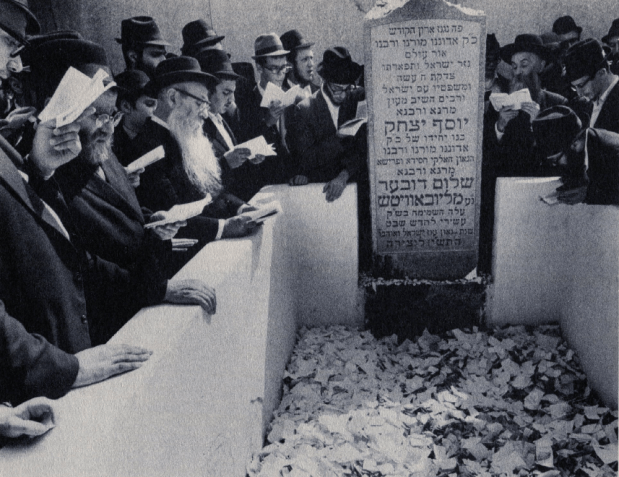
Today, walking on Eastern Parkway near 770, I overheard a Yeshiva Bochur explaining to an older woman that the upcoming day of Gimmel Tammuz is “the day the Rebbe passed away in 1994; you see, he is the Moshiach…”

Moshiach is described as transcending paradox (“nosei hafochim“).  We have no greater paradox than Gimmel Tammuz.  On the one hand, it has all the hallmarks of a “histalkus“, which essentially means “disappearance” as in “passing away” (although Chassidus explains that it actually means greater revelation, one which transcends revelation).  A “histalkus” of a Rebbe is the culmination of his leadership, and even though he continues to live on (also in this physical world, and even in a body [as we know that the Baal Shem Tov and the Maggid of Mezeritch were present in a bodily form in the Alter Rebbe’s prison cell])—nonetheless, there is an “end of an era”, and a new Rebbe emerges to carry on the mission.

Nothing of the sort happened on Gimmel Tammuz 5754.

The leadership of the Rebbe has not diminished by even the smallest measure, rather, to the contrary—the dedication of his Chassidim is stronger than ever and his leadership is more widely influential than ever.  There has not been a “break” but rather a “continuation” (see the sicha of 28 Sivan).

The Rebbe, in the sichos of Gimmel Tammuz, addresses the previous miraculous events of Gimmel Tammuz:

  1. Yehoshua bin Nun causes the sun to stand still (the sun is the tzaddik of whom it says “the sun sets and the sun rises”—on Gimmel Tammuz the sun did not set);
  2. The Previous Rebbe was redeemed from a death sentence under the Communists and sent to exile.  It was the “beginning of the redemption”, but it was not clear to the Chassidim at the time. [Read further]

The power of our generation, the generation of Moshiach, lies in our ability to “see through the darkness”, to know that even despite all appearances to the contrary the leader of the generation, the Moshiach of the generation “stands and serves” and his leadership is uncontested.  The terminology for this day, and what the Rebbe’s present address is, are not the decisive factors.  Rather, the incontestable focus of this day is the fact that the Rebbe continues to lead our generation, the 7th generation, to greet the true and complete Geulah!

Yechi Adoneinu Moreinu v’Rabbeinu Melech HaMoshiach l’Olam Vo’ed!