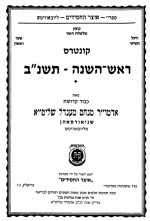
14) Kuntres Chof Marcheshvan, 5752: The Ohr Chodosh

14) Kuntres Chof Marcheshvan, 5752: The Ohr Chodosh

This maamor was edited and printed in honor of the birthday of the Rebbe Rashab, and it was handed out personally by the Rebbe in 770.*. It discusses deep inyonim of Chassidus, and demands attentive learning.  But here, we will focus only on one point from the maamor, which is overtly relevant to the concepts of Moshiach and Geuloh found in Dvar Malchus.

The Rebbe discusses here the concept of the Divine Light (Ohr) that preceded the tzimtzum (Tzimtzum being  the contraction of light by which it becomes possible to create limited, finite worlds).  This Ohr that existed prior to the tzimtzum possessed two dimensions: unlimited and limited.  These dimensions became the source for the two kinds of Divine revelation that exist now: Sovev (surrounding light, which cannot be grasped and thus is not revealed in the world), and Memaleh (filling light, which is limited and can this be grasped by the lower creatures).

Additionally: through the mitzvos we perform now, there will be the revelation of a new light in the time to come,  an Ohr Chodosh.  This Ohr Chodosh will bring about a new heavens and a new Earth (as stated by the novi Yeshaya).

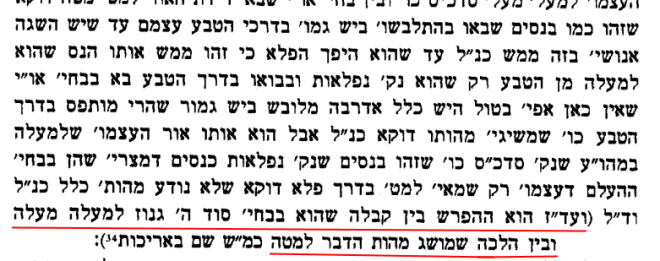
The Rebbe clarifies: if we are referring to the revelation of the unlimited light that illumined before the tzimtzum (which is presently not revealed in the worlds), this is not truly new (אין זה חידוש אמיתי) — this Ohr was already revealed before the Tzimtzum, and afterwards was concealed from the world.   Thus, when this Ohr will return and be revealed again, it will not truly be something new.  The truly new Ohr Chodosh, which will generate a new heavens and a new Earth, is Ohr that is drawn down by our fulfilling Torah and Mitzvos now, an Ohr that didn’t exist even before the Tzimtzum!

In these words the Rebbe is giving us a small glimpse at the great significantly of the avoidah of a Yid in performing Torah and Mitzvos — it is a complete chiddush, and draws down an Ohr Chodosh that never existed previously!  Here, in the oisios of Chassidus, the Rebbe is explaining the famous words of 28 Nissan (“I’ve done all that I can do, now you must do all that you can do to bring the Geuloh…”) — because it is the avoidah of a Yid, davka, to make this lowest world a “dira b’tachtonim” that draws down the Ohr Chodosh, which is the revelation of the Geuloh.

(Note that  in the kuntres published for Rosh Chodesh Kislev of this year, the Rebbe will elaborate further on this subject, bringing out the point that the avoidah of the Yid is even greater than the Ohr Chodosh that comes from his avoidah!)

* Some want to suggest that perhaps the timing of the distribution of this maamor by the Rebbe served as a “distraction”, so to speak, from the amazing revelations found in the Sicha “Beis Rabbeinu sh’b’Bovel”, which was printed the same week.  (Chassidim had in their hands a maamor given to them personally by the Rebbe and a second kuntres dropped off unceremoniously in 770 — it is obvious which a chosid would learn first.)

Well known is the principle that the first luchos were given with a big “shturem”, but had to be shattered.  The final luchos, to the contrary, were brought down without lightning, thunder, and the sound of the Shofar — but they were not shattered, they endure.  In our case, Chassidim were so excited to learn a maamor that the Rebbe had handed to them personally, from his holy hand, that they didn’t have time to make a big deal overthe other kuntres (“Beis Rabbeinu…”)…  (But what can a goat understand from gazing at the moon…?)

13) Kuntres Rosh Hashono, 5752

13) Kuntres Rosh Hashono, 5752

Released a few days in advance of Rosh Hashono, the discourse begins with the verse from the prophet Yeshaya: “On that day a great shofar will be sounded, and the ones who are lost in the land of Ashur and the ones who are pushed away in the land of Mitzrayim, will come and prostrate themselves to Hashem on the Holy Mountain in Yerushalayim.”

The Rebbe asks a few questions on this verse: What is special about a “great shofar”? Why does it say that the shofar “will be sounded” without specifying who will be sounding it — it seems as though it will be sounded on its own?

The shofar here is explained in spiritual terms: the cry of the innermost point in the heart which is above intellect. This cry draws down the corresponding level from Above, meaning the Supernal Will which transcends the level of Chochma (usually translated as “wisdom”).

There is a different verse that describes the shofar as being sounded by Hashem, but that verse refers only to a “shofar” and not a “great shofar”.  But the “great shofar” of the future is sounded from a level higher than any of Hashem’s names!

At Matan Torah there was also the sound of a shofar, but not a “great shofar” — because the shofar of the future will be even greater than at Matan Torah.  The reason (given in the name of the Mitteler Rebbe) is that at the time of Matan Torah the entire Jewish people were in a state of closeness with G-dliness קירוב לאלקות and therefore a “regular” shofar was sufficient to awaken their hearts.  But the shofar of the future, of the true and complete Geuloh, has to reach the “lost” and the “pushed away”, who are far from G-dliness, and therefore in order to reach them requires the “great shofar”. This also explains why it seems that it will be sounded “by itself” — because in order to awaken those who are so far from any interest or recognition of G-dliness will require a cry from Above, by itself, without any awakening from below at all. Now, on every Rosh Hashono, we sound a regular shofar, meaning that through our effort we awaken and draw down from Above.  But the great shofar of the future is drawn down by itself without any effort from below.

However, there is a question: we find that the great shofar of the future is likened to our own sounding of the shofar (by our own effort) on Rosh Hashono — they couldn’t be more different! The Rebbe explains it by connecting it to the original Rosh Hashono, at the Creation of the world, which preceded any effort from below (since “below” did not yet exist), and what this teaches us in our avoidah:

The shofar is narrow at one end and wide at the other. This reflects our cry from the narrow side, the limitations we find ourselves in.  Just like the way that a poor man’s prayer is more potent and heartfelt and more readily accepted, so, too, the cry that comes from the “narrow” limitations that challenge us.  And there is nothing more “narrow” and limiting than to be lost in Ashur or pushed away in Mitzrayim, so the “great shofar” of the future that is sounded “by itself” in order to awaken those distant individuals is indeed similar to our shofar.

But beyond that, it turns out that this itself — the very lowly and distant state of the lost and pushed away — is the cause of such a lofty revelation as the “great shofar”! And this is in fact the reason that Hashem created such places, and caused a Jew to be exiled there.  When these places cause an awakening of the “great shofar”, not only are the Yidden in those places elevated to a higher level, but these places themselves (the lowliest places of exile) are also elevated.

How does this explanation guide us in our avoidas Hashem (since the lost and pushed away are not consciously serving Hashem)?  Says the Rebbe: even one whose avoidah is complete בשלימות can learn from this: if he contemplates the loftiness of the Ohr Ein Sof then even his “true avoidah” is lacking and considered a sin; therefore, he feels himself to be “lost” and “pushed away”, and through this the revelation of the “great shofar” is awakened and drawn down.  Since he recognizes and feels that the Revelations are drawn down not by his own avoidah, but rather by Hashem’s chesed — it is like the shofar that is sounded by itself with no awakening from below at all.

The Rebbe then adds, in the name of his father-in-law the Previous Rebbe, that this “great shofar” awakens the “innermost point” of every Yid, and every single one (including the lost and pushed away) will want to go out of golus and go to Yerushalayim and prostrate themselves to Hashem, because this is the true desire of every Yid.  Meaning, that unlike Yetzias Mitzrayim when the desire to leave came from Above, in the future Geuloh it will be the desire of Yisroel to come to Yerushalayim — the awakening from Above of the “great shofar” is only the means by which the true desire of Yisroel is revealed. Thus, the avoidah will in fact be their own, only that for the truly “lost” and “pushed away” the avoidah will come after the great shofar which will awaken their true desire (which was drawn down from Above by itself).

The instruction for us is:

“… At the end of the time of golus when only a few moments remain before that day when the great shofar will be sounded [and more than this, as regards several inyonim the inyan of “the great shofar will be sounded” has already begun, as understood from the words of my father-in-law, and particularly that since the time he wrote that until now many years have passed, and how much more so in the recent times when we saw that there are a number of individuals who were at first in a situation of lost and pushed away, r”l, had an awakening of tshuva through the sounding of the “great shofar”*] there needs to be the avoidah of Bittul. This is the awareness and feeling that everything that is accomplished through his avoidah, both as regards himself and as regards others, is not due to his own virtues, but rather it had been given from Above.  Such a feeling will not cause a weakening in his avoidah, but to the contrary, this getting will cause his avoidah to be stronger.  Because when his avoidah derives from his own existence, it is limited: his “maximum” בכל מאודך is his own limited maximum.  But when he feels that his avoidah is not through his own power but rather from G-dliness, then he goes out from his own limited existence and his avoidah is above measurement and limitation.”

The Rebbe concludes that this has to be drawn into physicality גשמיות, and it is understood that whatever was done until now is insufficient (after all — we just learned that we can access the unlimited in our avoidah!). The awakening of the “great shofar” has to be in a way that every Yid, including the lost and pushed away, will come to prostrate himself to Hashem on the Holy Mountain in Yerushalayim, in the simple sense, through Moshiach Tzidkeinu.  Meaning: we don’t rest until every Yid is part of the Geuloh, until every Yid recognizes Moshiach, until every Yid reveals and acts upon his true desire to leave golus and go to Yerushalayim!

*This maamor was originally said after the awakening that followed the Six Day War.

12) Kuntres Chof Menachem Av: How to Add the “Alef”

12) Kuntres Chof Menachem Av: How to Add the “Alef”

The Rebbe mentions numerous times in these talks that everything that is necessary for the Geuloh is already here, we simply need to add the letter “alef” to the word gola (which means exile), thereby transforming it to Geuloh.  But what exactly does it mean to add an “alef” to the exile that we are in?

There are many levels to answering this question, the most basic of which is that it means revealing Hashem (the ruler of the world, “alufo shel olam“) in the world through Torah and Mitzvos.  Additionally, it means recognizing Hashem’s Divine Providence that is behind everything, even those things which appear to us as the opposite of good.

We find an even deeper and more comprehensive explanation in the Chassidic Discourse that was edited by the Rebbe and published in 1991 in honor of the Hillula (anniversary of the passing) of the Rebbe’s father, Levi Yitzchak Schneersohn.

The discourse discusses the source for the statement of our sages that a Jew must make 100 blessings every day.  The sages find scriptural support for this in a verse from parshas Ekev: “Now, Yisroel, what (“mah”) does Hashem your G-d want from you” (Devarim 10:12).  The sages say “don’t read mah (“what”) rather me’ah (“one hundred’)”.  This familiar technique of the sages doesn’t change the original meaning, of course, but adds another level.  In this case, they are adding the letter “alef” to the “mah” (which means “what”) and the result is the one hundred blessings (“me’ah”) that a Jew must say.

In chapter 3 of the discourse, the Rebbe explains the deeper significance of inserting an “alef”, which is surely applicable as well to the Rebbe’s instruction to add an “alef” to exile to transform gola into Geuloh.  To briefly summarize the Rebbe’s words:

“Mah symbolizes Malchus, which is the level where G-dly revelation can be internalized (in Chassidic terminology, the level of memaleh kol almin and the soul levels of Nefesh, Ruach, Neshoma).  In the  avodah of a Yid, this is the avodah of “you shall love Hashem your G-d with all of your heart” (b’chol levovecha) which derives from the external dimension of the soul’s intellect (chitzoniyus ha’seichel).  As implied by the term “all of your heart” it generates a feeling of love in the emotional attributes of the heart’s emotional attributes, but only there.

“Me’ah” is the level of Arich, a level that transcends us and can only be revealed in a transcendent, encompassing manner (sovev kol almin and the transcendent soul level of Chaya).  In our avodah this is the love “with all of your soul” (b’chol nafshecha) which derives from the internal dimension of the soul’s intellect (pnimiyus ha’seichel).  This love is felt in the intellect, and then automatically spreads out to affect all the soul’s powers and limbs.

How do we go from one level to the next, from “with all of your heart” (limited to the heart) to “with all of your soul” (which spreads to all the powers of the soul)?  It is through the avoda of “all of your might” (b’chol me’odecha), which reaches the “alef“, the supernal level of Atik which completely transcends the world (higher than both memaleh kol almin and sovev kol almin, the soul level of Yechida).  In avodah this is mesirus nefesh, to give one’s soul (either literally, or, in the way applicable in our generation: giving away one’s personal desires, mesirus haratzon, in order to fulfill the will of Hashem).  Because it transcends the other two levels, it is able to unite them and to draw down (the meaning of brocha, a blessing) the level of “me’ah” into the level of “mah“, that they should both be revealed in the person.

Clearly, this is understandable as regards the “alef” which we must insert into gola in order to make Geuloh: to awaken the level of Yechida, through serving Hashem “with all of your might”, having true mesirus nefesh to fulfill Hashem’s will, especially as it is revealed through “your servants, the prophets” and most especially the Novi of our generation.  This puts in the Alef and results in Geuloh!  Let’s not be lazy about this, because we have to bring Moshiach now!

Golus — Even While the Light of Geuloh is Shining?

The human eye can perceive light.  But only when it has a wavelength between approximately 380 nanometers (seen as violet) and 750 nanometers (seen as red). But these light rays are only a small fraction of the very broad spectrum of rays that exist, from 0.0001 nanometers in wavelength to a full meter.  This covers Gamma rays, x-rays, ultraviolet, infrared, microwaves, and radio waves — none of which the human eye can perceive.

But this is not a science lesson — what does it have to do with Geuloh?

We will see that it is a basis for understanding how the Rebbe can say that the Geuloh is here, all the end times have passed, and yet we remain in golus.  On the face of it, there is no logical basis to say that Continue reading

11) Kuntres 15 Av, 5751: An End to Darkness

11) Kuntres 15 Av, 5751: An End to Darkness

In honor of the 15th of Av, 5751, the maamor “קץ שם לחושך” (“He imposed a limit to the darkness”) was released.

The Rebbe asks the question: since every created thing has a limit, why does this verse say that Hashem “imposed” a limit on the darkness — implying that otherwise it would not have had a limit?  The answer begins that in general, undesirable things (darkness) are pushed away by light.  But our posuk is telling us that after reaching the limit of the darkness, it won’t be the possibility for darkness.  This is the true Geuloh, which leaves no room for darkness.

The maamor then begins to get into deep concepts of chassidus, of which we will mention only one.  Many of the Dvar Malchus sichos speak about the need to draw the makif into the pnimi, meaning to internalize in the intellect (seichel) that which is above the intellect.  For this there are two examples brought in this maamor: Will (ratzon) which is enlothed in intellectand Faith (Emunah) which is enclothed in intellect.  On their own, both Will and Faith, Ratzon and Emunah, are beyond the intellect, called in Chassidus “makif“.  But the manner in which they are internalized (brought into the intellect) is quite different.

We find that Ratzon overpowers and “forces” the intellect to come to the conclusions it wants.  The intellect understands things in the way that the Ratzon wants.  We see this in the ability of human beings to intellectually justify almost any behavior or goal that they want.  To “rationalize” something that is really not “rational” — this is the power of the Will to overpower the intellect so that it comes to the conclusions that the Ratzon wants.  The Ratzon is forcing and changing the seichel, and the seichel is being nullified in the face of the Ratzon.  Thus, it is not much of a chiddush that the Ratzon remains unchanged (the person still wants the same thing, because he “forced” his intellect to give him a good rational).

When bringing Emunah into intellect, however, the belief does not force the intellect.  The fact that his intellect will agree to what he believes in (meaning: to intellectually accept that his belief is true) is coming from the power of the intellect itself, the result of a true and unbiased conclusion:

When he contemplates intellectually in order that his intellect will also be in accordance with his belief, he makes an effort that his contemplation and “intellectual back and forth” will be honest and unbiased (ע”פ אמיתת השכל), and nonetheless it does not cause a change is his Emunah [he does not “lose his faith” as a result of his effort to come to a rational understanding of the things he believes in]…because even after he understands the matter intellectually, his Emunah remains above his intellect.  

The Rebbe also brings here, in footnote 33 (on the words “honest and unbiased (ע”פ אמיתת השכל)” from the Rebbe Rashab:

“and since he knows that the thing [in which he believes] is in essence true, because his Emunah is on strong foundations, he is not afraid to delve deeply into the subject and he does not limit the power of his seichel to inquire and seek and weigh each thing until he will come to the truth of the matter.”

The Rebbe is giving over something very relevant to the subject of Geuloh: it is not enough to have Emunah — this Emunah must be brought into seichel.  This must be done honestly and truthfully (unlike when we bring Ratzon into seichel, when the honesty of the intellect is compromised to the Ratzon).  This depends on our Emunah standing on strong, unshakable foundations, an Emunah which is not afraid to look honestly at the subject (and nonetheless, it will not be compromised from the challenges involved in trying to understand).  This is a sort of litmus test for us: do we really believe the Rebbe when he tells us that we are the last generation of golus and the first generation of Geuloh (and all that comes along with that)?  If so, we must take that Emunah and bring it into our understanding — this is the inyan of learning Moshiach and Geuloh.

If we find that we have to “force” our understanding, then our conclusions will not be true (probably because we are afraid that our Emunah is not so solid).  On the other hand, we cannot remain content with our Emunah above seichel, we have a mandate to draw it down into the intellect.  (This recalls the Rebbe’s statement on 28 Sivan that we must “agree” that the Geuloh is here.)

The key to all this?  The unification of self-nullification (bittul) and it’s opposite (metzius), as the Rebbe states in the maamor:

It is known that Emunah is bittul and intellect is metzius, and it is understood that for Emunah to be enclothed in intellect is bittul being drawn into metzius.  Since his intellectual effort is for the sake of his Emunah [and even this that his intellect remains in its metzius and is not nullified to the Emunah (like it is nullified to the Ratzon) is for the sake of the Emunah, in order that also the intellect as it is in its metzius will be in accordance with Emunah], and therefore even after the bittul of Emunah is drawn into the metzius of the intellect, the bittul remains intact.

We could say that this is also how we are meant to influence others: not to “force” them to accept what they are being told (the opposite of bittul, which nullifies the independence of the intellect); but, rather, to share with them the subject of the Emunah (that the Geuloh is here, the identity of Moshiach…) and to give them the tools to understand (which demands that we also must have these tools) and to reach the conclusion intellectually that these matters are in fact true.  In this way we and those around us will be able be “partners” (as the Rebbe says in the sicha of 28 Sivan) to truly agree that the Geuloh is here b’pashtus.

Audio recording of this article:
10) Kuntres 12-13 Tammuz: How We Can Burn Down Golus!

10) Kuntres 12-13 Tammuz: How We Can Burn Down Golus!

The maamor released for 12-13 Tammuz 5751 was originally said on 12 Tammuz 5729, a day before the maamor that was released on Yud Alef Nissan, 5751 (three months earlier).  Both maamorim speak about the “prayer of the rich man”.  Here, the Rebbe stresses the the connection between Yisroel and Moshe Rabbeinu, and adds the distinction that Moshe’s connection with Yisroel is his inward dimension (pnimiyus),  and everything else is secondary and external (chitzoniyus).  “All of his levels, including that he was also wealthy in ruchniyus, they are secondary, the external [chitzoniyus] dimension, relative to the fact that he is the shepherd of Yisroel…”  This, of course, is true also of the extension of Moshe in every generation — the Rebbeim — and now the Rebbe explains how this applies to the Geuloh of 12-13 Tammuz (and 19 Kislev):

Through the imprisonments that preceded the Geuloh of 19 Kislev and the Geuloh of 12 Tammuz came a great elevation, which is like the additional light that comes from the darkness.  Seemingly, since as regards the Nessiim it’s not possible to say that even while they were imprisoned there was a state of darkness by them [as the [Rebbe Rayatz] said about the imprisonment of the Alter Rebbe, that it was with his agreement, from which it is understood that by them all the concealments of imprisonment were only in chitzoniyus], then how could there come about an “additional light from darkness”?  We can say that since the main inyan of the Nessiim is that they are the shepherds of Yisroel, therefore, the concealments of the imprisonment as it was experienced by Yisroel is also found by the Nessiim.

This reveals to us how Moshiach can be holding by all the giluyim we can imagine and more, and yet he “bears our sufferings” and himself endures terrible suffering (as stated in Midrashim) — because of his identification with Yisroel who have not yet come out of Golus!  This means that our effort to bring an end to Golus is a great rachmones on the Rebbe!

The maamor begins with the verse from parshas Chukas about the Pora Adumoh (red heifer), and the Rebbe explains that the burning of the Pora Adumoh is also a metaphor for burning down golus.  What’s the connection?  How do we “burn down” the golus?

The Rebbe explains that the mitzvah of Pora Adumoh is “the” mitzvah, which is not understood and therefore must be performed with the most complete level of kabolos ‘ol.  But since Moshe Rabbeinu himself did understand the mitzvah, where does kabolos ‘ol come in for him, and how can he, through this mitzvah, draw it down to all of Israel?  The Rebbe explains that this is the concept of bittul and kabolos ‘ol in seichel.  

The inyan of seichel derives from the level of memaleh kol almin, which is the inyan of nature.

Emunah, belief in things that are above seichel, derives from the level of sovev, which is the inyan of miracles.

Generally speaking, seichel obscures emunah, nature obscures miracles.  The way to overcome this is through the revelation of Atzmus, which is truly unlimited and has the power to unify opposites.  The imprisonment and Geuloh  of 12 Tammuz drew down the level of Atzmus, which in fact brought about a unification of opposites, to such an extent that those who hated and imprisoned the Rebbe Rayatz were forced to release him, even as they remained in power, a miracle enclothed in nature.  How does this connect with burning down golus and the burning of the Pora Adumoh?

As regards the Pora Adumoh, we find that the closeness between Moshe and Yisroel goes in both directions: the mitzvah being a “chok“, the reason for it not being understood, is primarily by Yisroel and is drawn from Yisroel to Moshe (“take for you” in our posuk), so that also for Moshe it is a “chok” (even though he in fact knows the reason).  But as regards fulfilling the mitzvah with bittul and kabolos ‘ol, this is something Yisroel receives from Moshe.  The Rebbe adds that “We could say that via the fact that Moshe knew the reason for Pora Adumoh, and that the bittul of kabolos ‘ol is drawn into his comprehension (הסגה) this gives the power to every single Yid that emunah and kabolos ‘ol can exist also in his seichel.”  In other words, this mitzvah is what enables us to unify the opposites of seichel and emunah, nature and miracles, as the Rebbe explains:

His kabolos ‘ol is in a way that not only does he fulfill Hashem’s command (even when he doesn’t understand), but also he doesn’t question it at all (אינו מהרהר כלל), because the inyan of kabolos ‘ol is settled in his mind.  And we can connect this with the Midrash that that the Pora Adumoh hints at the exiles…because through this that kabolos ‘ol above intellect is settled in his seichel, this is a preparation for the Geuloh and the revelation of G-dliness that will occur… and through this that he doesn’t question…this is the burning of (the Pora Adumoh which hints at) the golus….

Meaning that when we utilize the power of this mitzvah — to have bittul and kabolos ‘ol settled in our intellect, to such an extent that our lack of understanding doesn’t bring us to question at all (and surely not to insist that we do understand things which are not fully understood) — we succeed in unifying seichel with emunah above seichel, unifiying nature and miracles (in our avoidas Hashem and in the world), thereby burning down the golus!  In this way we have the power to bring the true and complete Geuloh, and to finally redeem the Rebbe himself from our sufferings, in a way of “additional light from the darkness”!

9) Kuntres 28 Sivan: I Will Show You Wonders Behind the Miracles

9) Kuntres 28 Sivan: I Will Show You Wonders Behind the Miracles

A Chassidic discourse on the verse “As in the days when you came out from Mitzrayim, I will show you wonders” was edited and distributed by the Rebbe on 28 Sivan, 5751 (50th anniversary of the Rebbe’s arrival to America together with the Rebbetzin).  The subject is the nature and varying levels of miracles and wonders in general, and particularly as they will be in the Messianic age.  This not only shares an obvious connection with the miraculous escape of the Rebbe and Rebbetzin from Europe to America 50 years earlier, but also with the year 5751 תנש”א, which the Rebbe repeatedly referred to as the year of “I will show you wonders” (the letters of the Jewish year — Nun-Alef — standing for the  Hebrew words in our verse “I will show you wonders.”)

First, we need to understand the varying levels of miracles: miracles above nature (transforming water into blood, splitting the sea), and miracles enclothed in nature.  Miracles enclothed in nature themselves divide into 3 types: where the miracle is recognizable (Purim, Chanukah); where nature conceals the miracle but there is still a recognition that something out of the ordinary occurred and one is obligated to thank Hashem (an ill person who is healed, a prisoner who is freed, etc); and the lowest level, where nature so completely obscures the miracle to the point that one doesn’t even recognize that a miracle occurred (אין בעל הנס מכיר בניסו).

The Rebbe proceeds to explain that the last type of miracle, unrecognizable from the ordinary process of nature, is actually the highest in it’s source, from the verse עושה נפלאות גדולות לבדו, the great wonders that Hashem does “alone”, no one knows about them.  It is from this level that the great wonders of the Messianic age will come, which will be wonders even compared to the wonders of Mitzrayim.  This can explain why the about the Messianic wonders it says “I will show you wonders” — because they will come from the high level which today are unrecognizable — Hashem will have to “show” us that they are wonders.

But, the Rebbe explains, this verse of “showing wonders” doesn’t only apply to miracles enclothed in nature, but also miracles above nature.  Those miracles will be wonders even in comparison to the wonders that were seen in coming out of Mitzrayim.  But we are left with a question: what need is there to “show” the wonder of a miracle so above nature that it is already a wonder?  The answer the Rebbe gives is amazing.  But to reach that answer, we have to first understand the following:

First, the difference between these miracles is the degree to which they are grasped by human intellect.  A wonder like the splitting of the sea is so beyond human comprehension that we cannot grasp it at all, we can only gaze at it speechlessly.  The more the miracle is enclothed in nature, the more we can grasp it intellectually; to understand not only what happened, but how it happened.  The Rebbe gives examples: we don’t understand how a dead person is brought back to life, we only know that before he was dead and now he is alive.  But looking at the miracle of Purim, for example, we can see exactly how the decree was abolished, or when a sick person is healed we can grasp how it was brought about through certain drugs.  From this out comes out that being enclothed in nature is really what reveals the miracle, making it accessible to the human intellect.  The ultimate form are the miracles that we don’t even recognize — they are so fully grasped by our intellect that there is no sense of wonder that would cause us to notice something unusual has happened, which would cause us to give thanks to Hashem.

Mitteler Rebbe asks a question on the miracles that are unrecognizable: since they derive from the lofty level of “Him alone” (לבדו), then how is or possible for anything to conceal them?  His answer is that, in fact, nothing can conceal them.  They are so fully and seamlessly revealed by nature that we can’t even recognize that something out of the ordinary has occurred!

But really, all miracles come from the Ohr Ein Sof; the difference of whether that are enclothed in nature or not depends on whether they are from the aspect of concealment within the Ohr Ein Sof (למעלה מעלה עד אין קץ), or the aspect of revelation (למטה מטה עד אין תכתית).  And all the wonders of the Messianic era will revealed, including those that derive from the aspect of concealment.

So, the wonders of the Messianic era will come from the highest levels, and will also be revealed even into the human intellect.  But more than that, the Rebbe explains that even the miracles of the Messianic era that will not be enclothed in nature (like the splitting of the sea and the river) will be in the following manner: not only the splitting of the sea will be seen openly, but the revelation [of Elokus] that brings about the splitting of the sea will be seen openly! (As by the splitting of the sea upon coming out of Mitzrayim, when everyone pointed with a finger and said “this is my G-d” (זה א-לי ואנוהו). While by Yetzias Mitzrayim this was a one-time event, in the Messianic era it will be the ongoing reality!)

So we find that the miracles of the Messianic era will be wonders, from a higher level than even the wonders of Yetzias Mitzrayim, and at the same time they will be able to be grasped by human intellect.  (And they will be seen in a way where the Divine revelation itself will be perceived!)  But how will nature — which derives from the Divine name Elokim which conceals G-dliness that is above world — be able to accommodate such a degree of revelation?  The Rebbe explains that  through avoidas habirurim, refining the Divine sparks that fell in physicality, the Jewish people effect a refinement of nature.  Nature itself becomes elevated  (עלית הטבע), so that instead of obscuring the level of G-dliness that is above the world, it becomes a vessel for that G-dliness to be revealed!

It will be interesting to note (for those who have learned the Sicha explaining the “New Torah That Will Go Forth From Me”) that the Rebbe references chapter 16 in Shaar HoEmuna by the Mitteler Rebbe.  There, the Mitteler Rebbe explains this same subject of miracles, and also the difference between the aspect of concealment within the Ohr Ein Sof (למעלה מעלה עד אין קץ), and the aspect of revelation (למטה מטה עד אין תכתית).  He brings out that these two aspects correspond to Halacha (revelation to the lowest levels) and Kabbala (hidden secrets above revelation). Through this reference we can tie together everything in our maamor (which seems to be speaking only about miracles and wonders in physical objects) with the concepts discussed in the Sicha explaining the “New Torah That Will Go Forth From Me” — the ability of Moshiach to draw down the loftiest secrets of Torah to the point where they become Halacha! 

But what is the connection between the secrets of Kabbala, rulings in Halacha, and miracles in the physical world?  As explained by the Rebbe elsewhere, a Halacha ruling (psak din) has an affect on the world, and thus we can understand that when Moshiach draws down the secrets of Torah into Halacha (unifying the aspect of concealment with that of revelation) that this causes the same effect in the physical world, resulting in miracles and wonders which themselves unify the levels of concealment and revelation — above nature and within nature, as explained in this maamor of 28 Sivan!

Shaar Hayichud, Mitteler Rebbe, Ch. 15

6) Kuntres Lag B’Omer: Open My Eyes

6) Kuntres Lag B’Omer: Open My Eyes

This discourse starts with the words of Tehillim “Open my eyes and I shall gaze at [hidden] wonders from Your Torah” (“גל עיני ואביטה נפלאות מתורתך”).  This should immediately grab our attention, since the Rebbe called this year “I will show wonders” (“אראנו נפלאות”) and over the year would proceed to explain that all we need to do is “open our eyes”.  In this discourse the Rebbe explains to us what this means.

The verse mentioned above has a connection with Lag B’Omer (when the maamor was originally said, and when, 14 years later, it was published in 5751).  Because the word גל (“Gal” — Open [my eyes]”) contains the same letters as “Lag” B’Omer ל”ג בעומר.

Lag B’Omer is not only the day that Rabbi Shimon bar Yochai appeared (to fleshly eyes) to pass away, but it was the day of “the main revelation” of the inner dimension of Torah.  As brought in the Zohar that Rashbi revealed “holy words that he had not revealed over the course of his life (because the things he revealed [at the time of his passing] were the highest matters, that even Rashbi had been afraid to reveal then prior to this.)”.   Who fails to see the bold hint here —  that the Rebbe, in the year before our fleshly eyes perceived 27 Adar and Gimmel Tammuz, is revealing the us (in Dvar Malchus) things which had not been revealed previously.

The Rebbe proceeds to address a simple question: if the inner dimension of Torah is concealed from us, then the request should be “reveal to me” the hidden matters.  But the verse requests instead “open my eyes” — implying that the concealment is due to the eyes and not to the matters being hidden from sight.

The answer is that the Torah was given in order that we will become elevated, becoming vessels in which Elokus can be revealed. And specifically in those matters which apply “down below” (such as eating, drinking, business, etc.).  In terms of “Your Torah” (to quote the posuk) this means perceiving the hidden dimension of Torah within the revealed dimension; the deep intentions (כוונות) which are enclothed in the mitzvos. In fact, the main refinement and purification of the lower beings (the main intent of the giving of the Torah, as mentioned above) takes place via the intentions of the mitzvos.

All of this is related to Rashbi and Lag B’Omer, as the other verse that contains a hint to this day is “this witness-mound of stones” (עד הגל הזה) that Yaakov Avinu built as a mechitza for Lavan that neither of them would cross.  As the Rebbe explains here, this mound of stones was never meant to be permanent (as opposed to a wall, which has permanence).  Rather, this mound of stones (“Tzimtzum” and concealment) was only constructed in order that Yisroel will do the work to remove it, and to reveal the inner dimension of the Tzimtzum itself.  This recognition — that the Tzimtzum is really for the sake of revelation (we could say by way of a moshol: like the father who hides from his son on order that the son will search for and find him) — is the accomplishment of Rashbi, who refined this mechitza and brought about that the highest revelations could be perceived also in the lowest worlds.

This means that:

…the seeing of the wonders of Torah should be (not only because the wonders will be revealed, but rather)  because the Holy One, blessed be He, will open up the person’s eyes and the person will see the wonders of Torah in his own matters…that the Tzimtzum [the concealment which allows the dimension of “his own matters” to come into being] is really for the sake of revelation.”

In other words, the message of the year 5751, the year of “I will show wonders”, is that within matters that derive from the Tzimtzum itself, we should perceive the loftiest revelations of Elokus — in the  revealed world, in the revealed dimension of Torah.  And how can we possibly succeed to do that properly?  By diligently laboring to understand this dimension of Torah, and asking Hashem to please “Open my eyes…”!

5) Kuntres 13 Iyar: Like Which Brother?

5) Kuntres 13 Iyar: Like Which Brother?

This Chassidic discourse was printed in honor of the Yahrtzeit of the Rebbe’s brother, Yisroel Aryeh Leib.  Fittingly, it begins with the words of the posuk “Oh, that you were like a brother to me,” (Shir Hashirim, 8:1). Rashi comments that this verse refers to the way Yosef dealt kindly with his brothers even though they had mistreated him (by selling him as a slave to Egypt).  Contrasting this: there is a midrash which says that the verse refers to his beloved brother Binyomin, who, unlike his older brothers, had no hand in selling Yosef down to Egypt.

The discourse goes into depth about the nature of free choice, and the responsibility of Yosef’s brothers for selling him even though later Yosef reveals that it was divinely orchestrated for the good —  so that Yosef should rise to power in Egypt and be in a position to provide for his family when they sought respite from the famine in the land of Canaan.  However, we are now only going to focus on the part of the discourse that shows an open connection to the sichos of Dvar Malchus.

The verse “Oh, that you were like a brother to me,” is a request from the Jewish people to Hashem — to relate to us like a brother.  It is understood why we would interpret it to be referring to the brothers who sold him: the brothers did evil to Yosef but he repaid them with kindness.  Similarly, we request from Hashem that even though we have “done evil to Him” through our sins, He should repay us with kindness.  However, as we know from the story in chumash, Yosef’s kindness followed the trials and tribulations that he put the brothers through in order to bring them to do teshuva and acknowledge their sin.  By asking for Hashem to relate to us like Yosef to Binyomin, who had no hand in the sale of Yosef, we are asking for open and revealed good without any “trials and tribulations”.

The difference between the two interpretations (whether the verse is referring to Yosef’s conduct to his 10 brothers or to Binyomin) will be understood as the difference between a number of contrasting concepts, all of which contain a common thread.

On the one hand we have the lofty revelation of Yetzias Mitzrayim, which was an awakening from Above (not something Bnei Yisroel earned from their own efforts).  But, as lofty as it is, it remained essential “makif” and was not internalized.  On the other hand, we have Sefiras Ha’Omer (in the days following our going out of Mitzrayim), which is our own effort at refining ourselves.  It is not as lofty as when Hashem revealed Himself and took us out of Mitzrayim, but because it is our own avoidah it is internalized in a settled way (בפנימיות ובהתישבות).

The discourse goes on to find the same relationship between the avoidah of teshuvah (leaving one’s reality, the bittul of one who lacks all qualities) and the avoidah of Tzaddikim (having bittul that does not negate their existence, humility where one is aware of his abilities).  In short: powerful and lofty but remains “outside” the person, contrasted with a not-as-lofty revelation that is internalized.  It is specifically this aspect of being internalized that fulfills Hashem’s desire for a dwelling place down below (דירה בתחתונים).

Based on this, we can understand the two interpretations of our verse: the interpretation that “brother” refers to Yosef as he conducted himself with his brothers who sold him represents our request for the loftiest revelations (Yetzias Mitzrayim and the avoidah of Baalei Teshuva).  The other interpretation, which says that it refers to Binyomin, reflects a request for an internalized, settled revelation (Sefiras Ha’Omer and the avoidah of Tzaddikim).

Since both interpretations are going on the same verse, they are really not contradictory — they are complementary.  Meaning that our real request is for the highest revelations, but that these highest revelations should be internalized in a settled way — all of the benefits without any of the drawbacks!

This is the avoidah that the Rebbe has given us with the famous words of the Sicha of 28 Nissan: “oirois d’Tohu but in a way of keilim d’Tikkun“.  (In a later Sicha of 22 Shevat, this is described as the unification of the aspect of “10” and the aspect of “11”.)  Our avoidah to bring the Geuloh is not that of Baal Teshuvah nor that of a Tzaddik;  rather, ours is an avoidah that combines these two dimensions, demanding that we constantly transcend ourselves like a Baal Teshuvah, and then internalize it so it is as natural as the avoidah of Tzaddikim.

4) Kuntres Beis Iyar, 5751: Why Concealment

4) Kuntres Beis Iyar, 5751: Why Concealment

[The discourse presented here was edited by the Rebbe and printed for Beis Iyar 5751 (1991), and in retrospect we can see how it is meant to guide us and strengthen us through the present time (even more so than when it was published), as will be explained, בעז”ה.]

The haftorah that is read when Shabbos falls out in Erev Rosh Chodesh (the day before the new month when the moon is completely concealed) begins with the verse: “Yehonosan said to him: tomorrow is [Rosh] Chodesh and you will be remembered (נפקדת) because your place will be vacant (כי יפקד מושבך).”

The words of this verse demand explanation: why are words from the same root — נפקדת and כי יפקוד — used for completely opposite concepts? “You will be remembered” is seemingly quite the opposite from “your place will be vacant”, which implies that he will be missing?!  To explain this, the Rebbe mentions several concepts which we will touch upon here only superficially (but the wise will investigate and find deeper things…).

Firstly, the Rebbe explains that the entire “drama” in this haftorah involving Shaul Hamelech, his son Yehonosan, and Dovid Hamelech are, on a deeper level, referring to the unification of the 6 higher sefiros and the 7th (in the language of kabbalah Z”A and Malchus (ז”א ומלכות) which are likened to husband and wife) .  Thus, the word נפקדת also means the union which can bring forth children, relating to the union of husband and wife.  This unification of the sefiros takes place through the intellectual attribute of Bina, which is from a higher level.  This can be read as a hint to what the Rebbe describes as the “direct way” to bring the Geuloh in actuality: by learning and understanding (the power of Bina) the subjects of Moshiach and Geuloh.

Further, the Rebbe explains how the name נתן (last three letters of Yehonosan) refer to Malchus on the level described as sea (ים, which conceals the sefiros), whereas Dovid is Malchus on the level described as dry land (ארץ, where things are revealed).  The verse “Yehonosan said to him [to Dovid]…” refers to transforming the sea to dry land (as occurred at the spitting of the sea).

(Interesting to note that the gematria of the words in the verse of crossing the sea — ויבֹאו בני ישראל בתוך הים ביבשה — has the same value as the declaration יחי אדוננו מורנו ורבינו מלך המשיח לעולם ועד, which was declared before the Rebbe for the first time on the Shabbos following the release of this maamor in 5751!)

All of the above is in connection with Erev Rosh Chodesh, when the moon is concealed. This reflects a state of complete self-nullification (bittul) which brings about the birth of the new moon on the following day: the unification of the sun and the moon (mashpia and mekabel).  How can the bittul of Erev Rosh Chodesh accomplish this amazing unification?  Because the bittul of the time when the moon is concealed draws down from the level of Kesser (כתר), the level which is entirely above the chain of worlds (סדר השתלשלות).

Look closely: a period of concealment (which appears to be quite a negative phenomenon) is actually a time when the highest levels are being drawn down!  This is in order to bring about the Divinely desired unification of mashpia and mekabel (Hashem and Yisroel; the Rebbe and Chassidim) through the power of Bina (learning and understanding).  This learning and understanding brings about the internalization of the lofty levels that are drawn down at the time of concealment — an experience which is likened to the splitting of the sea, when the concealment itself is transformed to revelation (with the same gematria as “Yechi Hamelech…”)

(Perhaps we can sense that the Rebbe is explaining for us what is happening b’pnimiyus as we live through the “Erev Rosh Chodesh” of the post Gimmel Tammuz era?)

Returning to the maamor, the verse starts with the words “And Yehonosan said” (the drawing down of the lofty lights of Atzilus) and then is followed by “tomorrow is [Rosh] Chodesh”. This is Erev Rosh Chodesh, when the moon is in a state of concealment. First, the lofty lights are given over; after that, the concealment takes place.

(We can see how the lofty lights given over in the Sichos of 5751-52 serve as a preparation for the concealments of 27 Adar and 3 Tammuz….)

In fact, the Rebbe explains that in the path from coming out of Mitzrayim (in the month of Nissan) to Matan Torah (in the month of Sivan) we encounter Erev Rosh Chodesh twice: for the months of Iyar and Sivan. Erev Rosh Chodesh Sivan is a giving of power (נתינת כוח)  for the union (נפקדת) that occurs via the giving of the Torah. Erev Rosh Chodesh Iyar (when this discourse was originally said) is a נתינת כוח giving of power for ויפקד מושבך — the time of concealment, as described at length above.

Learning the discourse itself will surely help the reader to put all these concepts in their proper place, and understand how the Rebbe (in this discourse and in many of the Sichos of this period) is preparing us for the crucial avoidah that takes place in a situation of concealment — avoidah that brings about a revelation of the unification of the mashpia and the mekabel and an end to that very concealment itself!

Image by wirestock on Freepik