Everything in the life of the Rebbe’s Chassidim is governed by the Rebbe’s teachings. But when something occurs for which we don’t have explicit instructions — such as Gimmel Tammuz — we must look in the Rebbe’s Torah for guidance.
Many Chassidim will say that the Rebbe in fact does give explicit instructions for Gimmel Tammuz, for example in 5751 the Rebbe writes that Gimmel Tammuz represents “the beginning of the Geuloh”. Nonetheless, not every chosid today is prepared to accept that what the Rebbe said regarding the “beginning of the Geuloh” of the Rebbe Rayatz can so easily be applied to Gimmel Tammuz, 5754. Even so, this split — how Chassidim respond to the situation after Gimmel Tammuz 5754 — is itself addressed by the Rebbe, as we hope to show.
In Likkutei Sichos volume 19 is printed a famous sicha explaining an aggadeta at the end of Mesechta Makos. The aggadeta describes two incidents involving Rebbi Akiva while he was travelling with three other sages. What concerns us here is the second incident:
Rabban Gamliel, Rebbi Elazar ben Azaryah, Rebbi Yehoshua, and Rebbi Akiva were going up to Yerushalayim (after the destruction of the Beis Hamikdash). When they reached the point where they could see the Temple Mount they all (including Rebbi Akiva) tore their garments as a sign of mourning. As they proceeded and approached the site of the Beis Hamikdash, they saw a fox run out of the Holy of Holies. The three sages began crying, and Rebbi Akiva laughed.
“Why are you laughing?!” they asked him.
He responded: “Why are you crying?”
They answered: “The place about which the verse states ‘a non-Kohen who approaches will die’ and now foxes are are going there and we shouldn’t cry?!”
Rebbi Akiva responded: that is why I am laughing. The verse states (Yeshayahu 8:2) “two faithful witnesses will give testimony: Uriah haKohen and Zecharia [the prophet].” The prophecy of one is dependent on the other. Uriah prophesied (about the destruction of the Beis Hamikdash) that “Zion will be plowed like a field”. Zecharia prophesied (about the Geuloh) that “elderly men and women will yet sit in the streets of Yerushalayim.” “Now that I see that Uriah’s prophecy was fulfilled, I’m certain that Zecharia’s will be fulfilled.”
They said to him: “Akiva, you have comforted us. Akiva, you have comforted us.” Thus ends the aggadeta.
The Rebbe asks a number of questions, which are answered at length in the Sicha, but for our purposes we need to understand how the Rebbe explains Rebbi Akiva’s laughter upon seeing something as drastic as a fox running out of the Holy of Holies. The Rebbe explains Rebbe Akiva’s view as follows:
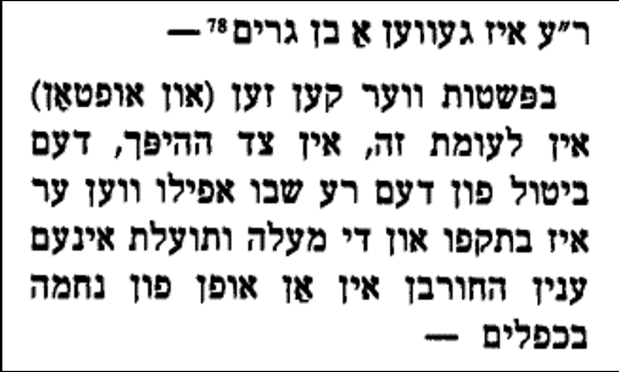
Rebbi Akiva was able to see the good, even in something that appears as not good at all. Since the good will come out in the end, his opinion was that the future good takes precedence over anything “not good” in the present. Thus, if one knows (according to Torah, not merely a “hergesh”) that the destruction that you see will lead to Geuloh — this demands, according to Rebbi Akiva, that one relate to the future Geuloh and not the present destruction. In the Rebbe’s words: Rebbi Akiva only saw the future good.
And more than that: in the verse the destruction itself is likened to a “plowed field”, which is actually part of the growth process. It is not a negative step which one must suffer in order to get to better things down the road; rather — the plowing itself is part and parcel of the sowing and reaping.
In other words, not only the future good must take precedence over the unpleasant present, but the present itself is part of the future good! And this is why the other sages were comforted by his words: because he showed them how the future good was actually already present in the “here and now” (despite how unpleasant the “here and now” might appear).
Let us translate this as it might apply to Gimmel Tammuz in our times: Continue reading →





 Dvar Malchus 770