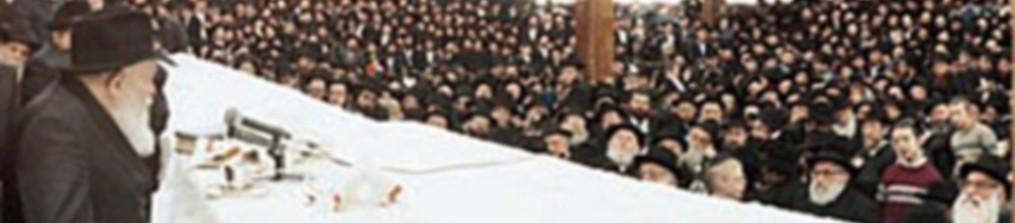
Vayikra 5751: Miraculous Conduct

Vayikra 5751: Miraculous Conduct

The sicha of Parshas Vayikra is the first sicha of the Dvar Malchus cycle (from Vayikra 5751 through Vayakhel 5752).  The focus of this sicha is a recurring theme in all the sichos from these 12 months: drawing the miraculous (which transcends nature) into the natural order of things.

The demonstration of this in our sicha is the special occurrence that occurs once in a few years: Rosh Chodesh Nissan comes out on Shabbos.  In such a year, three Sefer Torahs are removed from the Aron Kodesh to be read: the regular Sefer for the parsha, a second sefer for Rosh Chodesh, and a third sefer for the annual reading of  “Parshas Parah” prior to Pesach. The only other times 3 sefer Torahs are taken out are Simchas Torah (every year) and Shabbos Chanukah or parshas Shekalim that fall out on Rosh Chodesh (not the case every year).

The 3 sefer Torahs of Simchas Torah are described by the Rebbe as “t’midin“, a regular offering in the consistent, fixed order of things.  The 3 sefer Torahs of Shabbos Rosh Chodesh Nissan in such a year as 5751, an infrequent occurrence, is in the category of “musafin“, something “additional” to the usual order of things. It is also implicit in the nature of the readings on those days: on Simchas Torah we read “Bereishis”, Hashem creating the world as it conducts itself according to nature; and, on Rosh Chodesh Nissan the first mitzva (counting the months) “החודש הזה לכם”, which the Rebbe refers to as the miraculous conduct of the world.  Not only that, but Continue reading

“Yechi Hamelech”, Beis Nissan, 5748

“Yechi Hamelech”, Beis Nissan, 5748

We are presenting here a free-translation of the relevant passages from the sicha of Beis Nissan, 5748, where the Rebbe himself introduces and explains the significance of the declaration “Yechi Hamelech”.  (Bold emphasis in the original sicha):

…the heart is the life-force of the body itself, being that it is the location of “the blood, which is the soul”, and the heart causes “the dispersion and circulation of the life-force…which is enclothed in the blood of the nefesh which goes out from the heart to all of the limbs, and circulates the life energy (“ruach chayim“) and the blood into every limb and the ligaments and it is absorbed by them and returns to the heart, etc.” (as the Alter Rebbe explains in Igeres Hakodesh, ch. 31).

So it comes out that the important element of the life-force of all the limbs of the body are connected with the heart, since the blood (“which is the soul”) which is in the heart…is actually dispersed to all the limbs of the body.

Life-force is connected with movement.  And movement is found specifically in the heart, for it is found to be constantly pumping and drawing blood, “the pulse of the heart”.  And the blood that is in it is also in a constant state of movement, circulating throughout the entire body (as explained in Igeres Hakodesh), which is not the case with the liver and the brain [two other essential organs mentioned previously] which do not move.

Similarly this is true as regards the Leader (the Nosi) and the King (the Melech), “the heart of the community of Israel” (Rambam) — “who sends them out and brings them back”, meaning that in accordance with his word comes about (as well — in addition to the head and the brain which provide guidance and direction) the drawing down of life-force to Bnei Yisroel.

And when the day arrives which was Continue reading

VIDEO: The Poor Man Must Accept the Gift

Based on the Maamar in Kuntres Beis Nissan 5751: The Rebbe gives the moshol of giving to a poor man. The “initial thought” is not the giving of the tzedakah, but that the poor man should accept it and benefit from it, which is not in the power of the giver, only the recipient.

What does this mean for Dor Hashvii and the Rebbe’s assertion that “I’ve done all I can do, now I give it over to you…”

1) Kuntres Beis Nissan 5751: To Give and To Receive

A Chassidic discourse, called a maamor, was edited by the Rebbe and published in honor of the Hillula of the Rebbe Rashab, Beis Nissan, 5751.  This was the day after Shabbos Vayikra, the very beginning of the cycle of Dvar Malchus.  We are going to extract a small section of this maamor which stands out boldly as a descriptive explanation of the sharp and shocking words of the Rebbe on 28 Nissan (a few weeks after this maamor was released): “I’ve done all I can do, now I give it over to you to do all that you can do to bring Moshiach in actuality”.

The section of the maamor we will look at states as follows:

The Rebbe Rashab explains the difference between two inyonim: “its beginning is wedged into its end and its end into its beginning” (נעוץ תחילתן בסופן וסופן בתחילתן) and [the similar expression that] “the end of the deed was first in thought” (סוף מעשה במחשבה תחילה).  The difference between them is that “it’s end” (סופן) refers to the end and completion of the thought, wedged into the beginning of that which is being given (ההמשכה).  And a moshol is brought for this from the giving of tzedaka.  That the beginning (of the giving) is the mercy (רחמים) that is awakened towards the poor man.

The concept that “its end is wedged into its beginning” is that the main intent in the awakening of mercy (“its beginning”) is

Continue reading

Introduction to the cycle of Dvar Malchus

Introduction to the cycle of Dvar Malchus

Introduction to the cycle of Dvar Malchus

“Rav Asi asked, ‘Why do little school children begin their Chumash learning with Vayikra and not with Bereishis? It is because little children are pure and unblemished, and the sacrifices are pure and unblemished. The pure ones begin their learning with the study of the pure.'” (Vayikra Rabbah, Tzav 7:3)

The cycle of Dvar Malchus refers to the twelve months of sichos which the Rebbe said between 5751-52 (1991-92), the latest words (“Mishna achrona”) that we have from the Rebbe.  Notably, the cycle begins with the sicha of Parashas Vayikra, 5751.  Although the Torah of Moshiach will only be revealed to us together with the revelations of the true and complete Geulah, these sichos are a “taste” of the “new Torah that will come forth from Me” (Yeshayahu 51:4; Vayikra Rabbah 13:3) and fittingly we start learning from parshas Vayikra.  Furthermore, the sicha describes a connection to Simchas Torah, which is the day when we begin reading the Torah anew (finishing with “V’zos Habrocha” and beginning with “Bereishis”).

Some background: The year 5750 (1990-91) was termed by the Rebbe “it will be a year of miracles” based on the letters that form the Hebrew year.  The year 1990 saw the beginning of the disintegration of the Soviet Union and the outbreak of the first Gulf War.  The year 5751 received the name “it will be year of ‘I will show wonders’”. 

By the time we reach Parshas Vayikra, 5751 (March 1991), the Gulf War has ended (on Purim, two weeks earlier); the events in the disintegration of the Soviet Union will lead, in June (Rosh Chodesh Tammuz), to the election of Boris Yeltsin and the end of the Communist Regime, effectively ceasing to exist upon the resignation of President Gorbachev in late August (Shabbos Ki Seitze).  This new reality — the defeat of Sadaam Hussein in Iraq (and the overt miracles witnessed in Israel during that war) and the collapse of the Soviet Union (bringing an end to the Cold War and the nuclear arms race) — is the background to these sichos.

As the Rebbe often explains, events in the physical world are a consequence of what occurs spiritually, the realm of the Jewish souls.  If we see the fall of the earthly “iron curtain” it is because the spiritual “iron curtain” (“mechitza shel barzel”) which separated Israel from their Father in Heaven has fallen.  If an evil dictator who threatened to annihilate, G-d forbid, Jews young and old is defeated and rendered powerless without a Jew firing a weapon, this is because the same drama is playing out spiritually.  These sichos are to guide us in this “new world order” — a new earthly world order, reflecting a new spiritual world order. Continue reading

6) Kuntres Lag B’Omer: Open My Eyes

6) Kuntres Lag B’Omer: Open My Eyes

This discourse starts with the words of Tehillim “Open my eyes and I shall gaze at [hidden] wonders from Your Torah” (“גל עיני ואביטה נפלאות מתורתך”).  This should immediately grab our attention, since the Rebbe called this year “I will show wonders” (“אראנו נפלאות”) and over the year would proceed to explain that all we need to do is “open our eyes”.  In this discourse the Rebbe explains to us what this means.

The verse mentioned above has a connection with Lag B’Omer (when the maamor was originally said, and when, 14 years later, it was published in 5751).  Because the word גל (“Gal” — Open [my eyes]”) contains the same letters as “Lag” B’Omer ל”ג בעומר.

Lag B’Omer is not only the day that Rabbi Shimon bar Yochai appeared (to fleshly eyes) to pass away, but it was the day of “the main revelation” of the inner dimension of Torah.  As brought in the Zohar that Rashbi revealed “holy words that he had not revealed over the course of his life (because the things he revealed [at the time of his passing] were the highest matters, that even Rashbi had been afraid to reveal then prior to this.)”.   Who fails to see the bold hint here —  that the Rebbe, in the year before our fleshly eyes perceived 27 Adar and Gimmel Tammuz, is revealing the us (in Dvar Malchus) things which had not been revealed previously.

The Rebbe proceeds to address a simple question: if the inner dimension of Torah is concealed from us, then the request should be “reveal to me” the hidden matters.  But the verse requests instead “open my eyes” — implying that the concealment is due to the eyes and not to the matters being hidden from sight.

The answer is that the Torah was given in order that we will become elevated, becoming vessels in which Elokus can be revealed. And specifically in those matters which apply “down below” (such as eating, drinking, business, etc.).  In terms of “Your Torah” (to quote the posuk) this means perceiving the hidden dimension of Torah within the revealed dimension; the deep intentions (כוונות) which are enclothed in the mitzvos. In fact, the main refinement and purification of the lower beings (the main intent of the giving of the Torah, as mentioned above) takes place via the intentions of the mitzvos.

All of this is related to Rashbi and Lag B’Omer, as the other verse that contains a hint to this day is “this witness-mound of stones” (עד הגל הזה) that Yaakov Avinu built as a mechitza for Lavan that neither of them would cross.  As the Rebbe explains here, this mound of stones was never meant to be permanent (as opposed to a wall, which has permanence).  Rather, this mound of stones (“Tzimtzum” and concealment) was only constructed in order that Yisroel will do the work to remove it, and to reveal the inner dimension of the Tzimtzum itself.  This recognition — that the Tzimtzum is really for the sake of revelation (we could say by way of a moshol: like the father who hides from his son on order that the son will search for and find him) — is the accomplishment of Rashbi, who refined this mechitza and brought about that the highest revelations could be perceived also in the lowest worlds.

This means that:

…the seeing of the wonders of Torah should be (not only because the wonders will be revealed, but rather)  because the Holy One, blessed be He, will open up the person’s eyes and the person will see the wonders of Torah in his own matters…that the Tzimtzum [the concealment which allows the dimension of “his own matters” to come into being] is really for the sake of revelation.”

In other words, the message of the year 5751, the year of “I will show wonders”, is that within matters that derive from the Tzimtzum itself, we should perceive the loftiest revelations of Elokus — in the  revealed world, in the revealed dimension of Torah.  And how can we possibly succeed to do that properly?  By diligently laboring to understand this dimension of Torah, and asking Hashem to please “Open my eyes…”!

5) Kuntres 13 Iyar: Like Which Brother?

5) Kuntres 13 Iyar: Like Which Brother?

This Chassidic discourse was printed in honor of the Yahrtzeit of the Rebbe’s brother, Yisroel Aryeh Leib.  Fittingly, it begins with the words of the posuk “Oh, that you were like a brother to me,” (Shir Hashirim, 8:1). Rashi comments that this verse refers to the way Yosef dealt kindly with his brothers even though they had mistreated him (by selling him as a slave to Egypt).  Contrasting this: there is a midrash which says that the verse refers to his beloved brother Binyomin, who, unlike his older brothers, had no hand in selling Yosef down to Egypt.

The discourse goes into depth about the nature of free choice, and the responsibility of Yosef’s brothers for selling him even though later Yosef reveals that it was divinely orchestrated for the good —  so that Yosef should rise to power in Egypt and be in a position to provide for his family when they sought respite from the famine in the land of Canaan.  However, we are now only going to focus on the part of the discourse that shows an open connection to the sichos of Dvar Malchus.

The verse “Oh, that you were like a brother to me,” is a request from the Jewish people to Hashem — to relate to us like a brother.  It is understood why we would interpret it to be referring to the brothers who sold him: the brothers did evil to Yosef but he repaid them with kindness.  Similarly, we request from Hashem that even though we have “done evil to Him” through our sins, He should repay us with kindness.  However, as we know from the story in chumash, Yosef’s kindness followed the trials and tribulations that he put the brothers through in order to bring them to do teshuva and acknowledge their sin.  By asking for Hashem to relate to us like Yosef to Binyomin, who had no hand in the sale of Yosef, we are asking for open and revealed good without any “trials and tribulations”.

The difference between the two interpretations (whether the verse is referring to Yosef’s conduct to his 10 brothers or to Binyomin) will be understood as the difference between a number of contrasting concepts, all of which contain a common thread.

On the one hand we have the lofty revelation of Yetzias Mitzrayim, which was an awakening from Above (not something Bnei Yisroel earned from their own efforts).  But, as lofty as it is, it remained essential “makif” and was not internalized.  On the other hand, we have Sefiras Ha’Omer (in the days following our going out of Mitzrayim), which is our own effort at refining ourselves.  It is not as lofty as when Hashem revealed Himself and took us out of Mitzrayim, but because it is our own avoidah it is internalized in a settled way (בפנימיות ובהתישבות).

The discourse goes on to find the same relationship between the avoidah of teshuvah (leaving one’s reality, the bittul of one who lacks all qualities) and the avoidah of Tzaddikim (having bittul that does not negate their existence, humility where one is aware of his abilities).  In short: powerful and lofty but remains “outside” the person, contrasted with a not-as-lofty revelation that is internalized.  It is specifically this aspect of being internalized that fulfills Hashem’s desire for a dwelling place down below (דירה בתחתונים).

Based on this, we can understand the two interpretations of our verse: the interpretation that “brother” refers to Yosef as he conducted himself with his brothers who sold him represents our request for the loftiest revelations (Yetzias Mitzrayim and the avoidah of Baalei Teshuva).  The other interpretation, which says that it refers to Binyomin, reflects a request for an internalized, settled revelation (Sefiras Ha’Omer and the avoidah of Tzaddikim).

Since both interpretations are going on the same verse, they are really not contradictory — they are complementary.  Meaning that our real request is for the highest revelations, but that these highest revelations should be internalized in a settled way — all of the benefits without any of the drawbacks!

This is the avoidah that the Rebbe has given us with the famous words of the Sicha of 28 Nissan: “oirois d’Tohu but in a way of keilim d’Tikkun“.  (In a later Sicha of 22 Shevat, this is described as the unification of the aspect of “10” and the aspect of “11”.)  Our avoidah to bring the Geuloh is not that of Baal Teshuvah nor that of a Tzaddik;  rather, ours is an avoidah that combines these two dimensions, demanding that we constantly transcend ourselves like a Baal Teshuvah, and then internalize it so it is as natural as the avoidah of Tzaddikim.

Behar-Bechukosai: Dwelling Place — Below

Behar-Bechukosai: Dwelling Place — Below

Consistent with the theme that runs through almost all the Sichos of Dvar Malchus, the Rebbe address in this Sicha the split between Above and Below, “Oneness” and multiplicity. Paraphrasing the Mishna in Pirkei Avos: the dimension of “one utterance” and that of “ten utterances”.

The aspect of “one utterance” (through which the world could have been created) refers to the higher dimension, where the simple Oneness of G-dliness is the only reality, and any created entity is completely nullified to that Oneness, losing all individual importance.

The aspect of “ten utterances” (through which the world was created) refers to the lower reality where every entity has it’s own role and unique importance distinct from the greater unity and Oneness. This dimension of reality, however, can impose upon — and even conceal — the Oneness that underlies and permeates Creation.

In other words, “one utterance” brings a complete nullification of the world, whereas the “ten utterances” are what generate the reality of world (although in a way where the world is permeated with Holiness drawn down from Above).  The “problem” here is that each one cancels out the other, which is not the Divine intent.  Says the Rebbe:

..the true perfection is the combination of the two together — that also the level of G-dliness that is above the world (“one utterance”) is drawn down and revealed and permeates the multiplicity of the individual created begins (“ten utterances”).  Through this the intent of Creation is fulfilled, that the Holy One desired a dwelling place in the lower realms.

What is the true definition of the famous expression דירה בתחתונים (a “dwelling place in the lower realms”)?  It is the unification of the Upper and Lower dimensions.  Not in a way that the Higher dimension (עליונים) descends from it’s lofty level, for then it is no longer truly Higher; and not in a way where the Lower ascends from it’s own level, for then it is no longer truly Lower.  Rather: “The Upper as it is in its loftiness becomes united with the Lower as it is in its lowliness…”

In other words, Torah and G-dliness remain lofty (not sacrificing their inherent loftiness and Holiness in order to fit into the limitations of the earthly perspective); man remains earthly (physically eating, drinking, sleeping, etc.) — but these same “earthly” matters of the man down below become permeated with the loftiest dimensions of Above. When we achieve this, we have created a dwelling place (for Hashem’s essence, His “true self”, so to speak) in the lower realms (which remain earthly and lowly).

This is the purpose of the Giving of the Torah. But the Torah cannot only be “given” by Hashem, it must also be “received” by us.  In order to become a proper vessel to receive the Torah (especially that level of Torah which is above the world and man) a person must leave his reality through complete self-nullification (תכלית הביטול). This self-nullification will express itself through the impossibility of machloikes, since the reason for machloikes is one’s ישות lack of self-nullification. In this way one becomes fitting and prepared to receive the level of the Torah that is above any connection to the world, which is the level of Torah that will be revealed in the true and complete Geuloh.

That is the preparation to receive this level of the Torah; but to actually receive it means that through learning with understanding and comprehension it will permeate and become the person’s reality. And through this:

Immediately we will see that Moshiach is already found among us, and every single Jew will point with his finger and say “Behold, this one (is the Melech haMoshiach, and he already) came”.

Keep Your Eyes on the Rebbe!

In the sicha of Parshas Emor, that Rebbe makes the following enigmatic statement:

[The Geulah and building of the 3rd Beis Hamikdash] will be hastened through the study of Torah, and of Chassidus in particular. This also includes looking into the face of your Rebbe, which helps one’s understanding…

This concept is found in the Gemara (as brought in the sicha of Emor), and the Rebbe himself wrote (in the early years of his leadership) that a person should imagine the face of the Previous Rebbe or look at his photo, explaining the benefits that come from this.  So why mention it seemingly “out of context” in a sicha in 5751?

It can be understood that the Rebbe is not only saying to look at the Rebbe’s visage, whether in person or via a photo, but something more than this.  The Rebbe is giving us advice how to better understand these sichos of 5751-52, where the Rebbe is speaking openly about Moshiach in unprecedented ways: when we are learning here about Moshiach, we need to know whom we are talking about; that this is not just “learning Torah lishmah“, but has very practical ramifications. How will we properly understand what the Rebbe is trying to tell us about the identify of Moshiach, and whether we are waiting for him to come or if he has already come? Simple: Keep your eyes on the Rebbe!

Read the following words from the sicha of Behar-Bechukosai as they are without “looking at the face of the Rebbe”, then read them again with the Rebbe in mind — you will understand very well the “enigmatic” advice “which helps one’s understanding“:

Immediately we will see that Moshiach is already found among us, and every single Jew will point with his finger and say “Behold, this one (is the Melech haMoshiach, and he already) came”.

20180511_005203-1

Emor 5751: You Can Now Be a Tzaddik

Emor 5751: You Can Now Be a Tzaddik

Briefly, we have a major novelty (chiddush) in this sicha, indicating that our reality is no longer limited in the way earlier generations were limited (we will see similar insights in parshas Vayigash, be”H).  Before we get to this, it is very noteworthy the Rebbe’s statement about the importance of looking at the face of the Rebbe as being included as part of learning Torah, which speeds the Geuloh:

[The Geulah and building of the 3rd Beis Hamikdash] will be hastened through the study of Torah, and of Chassidus in particular. This also includes looking into the face of your Rebbe, which helps one’s understanding, as the Gemara (Eruvin 13b) quotes R. Yehudah HaNasi as saying, “This that my sharpness exceeds that of my colleagues is because I saw R. Meir from the back; and if I would have seen him from the front, I would be even sharper.”

As regards the novelty (chiddush), all students of Tanya know two things: Firstly, every single Jew must endeavor to fulfill the oath that his soul swore before coming down to the world (“Be a Tzaddik”); and secondly, as stated in Tanya, that try as one might, one may never reach this level because it is not dependent on ones merits.  Some souls are born to struggle but not to achieve the goal of being a true Tzaddik (one who has overcome and transformed his evil inclination).  Here the Rebbe informs us that there is now nothing standing in our way of achieving the objective! You and I, every Jew, if we will truly make the effort we can succeed to be victorious over our evil inclinations:

All this will help further purify the world and reveal G‑dliness within it. It must be accompanied by the additional G‑dly service of each particular Jew, by keeping away from evil and, furthermore, doing the utmost to fulfill the oath administered to his soul before birth, “You shall be a Tzaddik.” One might object and point out that in Tanya itself it is written that not every individual can necessarily become a Tzaddik, and that one doesn’t have complete free choice in this area. However, since the Jew has the essence of G‑d within him, ultimately even this is within his reach. Furthermore, after all the purification, etc. of the Jewish people over the course of time, now every Jew is able to reach the level of Tzaddik — similar to the way things will be in the Messianic Age.

The excuse that being a Tzaddik is “beyond my reach” and “halevai beinoni” (“if only I could reach the intermediate level”) is no longer valid! Today we are truly in a period of “I tried and I found” (“yagaati u-matzosi“).


Full sicha in English
Full sicha in Laha”k