Chayei Sara 5752: Shlichus is Finished, Now We Must Greet Moshiach

Chayei Sara 5752: Shlichus is Finished, Now We Must Greet Moshiach

This sicha was said on Shabbos during the annual Kinus Hashluchim gathering in 5752 (1991), and primarily addresses the task of shlichus.

Standing by the beginning and opening of the Kinus Hashluchim — emissaries of my father-in-law the Rebbe, Nosi Doreinu, in all corners of the globe — we must mention, first of all, the foundation [of the Shlichus] and to verbalize the task of the shluchim in our generation in general, and especially — the new element which has been added especially in the most recent time to the work of shlichus: to greet Moshiach Tzidkeinu in the true and complete Geuloh. [Emphasis in the original]

The Rebbe proceeds to explain that periodically there a new element (“chiddush”) is added to the Shlichus, which becomes the gate through which all the other elements ascend, and in our generation and in this time “the special shlichus of our time: to greet Moshiach Tzidkeinu.”  [it should be noted that in the original the expression is “lekabel pnei Moshiach Tzidkeinu”, which can be translated as “to greet”, but literally the words convey the meaning “to accept the face of Moshiach”.]

Then the Rebbe explains at length what a Shliach is, according to halacha, and how in fact every Jew is a shliach of the Holy One, blessed be He, to transform the world into a dwelling place for Him through Torah and Mitzvos, which is the avodah of unifying the spiritual and the physical.  The concept of a shliach receives emphasis on parshas Chayei Sara where the Torah goes on at great length about the first Shliach, Eliezer the servant of Avraham, to make the shidduch of Rivka and Yitzchok, which itself is the basis for the unification of the spiritual and the physical, the soul and the body, self-nullification (“bitul”) and individual being (“yesh”).  (This can be addressed in another post, with Hashem’s help.)  The Rebbe then returns to the subject of greeting Moshiach:

From this it is understood, that the only thing which now remains in the avodah of the shlichus is: to greet Moshiach Tzidkeinu in actuality, so that he [Moshiach] will be able to fulfill his shlichus in actuality and to take all of Israel out of the golus!

In other words: in order for Moshiach to be able to fulfill his task of taking us out of exile, we need to “greet” him, to “accept his face”, meaning to recognize him and acknowledge that he is the one we follow to get out of golus — because only by following his guidance can we be lead out of golus!

In the name of the Rebbe Rayatz, we are already “standing ready” to greet Moshiach, tshuva has already been done, all the avoidah is finished, but yet the Geuloh has not yet come.  Thus, there must be something else that we must do.

What is in fact required of us? Our Sages explain that in each generation, there is an individual who is fit to be Moshiach and “when the time comes, G‑d will reveal Himself to him and send him.” The service at present is thus to be prepared to actually accept Moshiach and create a climate in which he can accomplish his mission and redeem Israel from the exile.

And this is the task of the International Conference of Shluchim: First and foremost, to make a public statement that this is the task confronting us — to prepare ourselves to accept Moshiach. Every aspect of our service and every dimension of our activity must be directed to this goal.

Every shliach should realize that he is responsible to explain the above concepts to all the individuals in his city. He must convey to them, in a manner which they can understand and relate to, the imminence of Moshiach’s coming and the need to study about Moshiach and the Era of the Redemption.

This sicha makes clear that not only are we dependent on Moshiach, but that — Moshiach is dependent on us!  He cannot lead us out of exile unless we recognize him and accept his leadership.  [And, as the Rebbe mentions in other sichos, the attribute of Kingship (“Malchus”) is only awakened to accept the Crown (“Kesser”) due to the expressed desire of the people, and the implications are easily understood.]

How do we fulfill this shlichus?  By conveying theses concepts in a manner which the other person can understand.  While the concepts like “Malchus“, “Kesser” and “pnimiyus Atik” may not understood by someone who hasn’t studied pnimiyus haTorah, but the concepts of a nation appointing and accepting a King are surely understood by all.  And the examples are many.

The key to it all: learning and teaching.  As the Rebbe expresses numerous times in the Dvar Malchus sichos, that the direct way to bring the Geuloh is by learning about the subject.  And in this particular sicha the Rebbe adds that this is speeded up by making a resolution to learn the entire Torah Ohr and Likkutei Torah of the Alter Rebbe.  Understanding Moshiach and Geuloh enables one to recognize the Moshiach.

Nothing else remains to be done.

Chayei Sara: The Message Beyond the Sicha

Chayei Sara: The Message Beyond the Sicha

As we learned in the Dvar Malchus sicha of parshas Chayei Sarah, this parsha contains the first shilchus in Torah and that in our times shlichus has a new element: the acceptance and “kabbalas panim” of Moshiach.  In most years, it comes out to be the time when the International Gathering of the Rebbe’s shluchim is held.  The Rebbe often brings the words of the Shelah that everything is by hasgacha protis, and thus days and events which fall out near the Parsha are connected with that Parsha.  The Rebbe also speaks about the connection between the Torah portion and the daily section of Tanya, Tehillim, and Rambam.

If we look, we see a wonderful and eye-opening hasgacha protis as regards the Kinus Hashluchim.

When the Kinus Hashluchim falls out on parshas Chayei Sarah, thousands of Shluchim find themselves at the Kinus on Shabbos listening not only to the story of Eliezer, the servant of Avraham Avinu (the first shliach in the Torah), but also, of course, to the haftorah.  The haftorah for parshas Chayei Sarah (Melachim I, 1:1-31) describes the attempt by Adoniyahu, son of Dovid Hamelech, to usurp his aged father’s throne and rule in his father’s place instead of his brother Shlomo (Solomon, whom Dovid Hamelech had chosen as his successor).  Dovid is informed what his son is doing:

[Adoniyahu] has gone down this day and has slain oxen and fatlings and sheep in abundance, and he called all the King’s sons, and the officers of the army, and Evyassar the priest, and behold they eat and drink before him, and they said, “Long live King Adoniyahu” (“Yechi Hamelech Adoniyahu“).

The culmination of his attempt to usurp the throne is the people’s acceptance of his Kingship by declaring “Yechi Hamelech”!  Dovid Hamelech swears that Shlomo shall reign after him, and the haftorah ends with the words  “Let my lord King David live forever” (“Yechi Adoni Hamelech Dovid L’olam“).

The importance of declaring “Yechi Hamelech” is explained by the Rebbe in the sicha of Beis Nissan, 5748 (1988)*, where the Rebbe brings the Rambam’s description of the king of the nation as the heart of the nation.  Just as the heart pumps blood, which is life, to all of the limbs of the body, giving life to the body, proper circulation is dependent on the limbs, which must also return the blood to the heart.  This, explains the Rebbe, is the people’s declaration of “Yechi Hamelech”the limbs (the people) returning life-blood to the heart (the king).

Now see more hashagacha protis:

In the portion of Tanya that is learned around this time (Igeret Hakodesh 31), the Alter Rebbe writes about the circulation of the blood in spiritual terms:

The cause of illness or health lies in the distribution and flow of the life-force from the heart to all the organs, [this life-force] being vested in the blood of life which flows from the heart to all the organs; and the spirit of life and the blood circulates all around into all the limbs, through the veins that are embedded in them, and returns to the heart.  Now, if the circulation and flow of this spirit of life is always as it should be…then the individual is perfectly healthy.  …But should there be any disorder in any place, restraining, hindering or reducing the circulation and flow of the blood with the spirit of life vested in it, then this bond — which connects all the limbs with the heart by means of this circulation — is severed (which would extinguish life), or diminished, in which case the individual will fall ill and sick (May G‑d protect us!)

To summarize: On the Shabbos day when all the Shluchim of the Rebbe are gathered together to discuss the goals and techniques of their Shlichus, Divine Providence brings about that:

  1. The “latest word” from the Rebbe on this parsha the Rebbe informs us what is the new element in shlichus in our times: that in each generation, there is an individual who is fit to be Moshiach and “when the time comes, G‑d will reveal Himself to him and send him.” The service at present is thus to be prepared to actually accept Moshiach and create a climate in which he can accomplish his mission and redeem Israel from the exile;
  2. The haftorah concludes with the declaration “Yechi Hamelech” (describing how “Yechi Adoni Hamelech Dovid L’olam” negates and prevents the crowning of the “usurper to the throne” as expressed in the undesirable declaration “Yechi Hamelech Adoniahu”); and,
  3. The daily section of Tanya teaches that spiritual health derives from proper circulation, when the limbs return the flow of blood to the heart — the exact metaphor that the Rebbe uses to explain the declaration “Yechi Hamelech”!

For those who need a hint in this matter, Hashgacha Protis has provided it.

We conclude with a brocha that every single one of the Rebbe’s shluchim (and, as the Rebbe says in the sicha, every Jew in our generation has been appointed a shliach of the [Previous] Rebbe) should be healthy in all their limbs and in their heart, both physically and spiritually, and that they should be successful in fulfilling the shlichus of the one who sent them, including and especially the “new element” that has become the “gateway” for the entire shlichusto greet Moshiach Tzidkeinu in actual reality, through the final words of the haftorah as they apply in our generation, the generation of Moshiach (a descendant of Dovid through his son Shlomo**):

Let our Master our Teacher and our Rebbe, Melech Hamoshiach live forever!

* subtitled video

** Rambam, 13 Principles of Faith, #12 (See the original sicha and also questions and answers by Rabbi Shlomo Majeski)

Vayera 5752: To Truly Desire Divine Revelation

Vayera 5752: To Truly Desire Divine Revelation

This sicha begins with the story of the Rebbe Rashab as a young boy.  On his 4th or 5th birthday he was brought to his grandfather, the Tzemach Tzedek, to receive a blessing.  When he entered his grandfather’s room he burst out in tears and said “In cheder, we learned that G-d revealed Himself to Avraham.  Why does He not reveal Himself to me?”

The Tzemach Tzedek responded:When a Jew [alternatively, ‘When a tzaddik’] who is ninety-nine years old recognizes that he must undergo [the spiritual service of] circumcision, he is worthy of having G-d reveal Himself to him.”

Both the question and the answer contain clues to the process of redemption.

The mitzvah of circumcision is a unique covenant with the Creator which is brought about by removing the foreskin, the “orlah“, an impure manifestation that obscures.  Although none of us is on the level of Avraham Avinu’s Divine service, we learn from him that even if a person has reached the 99th level of perfecting himself (corresponding to his 99 years at the time), he must take the next step to realize that there is a greater level of Divine revelation which can only be revealed by circumcising himself — removing the orlah which obscures that revelation (even if it may be very subtle and barely noticeable to him).  The goal is not “self-perfection” but rather G-dly revelation.  The orlah blocks this G-dly revelation from being complete, and must be removed even at the age of 99 years (and how much more so before then).

In order to accomplish this, we must tap into the same yearning, the same sense  that something critical is lacking, which caused the young Rebbe Rashab to burst into tears that G-d had not revealed Himself to him.  The goal of all of our effort and service of Hashem is to bring about this Divine revelation.  No matter what we have accomplished, no matter how far we have come (whether as individuals or the Jewish people as a whole), until we bring about this revelation of G-dliness we have not accomplished the goal.  Even if we have finished the Divine service of golus, we still need to bring about the revelation of G-dliness in the world, to bring into actuality the true and complete Geuloh.  To do this we need to feel a yearning for Hashem’s Divine revelation.

This is particularly evident in the mitzvah of milah (circumcision) which is “sealed in our flesh”, connecting the Divine command with the material body of each Jew.  Similarly, the Divine revelation of which we speak cannot remain spiritual, it must come down to the world, to the soul as it is enclothed in a material body.

The Rebbe explains that all of this is connected with the revelation of the spark of Moshiach which is contained in every Jew — that each one of us must reveal this spark of Moshiach which is within us.  Revealing it means bringing it out in our consciousness, in our actions, and in our influence on the world.  A person revealing his spark of Moshiach is a “personal redemption” and all of the “personal redemptions” come together to become the true and complete Geuloh.  How do we speed this up?  By acting as a shliach, meaning an “agent”, utilizing all 10 powers of soul (3 of intellect, 3 of emotion, 4 of action) to bring about G-d’s revelation in the world, primarily by learning and spreading the teachings of Chassidus in way where they are understood and internalized.  This is a preparation for the inner bond with Hashem that will be revealed.

Furthermore, we are at a stage where there are no more obstacles to this revelation.  The Rebbe Rashab, when he founded the Yeshiva Tomchei Temimim, spoke about the two stages before the redemption which are hinted at in Psalm 89: those who are the “enemies of Hashem”, enemies of G-d and His Torah (the maskilim and reformers of his generation); and those who “scorn the footsteps of Your anointed one (Moshiach)”, meaning Torah-observant Jews who have little faith in Moshiach (complete sicha of the Rebbe Rashab).  The Rebbe Rashab noted then that the students of Tomchei Temimim are the “soldiers of the House of David” who fight these wars.

In our sicha of Parshas Vayera, the Rebbe says that even this has been completed, indicating that there are no longer any real “enemies of Hashem” among the Jewish people (only those who are like a “captured child” (תינוק שנשבה) raised by gentiles, not responsible for how he was raised), and similarly (and a greater chiddush)  — there is no longer any real opposition to Moshiach.  Rather, we have entered the stage of Psalm 90 (the Rebbe’s kapital for the year 5751-52) which concludes with the verse “May the pleasantness of G-d our L-rd be upon us, establish for us the work of our hands,” referring to the Holy Temple.

Since we have reached the completion of our Divine service, all that remains is to awaken a yearning for Divine revelation like the young Rebbe Rashab and to act like Avraham Avinu and “circumcise ourselves” — meaning to remove from ourselves anything which obscures the Divine revelation, no matter how subtle it might be.  This, together with learning and teaching Chassidus and fulfilling our shlichus with all powers of our soul, speeds up and brings about the true and complete redemption which can take place immediately!

Lech Lecho 5752: Pick up and Leave

Lech Lecho 5752: Pick up and Leave

Hashem’s instruction to Avraham Avinu “Lech Lecho” is a leaving (from “your land, your birth place, your father’s house”) for the sake of arriving: arriving to “the land I will show you”, Eretz Yisroel.

According to Chassidus, each of these expressions of leaving has a spiritual counterpart in the avodah of a Jew:

  • Your land (artzecha) refers to one’s will (ratzon), that one has to leave his concepts of “I want”;
  • Your birth place refers to the traits one was born with, to leave the concept of “that’s the way I am”;
  • Your father’s house refers to the education and training that one has become accustomed to.

First one must completely leave these three limiting self-conceptions (even if they are in the realm of Holiness), and having left them he can now proceed towards “the land I will show you”, the Land of Israel.  Back in parshas Pinchas the Rebbe explained that a Jew must “make here Eretz Yisroel”, make it “a place where G‑dliness, holiness, and Yiddishkeit are openly revealed”, and further: to conduct ourselves in the spirit of the Geulah.  Here the Rebbe says that we are far beyond the beginning of the process of conquering the land outside of  Israel and making it Eretz Yisroel, and thus the instruction to “go out from your land” in our case refers also to the land that has already been made into Eretz Yisrael. To not only “go out” from negative things, but to “go out” from the current, limited level we have obtained even in holy things.

This includes not only the land of the 7 nations, which correspond to the 7 midos (the 7 emotional attributes of chesed, gevurah, etc.), but the land of all 10 nations that was promised to Avraham, including the 3 nations of Keni, Kenizi and Kadmoni, which correspond to the 3 moichin (the 3 intellectual attributes of the soul: Kesser, Chochma, and Bina).  And the acquisition of this land will take place peacefully, without the war that was required to conquer the 7 lands, meaning the 7 midos.

This process of “Lech Lecho” — leaving what one is accustomed to, even good and holy things — takes place by revealing powers that one did not even know he had.  This includes adding in learning Torah and making chiddushim (novel insights), gathering people on Shabbos to teach them Torah.  This process of “Lech Lecho” is the preparation needed to reach the “Torah of Moshiach”, which is connected with the acquisition of the 3 lands, the 3 moichin, which is the “sha’ar haNun“, the 50th gate which Moshe Rabbeinu was only able to reach at the end of his life.  And through this we will reach the complete revelation of the Torah that was given at Har Sinai: the level of “a new Torah will go forth from Me” (Vayikra Rabba 13:3 on Yeshayahu 51:4).

Lech Lecho: The 3 Nations and Geuloh

Lech Lecho: The 3 Nations and Geuloh

We present this worked-over translation of a maamer of the Tzemach Tzedek to give a deeper understanding of the land of the 3 nations mentioned in Dvar Malchus and the connection to Geuloh.

The Borders of the Land of Israel in the Future

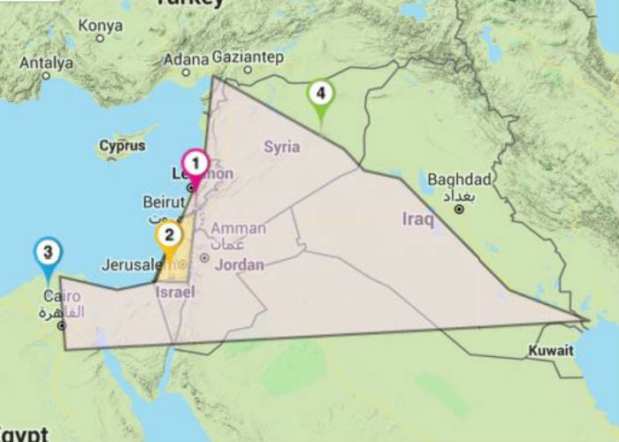
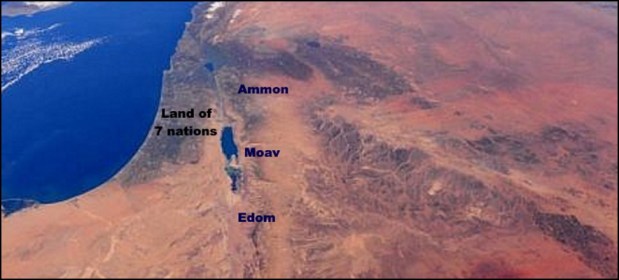
We are promised in the Torah that in the time to come the Jewish people will receive the land of Israel consisting not only of the land of the 7 nations of Canaan but also the land of the three nations of Edom, Moav, and Amon (the Keni, Kenizi and Kadmoni).

This being so, we are confronted with a question: The prophecy of Yechezkiel describes the borders of the land of Israel as they will be in the time to come, but in his prophecy they are clearly defined as being the same borders as were conquered by Yehoshua ‐‐ the land of only 7 nations. His prophecy is about the time to come: why doesn’t he mention the lands of the other 3 nations?

This is also connected to the additional three refuge cities (arei miklat) which we are instructed to establish in those lands. These refuge cities are, in turn, associated with the rectification of Hevel.  Kayin was able to kill Hevel because Hevel was already condemned to death (“chayav misa“) for having “gazed at the shechina” while offering his sacrifice.

Chazal (Sanhedrin, 98a) explain the verse “in its time I will hasten it” (“B’itah Achishena“) as referring to two distinct end times (ketz, plural: kitzin): “if they merit, I will hurry it (Achishena), if they don’t merit, [Hashem will bring the Geuloh] in its time (B’itah)”. If the ketz comes in its last possible moment ‐‐ B’itah ‐‐ all the descendants of Hevel will be rectified. But, if the Jewish people will merit to the redemption before the ketz of the rectification Hevel is completed, then there will be need for refuge cites (arei miklat) for those (descendants of Kayin) who will kill accidentally (but not intentionally).

[Important to note what is explained in Chassidus: that the rectification of the souls that derive from Hevel are the basis of “refining the sparks of holiness”, the “avoidas habirurim“, which the Jewish people accomplish during the time of golus. See also Toras Chayim, Shemos II, 277a.]

Achishena — An Awakening from Below

In order to understand this matter of B’itah and Achishena, we find that chazal say “the woman conceives first and a male is born; the man conceives first and a female is born.” This means that when Knesses Yisroel (the collective soul of the Jewish people) will “conceive first”, which is the aspect of “elevating the feminine waters” (hala’as ma”n) from below to above, like the yearning of the woman for her husband, then this awakening from below will generate the awakening from Above which draws down the masculine waters (hamshachas ma”d) from a very lofty level so that a male will be born, meaning a higher level [than a female].

We are talking here about the avoidah that gives birth to love in the Jewish people, a male child representing “great love” (ahava raba). But, if the man (Hashem) will conceive first, then a female will be born, meaning the aspect of love [of Hashem] in order to receive a reward in Gan Eden (see Likkutei Torah, Tazria, “Sos Tasis“).

So, too, in our case: if the ketz will be via the awakening of Knesses Yisroel, meaning that through the awakening from below there will be an awakening from Above to speed up the matter before its time, which is the aspect of Achishena, then Hashem will widen the borders and we will inherit the land of the Keni, Knizi and Kadmoni. But, if it will be the man conceiving first, meaning the ketz will come due to an awakening from Above in its (pre‐determined) time, then the borders of the land will remain unchanged, as in the prophecy of Yechezkiel, and the lands of the three nations will be left a desolate wasteland.

Refining the Sparks (Avodas Habirurim)

To explain this matter: the shattering of the vessels occurred primarily in the 7 midos of Tohu (the emotions), but not so much in the Kesser, Chochma and Bina (intellect and super‐intellect) of Tohu.  Thus, as regards their rectification, which is the avoidas habirurim performed by the Jewish people down in this world via Torah and Mitzvos, this is performed on the 7 midos.  At the same time, the three dimensions of Kesser, Chochma and Bina of Tohu are being rectified together with them.

According to this, it would be fitting that the Jewish people should inherit these lands when they finish the task of refining the 7 midos of Tohu; however, this depends on the actions of the Jews in this world, whether it will be “in its time” or “I will hasten it” (B’itah or Achishena, which was explained above as dependent on whether there is first an awakening from below). The expression “inheriting these lands” means the revelation of the good found in the aspect of Kesser, Chochma and Bina of Tohu.

[In other words, we have two factors: the avoidas habirurim and the awakening from below. If the avoidah is finished before there is an awakening from below, this is called B’itah. If the awakening occurs before the avoidah is completed, this is called Achishena. This determines the inheritance of the land.]

Inheriting the Land of the 7 or the 10 Nations?

If the good that is in them will be revealed in a tangible way in the Jewish people, then these lands will be considered part of the Land of Israel and this will take place in the simple sense as well. But, if we will not inherit these lands, then the gentiles in those places will (as stated in the prophecies) be wiped out along with the evil that is there, however, the lofty good that is there will not be revealed directly; rather, it will only be revealed through being enclothed in the 7 midos (the land of the 7 nations of Canaan). Which case will take place depends on the actions of the Jewish people down in this world.

If we bring about Achishena, an awakening from below (hala’as ma”n), the woman conceives first: this will cause a drawing down from below (hamshachas ma”d) and the inheriting of the 3 lands of Kesser, Chochma and Bina of Tohu, and the good that has been refined from them will actually shine forth there. Those lands will be considered as part of the land of Israel, and physically the borders of Israel will reflect this.

However, if it will be B’itah, from Above, even though the spirit of impurity will be removed, nonetheless the good in them will not be revealed; rather, it will only appear through being enclothed in he midos, the land of the 7 nations. In such a case, the lands of the 3 nations will be left desolate.

[We could explain that these revelations will not have a vessel in which to be revealed. These levels of lofty understanding cannot be revealed in the regular vessels of intellect which we presently possess.  Thus, they will only be revealed in the midos, like a person who feels strongly attracted to something or feel vehemently against something without understanding the reason.]

Why Yechezkiel Saw a Future of the Land of 7 Nations

Since the expansion of the land of Israel to include the 3 lands is dependent on the ketz being in a way of Achishena (love that derives from an awakening from below, as explained above), this is why Yechezkiel’s prophecy describes only the land of the 7 nations: because he prophesied about the final ketz which is the ketz B’itah where the borders of the land of Israel remain as they were in the days of Yehoshua.

We notice that in the prophecy of Yechezkiel, the land is divided into 13 sections. The question is: how do we arrive at the number 13 when there are only 10 sefiros? The answer is that the 7 midos each possesses 3 moichin (the Chabad of the midos, bringing to 10) and further the Kesser, Chochma and Bina of Tohu are enclothed in them in a hidden way (bringing to a total of 13).

Thus, we see that the prophecy of Yechezkiel is on the ketz B’itah wherein Kesser, Chochma and Bina will be enclothed in the 7 midos in a hidden way, because the awakening is from Above, that the supernal Man conceives first and there will not be an actual inheritance of the 3 lands. But, afterwards, in the days of Moshiach, through the avoidah of Yisroel they will arrive and merit after several years to the aspect of Achishena, inheriting the 3 lands as part of the land of Israel, until the good in Kesser, Chochma and Bina of Tohu will be actually revealed there.

We see from this maamar of the Tzemach Tzedek that if the Jewish people finish avoidas habirurim but still have not had an “awakening from below” on their own, then the Geuloh arrives but they lack the vessels to perceive the lights of Tohu that have been refined from level of Kesser, Chochma, and Bina of Tohu. If this occurs, then they will have to do the avoidah in Yemos Hamoshiach in order to reach the level where they will “inherit the land of the Keni, Kenizi and Kadmoni”, meaning a revelation of the lights of Tohu in a revealed way.

This explains the assertion of the Rebbe that:

  1. Avoidas habirurim has been completed,
  2. We only need shout “ad Mosai”, to open our eyes to see that the Geuloh is here, and
  3. That we are presently found in Yemos Hamoshiach.

Based on the maamor of the Tzemach Tzedek printed in Ohr HaTorah, Bereishis, page 1167 תתשסז

This article in downloadable PDF format

Conquering the 3 Lands Peacefully

Conquering the 3 Lands Peacefully

The Rebbe mentions in the Dvar Malchus of Parshas Lech Lecho that Avraham Avinu is promised by Hashem that his descendants will inherit the land.  Hashem made a covenant with Avraham, stating:  “To your seed I have given this land, from the river of Egypt until the great river, the Euphrates river.  The Keni, the Kenizi, and the Kadmoni, And the Chitti and the Prizi and the Rephaim, And the Amori and the C’naani and the Girgashi and the Yevusi.”  (Parshas Lech Lecho, 15:18-21)

Rashi here points out that “There are ten nations [enumerated] here, but He gave them only seven nations. The [other] three are Edom, Moab, and Ammon, and they are [here referred to as] the Keni, the Kenizi, and the Kadmoni, which are destined to be [our] heritage in the future.”  The seven nations dwelled in the land of Canaan, which was conquered by the Bnei Yisroel when they entered the land with Yehoshua bin Nun.  The other three nations (Keni, Kenizi, Kadmoni) were not ever conquered, and in fact there are verses in the Torah warning the Bnei Yisroel “Do not distress Moav and do not provoke them to war…”, “When you approach opposite the children of Ammon, neither distress them, nor provoke them…”  In the time of golus these lands and nations who live in them are not to be provoked because Hashem says “I will not give you any of their land [as] an inheritance” until the time of the true and complete Geuloh.

These lands and the nations who dwell in them are described in the teachings of Chassidus: the seven nations (lands) correspond to the seven emotional character traits (midos) of the animal soul which must be conquered and then transformed from evil to Holiness.  The three nations/lands refer to the intellect (Wisdom and Understanding, Chochma-Bina) and the super-intellect (Crown, Kesser).  The avoidah of a Yid in the time of golus was focused on conquering the land of the seven nations, the midos of the animal soul.  Only after we have finished refining the midos can we begin to take possession of the other three lands, referring to the intellect.  We have already posted how Chassidus explains this process in the post entitled The 3 Nations and Geuloh.  Here we will present what the Rebbe says is the avoidah in the present time regarding the three additional lands of the Keni, Kenizi, and Kadmoni.

In section 12 of Dvar Malchus Lech Lecho, the Rebbe refers to “avoidas haMoichin“, the avoidah of the intellect, as being connected with taking possession of the three additional lands.  This is an avoidah which is relevant only at the end of golus, since until now we were busy with the midos.  In fact, even the intellectual labor in Torah that took place until now was for the purpose of influencing the midos.  However, in the Time to Come there will be intellectual labor for its own sake, “to unify with Elokus via the complete unification (“a wonderoud unity”, Tanya ch. 5) of the individual’s intellect with the Torah (Hashem’s wisdom, which is one with Him).  Via the fact the Torah and the Holy One, blessed be He, are all one, it will be revealed that Yisroel, the Torah, and the Holy One, blessed be He, are all one.”

At present we only have a revelation of the intellect in Torah as it relates to the midos (49 gates of wisdom, מ”ט שערי בינה).  In the future, there will be a revelation of the three intellectual attributes as they are in their essence (the 50th gate, שער הנו”ן).  The Rebbe takes notice that the names of these three nations all start with the letter Kuf (ק) which has a leg the goes below the line.  This hints at these lofty levels coming all the way down to this mundane world.  The Rebbe then tells us that the avoidah that is connected with this is to reveal chiddushim in Torah.  By doing so, the individual reveals hidden powers of his soul, including the essence of his intellect, his moichin b’etzem.  At this point there is a footnote that references the sicha the Rebbe said on the night of the 8th of Marcheshvan, a few days before Shabbos Lech Lecho. (Listen here.)

In the sicha of 8 Marcheshvan,  the Rebbe elaborates on the subject of avoidas haMoichin and taking possession of the lands of the three nations in our days.  Firstly, the Rebbe says that “it is incumbent to make an effort that already now there will be the avoidah which is a foretaste and example and preparation for the avoidah that will be in the true and complete Geuloh.”

 What is this avoidah?

There needs to be an effort and an increase mainly in the learning of Torah that is related to the time of the Geuloh — learning Torah that speaks about Moshiach Tzidkeinu and the true and complete Geuloh.  And more, and a main thing: an increase in learning Pnimiyus HaTorah in a way of understanding and grasping [the material] unified with the revealed dimension of Torah — one Torah.  And not just the first period of Yemos Hamoshiach, but also the second period.  [See The 3 Nations and Geuloh].  And more specifically — an increase regarding the “seven nations” which we were already given … the avoidah of the seven midos and also the avoidah of the three moichin

Since we are found truly close to the true and complete Geuloh, there needs to be a sampling and example and beginning of avoidas haMoichin as they are by themselves — via the learning and effort to fulfill in actuality the matters connected with avoidas haMoichin, even if not related to avoidas haMidos

This avoidas haMoichin means learning deep concepts of Chassidus (such as in the teachings of the Mitteler Rebbe).  The Rebbe says that all of this increase in learning (which will surely lead each one to the new unique insights (chiddushim) which the Rebbe asked for) will bring “broadness” (רחבות) in the learning and also in material matters, that “with only a small effort with one finger” he can receive his parnosa from Hashem.

Additionally, the Rebbe says to add in joyous Chassidishe farbrengens in which the participants will discuss matters of Pnimiyus HaTorah in a way of broad understanding and grasping the material.

And what does all of this accomplish?

Additionally, and this is the main thing — via this we speed up and hasten and bring about immediately that all of Bnei Yisroel will go to our Holy Land, “a great congregation will return here” — to the land of ten nations. 

To summarize: the Rebbe is telling us that since avoidas haBirurim is finished (as mentioned many times in Dvar Malchus) and everything is ready for the Geuloh, we must begin acquiring the complete land of Israel — the land of all ten nations — by beginning to be involved with avoidas haMoichin by adding in all the aspects of Torah that the Rebbe mentions (adding in learning the subjects of Moshiach and Geuloh, and adding in learning Chassidus as it shows itself united with the revealed dimension of Torah, and adding in learning deep subjects in Chassidus).  This represents our first steps into the avoidah of the future, an example of what the Rebbe is telling us throughout these sichos: by beginning to conduct our lives in a way that is fitting with the Geuloh, we speed up the revelation that the Geuloh is really here with us already.  It is primarily a switch in our perception, understanding, and outlook — the intellectual avoidah of bring into reality the Geuloh!


Noach 5752: Geuloh is Dependent Only on Moshiach Himself

Noach 5752: Geuloh is Dependent Only on Moshiach Himself

The chosid R’ Zushya Willemovsky, “The Partisan”, was told by the Rebbe in a private audience in the 1960s that there remained 20 or 21 things that needed to be accomplished in order for Moshiach to come.  From this we learn the significance of the sichos of Dvar Malchus in general, and parshas Noach in particular — that everything has been accomplished and nothing is preventing the Geuloh.

In this sicha, the Rebbe speaks about the importance of periodically making a proper spiritual accounting (cheshbon tzedek) to search out a recognize the areas in ourselves which need improvement, even things that are very slight imperfections (such as causing someone to feel bad because we didn’t return their greeting(!)).  This should be done with joy, with recognition that it is easier than ever to rectify these matters because the Jewish people, who are like one body, “are found in a state of an individual who is healthy in all of his limbs and organs, both spiritually and physically, and thus anything that is lacking is likened to a weakness or a minor illness in one limb which can be healed quickly and easily”.

Furthermore, when a person takes stock of himself and recognizes that he has flaws and failings which need to be rectified, “this is not a contradiction, G-d forbid, to the testimony of the Leader of the Generation that the work has already been completed and we are standing ready to receive Moshiach Tzidkeinu.”  Yes, we need to search these things out, and upon identifying them to rectify them, but these things do not delay Moshiach’s coming.

Dependent Only on Moshiach Himself

“With absolute certainty all the ‘end times’ have passed, and [the Jewish people] have already done tshuva, and now the matter is not dependent upon anything other than Moshiach Tzidkeinu himself!  (Italics in the original.)  Towards the end of the sicha the Rebbe repeats: “…when we do a proper accounting at  the end of the first week of the year 5752, “it will be a year with wonders in it”, we come to the conclusion that the matter is not dependent upon anything other than Moshiach Tzidkeinu himself (as stated above)…”

It might seem that the implication of these words is that we have done all that we can do, now all that remains would be to wait for Moshiach to decide when to reveal himself.  However, this sicha was preceded a half a year earlier by the famous sicha of Chof-Ches Nissan, 5751, where the Rebbe told the Chassidim that he had done everything he could do, all that remains is to give it over to us to bring Moshiach.  (Several days later a woman passed by the Rebbe for dollars, crying that we were counting on the Rebbe to bring Moshiach, to which the Rebbe answers “it must be done by Klal Yisroel, you included, and this person included, and that person included…”)

This means that we need a different way to understand the expression “the matter is not dependent upon anything other than Moshiach Tzidkeinu himself” — since the Rebbe clearly has put in the hands of the Jewish people to “do all that you can” to bring Moshiach in actuality.  Meaning that it is clearly not the Rebbe’s intention that we stand around demanding of Moshiach: “reveal yourself!”  If that’s the case, that it’s not enough to wait patiently (or, even impatiently) — then what is implied by the matter being dependent upon Moshiach himself?

We can better understand this expression in light of the words of the Rebbe in the sicha of Chayeh Sara (three weeks after this parshas Noach) in which the Rebbe describes the chiddush, the change in the shlichus which becomes the new gateway for the rest of the efforts of shlichus, namely: to accept Moshiach Tzidkeinu in the true and complete Geuloh.”  (Italics in original.)

ACCEPTING HIM AS KING

 This sheds light on the expression in our sicha, “that the matter is not dependent upon anything other than Moshiach Tzidkeinu himself ” — it is not that we are waiting for Moshiach to do something, since we already know that we are the ones who have to do (“do all that you can“).  Rather, the statement comes to tell us what it is that we need to do, that our efforts to bring Moshiach pertain to Moshiach himself: to accept this individual as Moshiach, to make him (personally — my, and collectively — our) King.  What the King commands, his subjects fulfill without question (and without checking first with the nefesh habehamis to see if it’s comfortable).  As understood from the midrash that is brought in Chassidus about the the nation who requested a certain individual to be their king.  He responded simply: accept upon yourself to fulfill my decrees, then I’ll accept to be your king.

Everything else has been done, the road has been paved to Moshiach.  Now, all that remains is the acceptance of his Kingship by the people.   Real acceptance, by each one of us, like a subject to a king (an inner change which goes beyond the slogans).  This is what will “flick the switch” to the true and complete Geuloh!

Noach “Saw a New World”

Noach “Saw a New World”

The opening verse in Parshas Noach says that “נֹ֗חַ אִ֥ישׁ צַדִּ֛יק תָּמִ֥ים הָיָ֖ה בְּדֹֽרֹתָ֑יו” “Noach was a righteous man, he was perfect in his generations”.  The Midrash on this posuk (Midrash Rabba Noach, 30:8) says in the name of R’ Levi: “Whoever it is said about them ‘he was’ saw a new world.”  The Midrash then enumerates five individuals, the first being Noach, citing that when he and his family exited the ark, they saw a new world.

In what sense did Noach see a new world?  Obviously, it was the same Earth, although following the waters of the flood surely the surface of the Earth looked different than it did previously.  And of course, the evildoers who populated the Earth previously were no longer around.  But can we really say that this is what it means to see a “new world”?

The Rebbe, in the sicha of Noach 5752, clues us in to what is being implied here according to pnimiyus haTorah:

In the creation of the world, the Torah refers to Hashem using two names: YKVK and Elokim.  YKVK is G-dliness that is above the world.  Elokim is the name which indicates concealment, allowing independent-feeling worlds to come into existence.  In the words of Tehillim: “The Sun and a shield [these are the names] YKVK [and] Elokim”.  The name YKVK is the emanation of worlds, the infinite “light” of the worlds, and Elokim is the “shield” or “filter” that conceals the light in order that finite worlds can come into existence.

“That in the reality of the world as it is created via the name Elokim is revealed the name YKVK, until it is recognizable in a revealed way that “YKVK is Elokim” (הוי’ הוא האלקים), that in truth the contraction and concealment (Elokim)  are really the name YKVK. הצמצום וההסתר (אלקים) הוא לאמיתתו שם הוי-ה

(Sicha Parshas Noach, 5752)

Meaning that the world is still the same world that was created via the name Elokim, only that it becomes revealed that really even this name Elokim is just a reduction of the light of YKVK, but not something independent or separate.

So the “new world” that Noach saw was not a new form of creation, but a new perception: he could now perceive how the world of Elokim is really a world of YKVK.  It was recognizable and revealed to him.  He saw the same world but in an entirely new way, thus he saw a “new world”.

We can use this to understand many things the Rebbe is trying to tell us in these Dvar Malchus sichos, giving us the tools to “open our eyes”, including the subject of last week’s sicha regarding “servitude to the nations”.  Over there the Rebbe explains how there is servitude to the nations in the time of Golus, but that this servitude does not extend to our neshomas, nor to our bodies as regards matters of Torah and mitzvos.  And even those things where we must follow the law of the land because “dina d’malchusa dina” (the law of the land is the law) is not because we are in servitude to the nations of the world, but because this is how Hashem wants it to be in the time of Golus.

In those short paragraphs, the Rebbe has opened our eyes to a “new world”: a world where there is no servitude to the nations, which is the definition of (the first period of) the Days of Moshiach!  In other words, if one is in a personal Golus and in fact believes that the Jewish people is in servitude to the nations, then in fact he is in such a state, r”l.  But when one internalizes what the Rebbe says there, he discovers that not only our neshomas and our bodies (as regards performing Torah and Mitzvos) are not in servitude to the nations, even those areas where we do go according to their decisions (monetary matters and the like) — this is not due to any form of “servitude” but rather it is Hashem’s will!  So by following civil monetary law, we are in fact fulfilling Hashem’s will no less than in other halachic matters!  Externally, it is the same Golus, but the Rebbe has given us the tools to “see through” the darkness of Golus and realize that the concealment of the name Elokim (Golus) is really coming from YKVK — a new world!

This is one example of many to be found in Chassidus in general, the Rebbe’s teachings in particular, and the Dvar Malchus sichos most especially.  By making these changes in our perception and understanding of the world, we place ourselves in a state of Geulah even while the world “continues in its natural way”.  This is the beginning of Yemos Hamoshiach, each one coming to the realization based on his own efforts to internalize these concepts.

Bereishis 5752: Servitude to the Nations is Finished

Bereishis 5752: Servitude to the Nations is Finished

The Rambam, in his “Laws of Kings and Their Wars and Melech HaMoshiach”, declares that the coming of Moshiach and the process of redemption are not dependent upon the miraculous: “Do not expect that in the Days of Moshiach the pattern of conduct of the world will change, but rather the word will conduct itself in a normal manner…”  “Our sages have taught that there is no difference between this world and the world to come other than servitude to the nations.” (Chapter 12)  This means to say that even in the Messianic Era (the first stage), the world continues to go in a natural way, however the Jewish people are no longer in a state of “servitude” to the nations as they were during golus.

In this sicha, the Rebbe explains how the Jewish nation was chosen by Hashem and thus the entire Creation exists for the sake of the Jewish people. The truth is that the nations of the world do not truly hold sway over us (“servitude”).

Even though the Jewish people in exile are found in a state of “servitude to the nations”, and there is a command in the Torah “the law of the land is the law” (dina d’malchusa dina)…the reason is not due to fear of the nations of the world (at the time of exile) G-d-forbid, but quite the contrary: Jews are the primary thing (reishis) and the nations of the world were created for their sake… the reason is that this is the way the Holy One, blessed be He, ordered things, that this is how things need to be in the time of exile.

Although in certain matters (monetary cases, taxes, and the like) “the law of the land is the law”, yet this does not infringe upon matters of Torah and Mitzvos, of the neshoma, and also does not infringe on the bodies and the physicality (and materiality) of a Jew, for he always remains primary (reishis) and above the nations of the world.  The command that “the law of the land is the law” is not because he is in a state of servitude to the nations of the world, but because this is what Hashem decreed to be the state of affairs in exile (“because of our sins [we were exiled from our land]”).

In other words, the Rebbe is stating that we are not now in a state of servitude to the nations in any respect.  This was in fact always the case, however it is clear that the Rebbe is indicating that a new threshold has been reached: while the Jewish people have always been in essence above servitude to the nations, this was not something that was perceptible in the world (a world of persecution and suffering for the Jewish people, both materially and spiritually).  But now it is possible to recognize that despite that we and the world still operate in the natural way, the Jewish people are not in a state of servitude to the nations of the worlds.

This is evident in a simple sense (freedom to fulfill Torah and Mitzvos in every country where Jews live), as the Rebbe points out in the sicha.  It can also be understood as referring to something deeper (and not explained explicitly in the sicha).

According to Chassidus, the “nations of the world” (which are numbered as 70 according to Torah) refer to our midos, our natural responses to what we understand according to our human intellect which is informed by the physical world we inhabit.  Servitude to the nations of the world, according to Chassidus, means that a person cannot escape the feelings and emotions generated by his worldly outlook.  To be free of servitude to the nations means: although one still perceives the world as operating in the natural manner (according to “nature” rather than Torah) one is not bound to this perception, and in fact one is free to understand things according to Torah and to have feelings and emotions generated by Torah rather than the “way of nature”.

As an example: a person has a lack of income, the “nations of the world” tell him that he must cut down on the amount he gives to tzedaka, and work more hours, including on Shabbos, G-d-forbid, in order to generate more income.  The Torah says that he should increase the amount he gives to tzedaka and to be careful not to work on Shabbos.

Servitude to the nations of the world means that even though he knows what Torah says, nonetheless he feels forced to cut back on tzedaka and to work on Shabbos — he is enslaved to the outlook of the natural world.  To be freed from this servitude means that not only does he not feel “forced” to do these things, but on the contrary he can actually feel the need to give additional tzedaka. He has been liberated from the natural perspective, even though he continues to perceive the world as operating in a natural manner.

We still see a natural world, but we are now free to relate to that world in the way that Torah instructs — without feeling compulsion from the nations of the world (from without or from within).  This is the first stage of the Messianic Era.

Kuntres Beis Rabbeinu Sh’b’Bavel: The Place of the Beis Hamikdosh in Golus

Kuntres Beis Rabbeinu Sh’b’Bavel: The Place of the Beis Hamikdosh in Golus

“I will be for them a small sanctuary (mikdash me’at) in the lands where they will come.” (Yechezkiel 11:16)

Our sages explain this psouk to mean that even outside of Eretz Yisroel, in the place and time of golus, there is a “small mikdash” which is a scaled-down example of the “great mikdash” in Yerushalayim.  Rebbi Yitzchok in the gemora (Megillah 29a) said that these are the shuls and study halls in Bovel (Babylon), and Rebbi Eliezer said that this is “Beis Rabbeinu sh’b’Bovel” — “the house of our Rebbe in Bovel”.

The Rebbe, as might be expected, holds that these two sages do not have an argument, that each one surely agrees with the opinion of the other; the only difference is what they consider to be the main and most important fulfillment of the prophecy of “mikdash me’at“.  Rebbi Eliezer holds that it is the study hall (place of learning) and shul (place of Tefilla) of “Rabbeinu”.  Every shul possesses this quality in a small measure, but the primary and most complete manifestation of it is in the shul and study hall of the Rav whose Torah decisions are followed by the people of the city.  And, in a fuller sense, there is one place which is the main “mikdash me’at” in the time of golus: the shul and study hall of the leader of the generation.

Our sages state that “Everywhere that Yisroel were exiled, the Shechina was exiled with them.”  The sages in our gemora asked where in Bovel is the Shechina to be found?  Abaye answered: in the shul of Hutzal and the shul of Shaf v’Yosiv in Nehardea — sometimes here and sometimes there.  These were two unique shuls in Bovel, the first being close to the study hall of the revered Ezra the Sofer, the second being built from stones that were brought from the Beis Hamikdosh in Yerushalayim and “the Shechina was always found there” (Rashi).   It called “Shaf v’Yosiv” (meaning “uprooted and [re]settled”) to indicate that “the Mikdash travelled and settled there”.  It was literally the Beis Hamidkash of that generation, as “the revelation of the Shechina that was in the Beis Hamikdosh in Yerushalayim (and nowhere else) traveled and settled in this special place in Bovel, in place of the Mikdash in Yerushalayim.

Of course, the Shechina dwells in every shul where Jews gather for Tefillah, and every study hall where they learn Torah, but nowhere is the Shechina more revealed than in the Beis Hamikdosh in Yerushalayim, or (in the time of golus) in these special buildings.   Similarly we find that “in the future the shuls and study halls of Bovel will be established in Eretz Yisroel” — this is true of every shul and study hall, all of which will be connected to the Third Beis Hamikdosh in Yerushalayim.  And when these places are relocated to Eretz Yisroel, the revelation of the Shechina will also return to Eretz Yisroel, and there will no longer be a revelation of the Shechina outside the land of Israel where the “mikdash me’at” stood.  The Rebbe adds (quoting the Maharsha): Continue reading