What is easier: keeping a powerful beast like a cow or a bull locked up in it’s pen, or a bird? Which requires “additional guarding”?
Although a bird possesses nothing of the power that the bull has, it has an additional ability that even the most powerful beast lacks — the power of flight. Thus, fences are sufficient to keep a mighty bull locked up, but a tiny bird is not properly guarded unless the walls are capped by a roof.
In Halocho this expresses itself in the laws regarding courtyards — that a large courtyard that is not covered by a roof is considered a carmelis (by Rabbinic decree, even though according to Torah it is a private domain (reshus hayochid)), but if it is covered with a roof then it remains a private domain according to Rabbinic opinion as well.
The maamor printed for 18 Nissan, 5751 (anniversary of the Rebbe’s Bris Mila) explains this in terms of our Divine service: the animal for which fences are sufficient is our animal soul; the bird that requires a roof is our Intellectual Soul (Nefesh Hasichlis). The animal soul, while powerful, has four legs on the ground and looks down — it’s only attraction and interest is gashmiyus. It is enough to build fences to pen it in. But the Nefesh Hasichlis, while it is a human intellect which relates to worldly things, possesses an inclination to “fly away” to contemplate things which are of a higher nature. Thus it needs a roof as well.
This discourse of the Rebbe was edited and printed for distribution for the Rebbe’s birthday, 11 Nissan, 5751. A lengthy and deep discourse, we mention here only the main points, reflecting the themes of the Dvar Malchus sichos from the same period.
“Tefilla leMoshe” is called by our sages the prayer of a rich man, and “Tefilla leDovid” is the prayer of a poor man. Since tefilla is defined as our asking for our needs, what is a rich man’s prayer? What does he need?
We find that according to Torah one must fill the needs of the poor man. This doesn’t only mean those necessities required by every person, it means we are obligated also to fill his personal needs. If he had previously been wealthy and was accustomed to a servant and a horse to run before him, then for him such a thing is lacking and we must provide it for him. One is obligated to fill what he lacks, but one is not obligated to make him rich. Thus, it comes out that even having a servant and a horse running before him (i.e. to be not lacking anything) is still not wealthy.
Wealthy, explains the Rebbe, is “superabundance”, which is more than just that nothing is lacking. Furthermore, it means that this abundance is not received from another source (and thus could be cut off or taken away); rather, it is inherently his — making him rich in essence (עשיר בעצם). This is why our sages say “there is no one wealthy except in da’as (knowledge)”. Rich (in knowledge) means that what he has learned has become unified with him and part of him as a result of his own effort (as opposed to remaining on the level of what others taught him).
Back to the question: one who is rich has superabundance — what, then, is his prayer?! The Rebbe answers: Continue reading →
A Chassidic discourse (maamor) was edited by the Rebbe and published in honor of the Hillula of the Rebbe Rashab, Beis Nissan, 5751. This was the day after Shabbos Vayikra, the very beginning of the cycle of Dvar Malchus. We are going to extract a small section of this maamor which stands out boldly as a descriptive explanation of the sharp and shocking words of the Rebbe on 28 Nissan (a few weeks after this maamor was released): “I’ve done all I can do, now I give it over to you to do all that you can do to bring Moshiach in actuality”.
The section of the maamor we will look at states as follow:
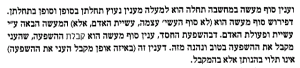
The Rebbe Rashab explains the difference between two inyonim: “its beginning is wedged into its end and its end into its beginning” (נעוץ תחילתן בסופן וסופן בתחילתן) and [the similar expression that] “the end of the deed was first in thought” (סוף מעשה במחשבה תחילה). The difference between them is that “it’s end” (סופן) refers to the end and completion of the thought, wedged into the beginning of that which is being given (ההמשכה). And a moshol is brought for this from the giving of tzedaka. That the beginning (of the giving) is the mercy (רחמים) that is awakened towards the poor man.
The concept that “its end is wedged into its beginning” is that the main intent in the awakening of mercy (“its beginning”) is that there should be actual giving to the poor man (“its end”). And if there will not be any actual giving, then the main thing is lacking. Its end is wedged into its beginning: the intent (of giving) which is wedged into its beginning (the awakening of mercy (רחמים) for the poor man)….
The inyan of “the end of the deed was first in thought” (סוף מעשה במחשבה תחילה) is higher than the inyan of “its beginning is wedged into its end and its end in its beginning” (נעוץ תחילתן בסופן וסופן בתחילתן). This is because the meaning of the expression “end of the deed” (סוף מעשה) is not the end of the act of performing the deed itself, the action of the person. Rather, it means the action that comes as a result of the actions performed by the person. In our moshol, the giving of chesed: the “end of the deed” (סוף מעשה) is when that which is being given is accepted — that the poor man should accept that which is being given to him with a good feeling (מקבל את ההשפעה בטוב) and that he should benefit from what he received.
This aspect — the manner in which the poor man accepts that which is given to him — is not dependent on the giver, but rather on the recipient…. Thus, the pleasure that the giver has from the acceptance of what he gives (the poor man accepting with a good feeling that which he has been given) is a greater pleasure than the pleasure from the “giving” alone.
This brief moshol, when we take a moment to contemplate what it is telling us, resolves a lot of questions. It also eliminates much of the anxiety raised by the sicha of 28 Nissan (which has been magnified by the state of affairs we find ourselves in for over 20 years, ר“ל, when do not receive new sichos or maamorim).
View the Rebbe’s renown sicha of 28 Nissan in light of this kuntres. The Rebbe telling the Chassidim “I have done everything in my power to do”, corresponds to giving to the “poor man”.* Having succeeded in completing the act of giving, he now has to wait until “the poor man should accept that which is being given to him with a good feeling and to benefit from it”, because “this is not dependent on the giver, but rather on the recipient”.
The Rebbe is sharing with us a most vital piece information: you, the Jewish people, have been given everything you need! It’s the reality: “the money is in the bank,” and the Geuloh is in the bank! But it is up to you yourselves to accept it, to realize what you have received, to put it to good use and benefit from it!
All the sichos and maamorim the Rebbe spoke, all the seforim the Rebbe instructed to print, all of the brocha and hatzlocha, guidance and direction that the Rebbe has poured and continues to pour on the Jewish people and the world…this is not just a coin in the poor man’s cup — this is true wealth!
But as long as it remains in the cup (and all the more so if we don’t realize that it’s even there), then we remain in a golus of poverty — poverty in our own perception of reality. We need to accept what the Rebbe has given us, put it to use in shaping our reality, and in this way we ourselves will realize that not only do we have the potential to no longer be poor, but that we are in fact rich in actuality — the true and complete Geuloh!
The matter was given over to us by the Rebbe and is completely in our hands! So, now, let’s ask ourselves the question: Ad mosai?!!
* We should note that in Kuntres Yud Alef Nissan, the maamor printed for the Rebbe’s 90th birthday, the Rebbe explains that the Jewish people are not really poor except in awareness, and the “prayer of the rich man” (Moshe Rabbeinu) is that the Yidden should realize that they are in fact rich. Nonetheless, one who sees himself as poor really is poor — “there is no poverty except for knowledge” (איו עני אלא בדעת).
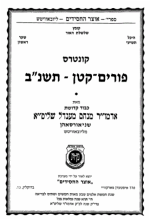
This Maamor was distributed by the Rebbe himself on Purim Koton, 5752, less than two weeks before the dramatic event of 27 Adar I (“Chof Zayin Adar“), making this the “last” Kuntres (so far) that the Rebbe distributed. Combined with the tremendous chiddushim of the maamor, it has earned a special status as a clear guide for how to proceed in our efforts to bring about the true and complete Geuloh.
The Maamor is based on a maamor that the Previous Rebbe said in Russia (“V’kibel HaYehudim”, 5689), and comes to explain the opening verse of Parshas Tetzaveh:
And you shall command the children of Yisroel, and they shall take to you pure olive oil, crushed for luminary, to kindle the lamps continually.
The Rebbe asks a series of questions on this verse:
Why does the verse state “You (Moshe) shall command…” when Hashem is the One who commands and Moshe is only the Shliach to carry out the command?
Why does it state that the Bnei Yisroel should bring the pure olive oil (for the lighting of the Menorah) to Moshe when the Menorah is lit by Aharon haCohen and not Moshe?
Why does it state “crushed for the luminary”, when we would expect it to say “for the light”?
Why does it state “to kindle the lights continuously” when in the very next verse it states “from evening until morning”?
In the course of answering these questions, the Rebbe will reveal some astonishing chiddushim that serve as a guidepost for our avoidah in this period.
This maamor begins with the verse of parshas Mishpotim: “These are the statues that you shall place before them: if you will acquire a Hebrew servant…”. The Talmud Yerushalmi says that statues the verse is referring to are the secrets of Torah. This raises a question, since the term “mishpotim” refers to the basic statutes of the Torah which the human mind can grasp (including the nations of the world), but not the Torah’s hidden secrets. Furthermore, what is the connection with acquiring a Hebrew servant?
The defining element of a Hebrew servant is his acceptance of the yoke of servitude: his kabbolos ‘ol. The reason this appears at the beginning of the Torah’s many “mishpotim” (statutes understood by the human mind) is to hint even when we fulfill the Torah’s laws which we understand — we must be fulfilling them [as well] out of kabbolos ‘ol, like a servant who does what he is told without understanding. After all, the main thing about these laws is that they are the Will of Hashem, and Will is above reason and understanding. But haven’t we defined the mishpotim as laws which our mind does understand? In fact, it is not a contradiction: Continue reading →
Note: This Maamor is NOT based on the chapter of Bosi Legani that we learn this year. (Unless you are reading this in the year תשצ”ב)
For 40 years the Rebbe would say a Chassidic discourse on one of the 20 chapters of the last maamor (Chassidic discourse) written by the Frierdicker Rebbe, entitled Bosi LeGani. Every year at the Yud Shevat farbrengen, the Rebbe would say a maamor (sometimes more than one) on that year’s chapter. Beginning from 5749 the Rebbe did not say a new maamor, instead an edited version of a maamor on that year’s chapter was printed. The cycle started again in 5751 (addressing chapter 1) and the maamor printed in 5752 can be expected to have added significance, as it was released during the year of Dvar Malchus sichos. In fact, when looked at in this light one indeed finds a message that fits with the unique chiddushim of 5751-52.
A general point: the edited version of a maamor is often significantly different from the way the Rebbe originally said the maamor. In some instances, the edited maamor is so different from the original that it presents a completely opposite perspective. (For example: the Rebbe once said a maamor in which the he spoke about the superiority of Torah over Mitzvos; when edited and published, the maamor addresses the superiority of Mitzvos over Torah!) In the maamor published for Yud Shevat 5752, it is noteworthy to point out that the relevant “chiddush” is not explicitly stated in the original, unedited version of the maamor which the Rebbe said in 5732 (which can be viewed here), but when edited in 5752 the Rebbe saw fit to state it clearly. The matter is as follows:
One who has been following Dvar Malchus, or has learned the Rebbe’s sichos and maamorim from all the years, is likely familiar with the concepts of the revelation from Above as opposed to the effort we make from below. In this maamor, this is associated with Matan Torah (from Above to below) and the Mishkan (the vessel for receiving the revelation of Elokus). The Rebbe explains that “this that Hashem desired to have a dwelling place down below (“dira b’tachtonim”) is that there will be a revelation of Elokus below via the avoidoh of human beings.” Thus, the main element is the Mishkan (and Mikdash), where the avoidah of korbanos takes place.
The Mishkan (and by extension, the Mikdash) has two distinct stages. The first is the making of the Mishkan (עשיית המשכן), the second is the avoidah which takes place in the mikdash — the Continue reading →
The Kuntres printed for Hey Teves (ה’ טבת) in the year 5752 is a Chassidic Discourse the Rebbe said on parshas Vayigash, 5732, edited for publication under the supervision of the Rebbe himself. The discourse explains some deep concepts in Chassidus, which we will not attempt to explain here; rather, we will take one point in the discourse.
The parsha begins with Yehuda approaching Yosef. As is known, Yosef was dressed as an Egyptian, his brothers had no idea that this was their brother that they had sold into slavery so many years earlier. This “Egyptian” was demanding that their brother Binyomin remain with him as a slave, because of the “theft” of his goblet (which Yosef himself orchestrated). Yehuda fearlessly approaches Yosef and asks — and even demands — that the “Egyptian” let Binyomin return to his father (of whom he says “his soul is bound up with his soul”) and enslave one of the other brothers in his place.
This act of selflessness on the part of Yehuda represents the rectification of the original sale of Yosef, as is known. But as explained according to Chassidus, there are even loftier things occurring here.
The lofty level of the Chanukah lights, as explained in the teachings of Chassidus, is connected with the self-sacrifice of the Maccabees, and through this they succeeded to impact and “light up” the public domain (reshus harabim). We see this in the mitzvah of Chanukah candles, which are intended to publicize the miracle specifically in the public domain. (The reason that the custom is to light inside the home, not in the public domain, is beyond the scope of this post.)
But why is this only by Chanukah, and not by Purim? The miracle of Purim, also, was brought about by self-sacrifice. Furthermore, Chanukah came about through the self-sacrifice of only a small number of Jews — Mattisyahu and his children; but by Purim the entire Jewish people head self-sacrifice! So why don’t the mitzvas of Purim impact the public domain?
This maamor, originally spoken on Yud Tes Kislev 5726, is based on the familiar posuk “Podah v’sholom nafshi“, but it provides a completely different perspective than the maamor released a week earlier (for 10-14 Kislev, 5752). Here, the Rebbe explains according to the words of our Sages that Hashem states: “whoever labors in Torah and in acts of Kindness (Gemilus Chassodim) and davens with the community, I consider it as though he redeemed me and my children from the nations of the world.”
Firstly, the Rebbe groups them as two: Torah and Gemilus Chassodim drawing down from Above, and Tefillah rising from below to Above. The Rebbe describes the difference between Brocha (drawn down from Above) and Tefillah (from below), based on the verse “Your Chassidim will bless you” חסידיך יברכוך as explained by the Rebbe Rashab: that specifically Chassidim have the power to draw down brocha in a way that the Divine light illuminates Malchus (the lowest level, which “possesses nothing of its own”).
The advantage of a brocha (generally given by Tzaddikim) is that it Continue reading →
Famous are the numerous maamorim over the years explaining the posuk “Padoh v’sholom nafshi“, the posuk which the Alter Rebbe was reading when he was notified of his release from Russian prison on Yud-Tes Kislev, 5559. This posuk is also relevant to the release of his son, the Mitteler Rebbe, from arrest on Yud Kislev some 28 years later. The maamor in this kuntres was said on Yud Kislev 5722 (the 3rd maamor of that farbrengen!) and edited and printed in 5752 in honor of that date (and also in honor of Yud-Daled Kislev, the Rebbe’s wedding anniversary).
The verse states: “He redeemed my soul with peace from the battle that came upon me, because the many were with me.”
The common thread in almost all of the maamorim, beginning with the maamor of the Mitteler Rebbe, focuses on the concept of being redeemed from battle in a way of peace, which is seemingly an oxymoron — if there is peace there is no battle! The explanation is that in fact there is a battle: a battle between the nefesh Elokis (our G-dly soul) and the nefesh habahamis (our animal soul). One may attempt to overcome his nefesh habahamis using his intellect (the lower levels of his nefesh Elokis: Nefesh, Ruach, Neshoma), or overpowering it with force of will, ratzon (from the level of Chaya), but in all these cases the nefesh habahamis can fight back with its own intellect and force of will — a battle. Only when one reveals his yechida, the highest level of his soul, can he nullify the struggle of the nefesh habahamis and thus win the battle “in peace” — “Padoh v’sholom”.
In this maamor the Rebbe explains that there are two aspects of “sholom” (בשלום — ב’ שלום): from Above to below, and from below to Above. When there is a revelation of Ohr from Above which Continue reading →





 Dvar Malchus 770