In the sicha related to the 4th yahrtzeit of the Rebbetzin Chaya Mushka (Chof-Beis [22] Shevat, 5752), the Rebbe reveals amazing things about this event, the date it took place, and what these mean for us.
The date of the Rebbetzin’s passing is found in the same month two other epochal events: Yud Shevat, the Hilulla of the Previous Rebbe, and Yud-Alef Shevat, the day when the Rebbe MHM officially accepted leadership and inaugurated the 7th generation — Dor Hashvii. The Rebbe explains the deeper significance of these events on these dates, and how they relate to the Geuloh.
First of all, while we generally view the Rebbetzin as the Rebbe’s wife, the Rebbe in this sicha identifies her primarily as the daughter of the Previous Rebbe. Her passing comes as a continuation of, and an addition to, the great elevation that occurred on her father’s Hilulla, Yud Shevat.
To give us insight as to what is going on “behind the curtains”, the Rebbe explains that there are two dimensions of a “dwelling place in the lower realms” (דירה בתחתונים): Continue reading →
This maamor begins with the verse of parshas Mishpotim: “These are the statues that you shall place before them: if you will acquire a Hebrew servant…”. The Talmud Yerushalmi says that statues the verse is referring to are the secrets of Torah. This raises a question, since the term “mishpotim” refers to the basic statutes of the Torah which the human mind can grasp (including the nations of the world), but not the Torah’s hidden secrets. Furthermore, what is the connection with acquiring a Hebrew servant?
The defining element of a Hebrew servant is his acceptance of the yoke of servitude: his kabbolos ‘ol. The reason this appears at the beginning of the Torah’s many “mishpotim” (statutes understood by the human mind) is to hint even when we fulfill the Torah’s laws which we understand — we must be fulfilling them [as well] out of kabbolos ‘ol, like a servant who does what he is told without understanding. After all, the main thing about these laws is that they are the Will of Hashem, and Will is above reason and understanding. But haven’t we defined the mishpotim as laws which our mind does understand? In fact, it is not a contradiction: Continue reading →
This sicha focuses on the 10 Commandments (“Aseres Hadibros“) and their connection with Hashem’s desire for a “dwelling place down below” דירה בתחתונים.
There are two versions of the Dibros: those spoken by Hashem (in parshas Yisro), and those repeated by Moshe Rabbeinu in parshas V’eschanon. The Rebbe refers to them as the “first Dibros” and the “last Dibros”. Each version expresses something different: the first Dibros coming from Hashem Himself on Har Sinai, and the second spoken by Moshe “with slight changes”.
The goal of creation is to create a dwelling place in the lower worlds. This means that just as a person’s essence is truly “at home” in his own dwelling place, we find the same by Hashem. Explains the Rebbe: the true “dwelling place” for Hashem’s essence (“Atzmus“) is the Yidden themselves. Why? Because the Yidden are (“so to speak”) one thing with Atzmus (as is stated in the Zohar “Yisroel and the Holy One, Blessed be He, are all One”). Furthermore, this enables them to make the world itself into a dwelling place down below — a “dira b’tachtonim”.
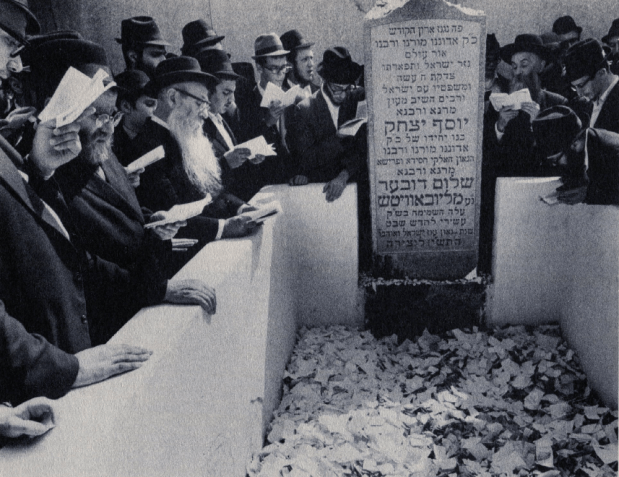
Yud Shevat marks the yohrzeit and Hillula (anniversary of the passing) of the Previous Rebbe in 5710 (1950), the father-in-law of the Rebbe MH”M. His resting place is in Montefiore Cemetery in Cambria Heights, NY, commonly referred to as “the Ohel”.
The Rebbe, MH”M, oversaw all the details, wrote the text of the gravestone, and even designed the Ohel structure itself (in a way that Kohanim could enter and avoid the halachic prohibition of being in proximity to a grave). The Rebbe visited the Ohel on a twice-weekly basis, and often more frequently than that.
At the same time, the Rebbe continued to refer to his father-in-law as “Nosi Doreinu”, the leader of the generation, and the “Moshiach of the generation“. The Rebbe asserted that “hu bachayim” (“he is alive”), like Yaakov Avinu who did not die. Each year on the Previous Rebbe’s birthday, the Rebbe spoke about his father-in-law’s new chapter of Tehillim, just like anyone else who has a birthday and begins a new year of life. The Rebbe spoke sharply that his father-in-law does not have an issue of inheritance because he is “fresher and more lively” each passing year.
Yud Shevat is the yohrzeit of a living man, the Ohel is the gravesite of a living man.
If we don’t understand, the problem is ours to ponder and to research. When we will understand how the gemora can state the “Moshe didn’t die” and “Yaakov didn’t die” and that after his passing Rebbi Yehuda Hanosi would appear at the home of his family on Shabbos night (and made Kiddush for them) — then perhaps we will begin understand the meaning of Yud Shevat. To understand how eternal life is not contradicted by a yohrzeit nor by a gravestone.
Note: This Maamor is NOT based on the chapter of Bosi Legani that we learn this year. (Unless you are reading this in the year תשצ”ב)
For 40 years the Rebbe would say a Chassidic discourse on one of the 20 chapters of the last maamor (Chassidic discourse) written by the Frierdicker Rebbe, entitled Bosi LeGani. Every year at the Yud Shevat farbrengen, the Rebbe would say a maamor (sometimes more than one) on that year’s chapter. Beginning from 5749 the Rebbe did not say a new maamor, instead an edited version of a maamor on that year’s chapter was printed. The cycle started again in 5751 (addressing chapter 1) and the maamor printed in 5752 can be expected to have added significance, as it was released during the year of Dvar Malchus sichos. In fact, when looked at in this light one indeed finds a message that fits with the unique chiddushim of 5751-52.
A general point: the edited version of a maamor is often significantly different from the way the Rebbe originally said the maamor. In some instances, the edited maamor is so different from the original that it presents a completely opposite perspective. (For example: the Rebbe once said a maamor in which the he spoke about the superiority of Torah over Mitzvos; when edited and published, the maamor addresses the superiority of Mitzvos over Torah!) In the maamor published for Yud Shevat 5752, it is noteworthy to point out that the relevant “chiddush” is not explicitly stated in the original, unedited version of the maamor which the Rebbe said in 5732 (which can be viewed here), but when edited in 5752 the Rebbe saw fit to state it clearly. The matter is as follows:
One who has been following Dvar Malchus, or has learned the Rebbe’s sichos and maamorim from all the years, is likely familiar with the concepts of the revelation from Above as opposed to the effort we make from below. In this maamor, this is associated with Matan Torah (from Above to below) and the Mishkan (the vessel for receiving the revelation of Elokus). The Rebbe explains that “this that Hashem desired to have a dwelling place down below (“dira b’tachtonim”) is that there will be a revelation of Elokus below via the avoidoh of human beings.” Thus, the main element is the Mishkan (and Mikdash), where the avoidah of korbanos takes place.
The Mishkan (and by extension, the Mikdash) has two distinct stages. The first is the making of the Mishkan (עשיית המשכן), the second is the avoidah which takes place in the mikdash — the Continue reading →
It is brought in the writings of the Arizal that the generation of the future Geuloh is a gilgul (reincarnation) of the generation that came out of Egypt, and according to this, we are redeemed in the merit of the righteous women in our generation, for they themselves are the righteous women in whose merit we came out of Egypt.
What makes our generation special? It is rooted in Nosi Hador, the leader of the generation:
The completion and perfection of the avodah (spiritual mission) of the Nosi Hador (on his Yom Hahillula [day of his passing –Yud Shevat]) is the completion and perfection of the avodah of the entire generation (for “the Nosi is everything” [Rashi on Chukas 21:21]), and since this generation is the final generation, then this is the completion and perfection of all of the avodah of Knesses Yisroel (woman) to make a dwelling place down below for Hashem, may He be blessed.
This relates to the concept of the “disappearance (סלוק) of Tzaddikim” (yahrzeit and Hillula) upon the completion and perfection of their avodah, as the verse states “My beloved went down to his garden…to collect roses”, upon which the Midrash expounds: “to hide away (לסלק) the Tzaddikim that are among Yisroel” (which means that they have completed their souls through Torah and Mitzvos [commentaries “Yafeh Kol” and “Yadei Moshe” on this midrash]). More importantly: this “disappearance” (“סלוק”) is for a much greater elevation (incomparably so) which will be in the world of the resurrection, “those who dwell in the dust arise and sing”, and the Tzaddikim (the “roses”) at their head, souls in bodies in this physical world, in the true and complete Geulah.
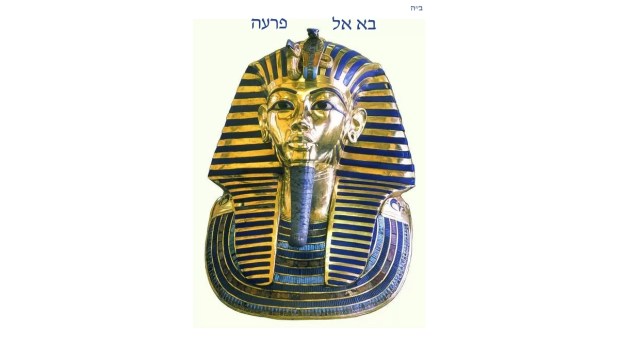
Our parsha begins with Hashem’s instruction to Moshe Rabbeinu “Come to Pharaoh”. The question is asked: why “come to Pharaoh” and not “go to Pharaoh” (as stated in other verses)? Furthermore, being that the Torah is eternal, what is the relevance of going to Pharaoh, King of Egypt, when we are standing at the end of golus — long after Egypt was rendered helpless and nothing remains of Pharaoh — at a time when the birurim of the klipah of Pharaoh are finished (as mentioned many times)?
CONFRONTING PHARAOH
The commentaries explain that Moshe Rabbeinu was afraid to go to the inner chambers of Pharaoh, and therefore Hashem said “Come [with Me] to Pharaoh” to ease Moshe’s fear of confronting Pharaoh alone.
However, our question becomes stronger when we learn, based on the Zohar, that the evil Pharaoh that we encountered in Egypt has his source in the “Pharaoh of kedusha (holiness)”, which refers to the revelation of G-dliness. Why was Moshe afraid to go to the Pharoah of holiness, so much so that he needed a direct command from Hashem to “come” together with Hashem?! Continue reading →
In addition to the radical chiddushim in the plain understanding of the second sicha of Parshas Va’era 5752, one can also find a number of hints and suggestions that give even deeper insight into the ground-shaking ideas the Rebbe is revealing.
In the explanation as to how the “good sign” of one who dies on Erev Shabbos applies to our era (the last quarter of the 6th millennium, “Erev Shabbos” of the entire creation), the Rebbe refers to the concept of “nesira” (“cutting”). This “nesira” describes what happened to Adam Harishon on the day of his creation: Hashem put him to sleep in order to separate Chava. From being a “back to back” entity they gained the ability to be “face to face”, and to bring into existence limitless future generations. While his sleep was one-sixtieth of death, it was completely a positive matter: in order to bring about an immeasurable improvement, specifically the ability to give birth to all future generations.
The Rebbe references the writings of the Arizal as a source for the Kabbalistic explanation of this concept of Nesira. In the writings of the Arizal (Shaar Hapsukim, p.17) one finds that the Arizal writes that “this matter is that the moichin (intellect) which is in the head of Z”A (the six sefiros) go out from it via this sleeping, and then they are given to the female (Malchus).” This brings about that Malchus grows from a point to her full development. Reading this, especially in the original language, seems to hint at the state of affairs after the events of 27 Adar and 3 Tammuz, when the Rebbe (the head — “Rosh Bnei Yisroel”) is not seen, and Malchus (the Jewish souls) receive and develop their potential via the intellectual power bestowed upon them by the head (“now I give it over to you, do all that you can to bring Moshiach in actuality” [sicha of 28 Nissan 5751]).
The Rebbe also brings (footnote 40) from “Kuntres Sfas Emes (at the end of Emes L’Yaakov)” that there is a “nesira” every Rosh Hashana which is the most difficult and requires Continue reading →
In the second sicha printed for parshas Va’era 5752, the Rebbe elaborates on the statement of the sages that “one who dies on Erev Shabbos, it is a good sign for him”.
The Gemara describes that when R’ Yehuda haNosi took ill, R’ Chiya visited him and found him crying. He asked him why he was crying (assuming that he was afraid of death). R’ Chiya proceeded to give him a list of signs that portend well for the fate of a person after death (and their opposite): Dying amidst laughter is a good sign, while crying is a not good; one who dies on Erev Shabbos is a good sign, after Shabbos is not good. (And several others.)
R’ Yehuda haNosi responded that he was crying (not from a fear of his fate after death, but rather) because of the Torah and Mitzvos he would no longer be able to perform. Seemingly, the list of good signs brought by R’ Chiya (several of which applied to R’ Yehuda haNosi and were meant to comfort him), do not help the reason given by R’ Yehuda for his crying, because seemingly being unable to perform Torah and Mitzvos after ones passing is not affected by the good signs of how a person passes away. (The Rebbe brings a proof for this from the story in the Gemara about Dovid haMelech, who asked to pass away on Erev Shabbos (because then one is not subject to “chibut hakever“), and Hashem refused him, telling him that even one day of his Torah learning was more dear to Him.)
Furthermore, the Rebbe asks on this whole discussion a fundamental question:
“How is it possible to truthfully say (in Toras Emes, the Torah of truth) that “one who dies on Erev Shabbos it is a good sign for him” — a “good sign” in relation to the occurrence of death, the opposite of life, the ultimate opposite of good according to Torah?!”
Since the Torah defines “good” as fulfilling the will of Hashem through the performance of Torah and Mitzvos as a soul in a body, then death is the opposite of Good, Continue reading →
This parsha, following the passing of Yaakov, Yosef, and the brothers, is the beginning of a new era in the history of Bnei Yisroel — the beginning of the Egyptian exile. “These are the names of Bnei Yisroel who came to Egypt” — the first exile.
The midrash states that the reason for the subsequent redemption from Egypt was “due to the fact that [Bnei Yisroel] did not change their names…they went down as Reuvain and Shimon and they came up as Reuvain and Shimon.” This is a comment on the name (and initial verse) of our parsha: Shemos (meaning, “names”), which refers to the beginning of the exile in Egypt, as mentioned.
The Rebbe derives from this that the verse “these are the names of Bnei Yisroel who came to Egypt” is also emphasizing the merit for which they were ultimately redeemed from Egypt (“that they didn’t change their names”). In other words — it is referring both to the beginning of the golus and also to the future Geuloh from that golus.
The whole idea of “coming to Egypt” is in truth the “Geuloh of Yisroel”. The descent which occurs in the meantime [until the Geuloh comes] is on the superficial level (בחיצוניות), but on a deeper level (בפנימיות), the descent itself is (not only for the sake that through it will come the ascent that occurs through the redemption from Egypt, but more than that–) a part of the ascent and the Geuloh itself, until we reach the ascent of the true and complete Geuloh…the future Geuloh.
In other words, not only is there a “descent for the sake of an ascent”, which makes the descent worthwhile in the end; here the Rebbe is saying something much greater: the descent itself is already part of the ultimate ascent!
At this point, the Rebbe turns to explain the familiar statement: Continue reading →







 Dvar Malchus 770