In particular in these days — the days of Moshiach — in which we are found now, we need only to “open up the eyes”, and then we see that we are already found in the true and complete Geuloh in the simple meaning of the words, and all of bnei Yisroel are ready in all the details “to approach and to sit down at the table”, a table set with all the delicacies and all good things, beginning with matters of Geuloh, Levyoson and the Shor haBar and the aged wine, and more and primarily, “to know Hashem”, “the earth will be filled with the knowledge of Hashem as water covers the seas.”
Author: Yankev
Now Available: Sefer Bereishis — for download!
We are pleased to offer a convenient way to read these articles off-line:
All the articles for Sefer Bereishis are gathered in an easy-to-read PDF format, at no charge.
Available on the “Downloads!” tab of the top bar of this website.
The Beis Hamikdosh Here in the Time and Place of Golus
The Rebbe mentions, in the printed sicha of Vayera 5752 (last week), a midrash* which states that the month of Marcheshvan (when the construction of the first Beis Hamikdash was completed, but it wasn’t opened until the following Tishrei) “lost out” and in the time to come the Holy One, blessed be He, will pay her back with the inauguration (chanukas) of the 3rd Beis Hamikdash which will take place in the month of Marcheshvan.
What significance does this have to the events of Marcheshvan 5752, when the sicha was spoken and printed? Several days after the sicha was spoken, and a day or two before the sicha appeared, in that very month of Marcheshvan, there was a revelation of the Beis Hamikdash.
This revelation was (and is) contained in a small booklet, the Kuntres Beis Rabbeinu sh’b’Bavel, edited by the Rebbe and published in honor of 20 Marcheshvan (birthday of the Rebbe Rashab). In this Kuntres, the Rebbe explains the words of the Gemara that the following the destruction of the Beis Hamikdash, the revelation of the Shechina which was revealed in the Beis Hamikdash “traveled” from Yerushalayim together with the Jews as they went into golus. Where did it settle? In the study hall and synagogue of the leader of the respective generations. In our generation, explains the Rebbe, this is 770 Eastern Parkway, the study hall and synagogue of the Rebbe, the leader of the generation (of course, the Rebbe makes the reference to his father-in-law, the Previous Rebbe).
Not only is every shul a “mikdash me’at“, a “miniature sanctuary”, but the shul of the leader of the generation is in fact a counterpart to the Beis Hamikdash that stood in Yerushalayim, and the revelation of the Shechina which is present there is the same revelation that was in Yerushalayim. (If one will ask why we don’t see this, learn the Dvar Malchus of parshas Vayera, wherein the Rebbe explains the difference between something being revealed from Above, and the concurrent need for the recipient to be a fitting vessel for that revelation in order to experience it.)
In other words, 770 Eastern Parkway is the place in golus where the revelation of the Shechina is presently situated as long as the Jews are in golus. And it will be the first place where the Third Beis Hamikdash will be revealed, after which it will return to Yerushalayim. In the Rebbe’s words:
Now we can appreciate the unique greatness of Beis Rabbeinu: As the main Small Temple of the final exile, Beis Rabbeinu is the very place of the future Beis Hamikdash, and moreover, the place where the future Beis Hamikdash will first be revealed, and the place from which it will return to Yerushalayim.
The implications are startling: this Kuntres reveals to us, based on the Rebbe’s explanation of a posuk in Yechezkiel and a sugya in the gemora, that the Beis Hamikdash is located at 770 Eastern Parkway, and this is the “very place itself”** (מקום המקדש גופיה דלעתיד) where the 3rd Beis Hamikdash will descend from Heaven, and from this place it will travel to Yerushalayim!
In other words, the Beis Hamikdash (as well as the place of the 3rd Beis Hamikdash) has been revealed in the realm of the intellect! In the month of Marcheshvan. And as the Rebbe explains, in last week’s sicha, in order to experience the revelation we have to desire it and then labor to make ourselves a fitting vessel (like Avraham Avinu did and thus he merited that Hashem was revealed to him), otherwise it will remain in the intellectual realm, unseen by physical eyes.
Please, do not suffice with these few words in this meager essay, but take the opportunity to read through (and even better–learn properly and in depth) the Kuntres Beis Rabbeinu sh’b’Bavel (available for viewing and printing here). After all, the Rebbe emphasizes numerous times that it is through learning the inyonim of Moshiach and Geulah that we speed up the actual true and complete Geulah. As the Rebbe says–all elements of the Geulah are here, we simply need to agree and desire and open our eyes. Learning these inyonim is the “fast way” to open our eyes.
It’s up to us!
* Yalkut Shimoni, Melachim I, remez 184. Footnote #108 in the sicha.
** See the maamor “Gadol Habayis Hazeh”, section IV and forward, for the significance of the place of the Beis Hamikdash as opposed to the structure itself.
Some Thoughts on Gimmel Tammuz
Today, walking on Eastern Parkway near 770, I overheard a Yeshiva Bochur explaining to an older woman that the upcoming day of Gimmel Tammuz is “the day the Rebbe passed away in 1994; you see, he is the Moshiach…”
Moshiach is described as transcending paradox (“nosei hafochim“). We have no greater paradox than Gimmel Tammuz. On the one hand, it has all the hallmarks of a “histalkus“, which essentially means “disappearance” as in “passing away” (although Chassidus explains that it actually means greater revelation, one which transcends revelation). A “histalkus” of a Rebbe is the culmination of his leadership, and even though he continues to live on (also in this physical world, and even in a body [as we know that the Baal Shem Tov and the Maggid of Mezeritch were present in a bodily form in the Alter Rebbe’s prison cell])—nonetheless, there is an “end of an era”, and a new Rebbe emerges to carry on the mission.
Nothing of the sort happened on Gimmel Tammuz 5754.
The leadership of the Rebbe has not diminished by even the smallest measure, rather, to the contrary—the dedication of his Chassidim is stronger than ever and his leadership is more widely influential than ever. There has not been a “break” but rather a “continuation” (see the sicha of 28 Sivan).
The Rebbe, in the sichos of Gimmel Tammuz, addresses the previous miraculous events of Gimmel Tammuz:
- Yehoshua bin Nun causes the sun to stand still (the sun is the tzaddik of whom it says “the sun sets and the sun rises”—on Gimmel Tammuz the sun did not set);
- The Previous Rebbe was redeemed from a death sentence under the Communists and sent to exile. It was the “beginning of the redemption”, but it was not clear to the Chassidim at the time. [Read further]
The power of our generation, the generation of Moshiach, lies in our ability to “see through the darkness”, to know that even despite all appearances to the contrary the leader of the generation, the Moshiach of the generation “stands and serves” and his leadership is uncontested. The terminology for this day, and what the Rebbe’s present address is, are not the decisive factors. Rather, the incontestable focus of this day is the fact that the Rebbe continues to lead our generation, the 7th generation, to greet the true and complete Geulah!
Yechi Adoneinu Moreinu v’Rabbeinu Melech HaMoshiach l’Olam Vo’ed!
Achrei Mos-Kedoshim 5751: No Reason to Fear Geulah
At present, we are at the conclusion of the exile and at any moment Moshiach will come. First of all, a response is necessary for all those who are worried when they hear a clamor that everyone is required to do what they can do to bring Moshiach: They are concerned that the entire time they spent building up business and social relationships in exile will be forfeited when the Redemption comes.
These worries can be assuaged on the basis of the concepts explained above: The redemption will not nullify the natural order as it exists at present. On the contrary, all the positive achievements of the exile will remain and indeed, will be elevated with the coming of the Redemption. Within them, will be revealed the Alef, G‑d’s Presence. This will put the focus on what the true intent of these activities is, the revelation of G‑d’s honor throughout the world.
Therefore, a person need not worry about what will become of his business activities when Moshiach comes. On the contrary, he can rest assured that all the activities that he carried out according to the Torah’s guidelines — even those that are not directly associated with the Torah and its mitzvos — are of value. However, this also points to the importance of a person keeping the fundamental purpose of his business activity in mind, and making sure that his efforts are directed to revealing G‑d’s honor.
This also leads to another concept. A person should not think that the Redemption will be totally a spiritual matter without any connection to our activities within this world. This is not the case. On the contrary, it is through our activities in exile, that we will merit the coming of the Redemption. Within those activities must also be a fundamental stress on “Reflecting on three things,” as explained above; i.e., focusing one’s energies one elevating the world at large. In particular, this should be expressed in increasing one’s donations to tzedakah, giving of one’s physical effort and wealth to provide another person with his material needs.
We see in fact that the nature of the world encourages such activities and in that context, it is worthy to mention the discovery of jewels in a far removed corner of the world. These jewels will be used for “a bride’s ornaments,” to increase the merit of the Jewish people through gifts to tzedakah.
* * *
In connection with the redemption, we find the prophecy, “And Kingship will be the L‑rd’s.” This includes kingship, not only over the Jews, but also over the gentile nations as well. Hence, as a preparation for Moshiach’s coming, it is also important to spread the observance of the Seven universal Laws commanded to the descendants of Noach.
In this context, it is worthy to mention how the activities of the world and that of the gentile nations appear to be assisting the coming of the Redemption. In previous generations, the Jews suffered oppression from the gentile nations in which they lived and in the present generation, the opposite is true. Most Jews live in countries whose governments are generous and assist them in the observance of the Torah and mitzvos, allowing them to carry out the inner service that will bring about a personal redemption which, in turn, will hasten the coming of the redemption as a whole. Surely, this is true of the country in which we are living. Furthermore, these countries are also granting assistance to Jews in the world at large, helping Jews immigrate to Eretz Yisrael.
In the last few years, we have seen this tendency spread to other nations throughout the world, even to Russia. Instead of suppressing the observance of the Torah and its mitzvos as in previous generation, they have granted religious freedom and are also allowing Jews the opportunity to emigrate to Eretz Yisrael. Furthermore, they are even assisting them in this objective. This helps prepare the way for the ultimate ingathering of the exiles in the Era of the Redemption.
Similarly, we see how the United States, the most powerful nation in the world, has dedicated its resources for the purpose of charity and education, two of the most fundamental activities necessary to create a stable environment in the world.
For this purpose, the United States has sent hundreds of its soldiers to help hungry and starving people in a far off corner of the world. Instead of using its airplanes for war, it employed them to reach those people who require such assistance. And instead of using its wealth for the benefit of its own people alone, it gave of that wealth to save the lives of unfortunate people and children. Although the people of this country had little contact with these unfortunate people previously, as soon as they heard of their suffering, they volunteered their assistance.
Similarly, in these days, the President of this country has issued Proclamations calling for an increase in education. At the very beginning of his Presidency he stated his desire to be known as “The Education President,” and at present, efforts are being made to strengthen education throughout the country.
An interrelationship exists between the fact that these steps are being taken by the United States and that the United States has been established as the most powerful nation in the world. Because the United States has dedicated itself to these goals, G‑d has granted it such power. This reveals how there is an inner process of causation operating within the world, pushing it to reveal its true G‑dly nature.
Translation: Sichos in English
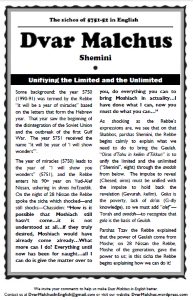
Tazria-Metzora PDF for download
Dvar Malchus Tazria-Metzora in English–available here in PDF format.
Shemini PDF for Download
The same translation as posted previously is also available here in PDF format.
Acharon Shel Pesach, 5751: Seven and Eight
1. This year the holiday of Pesach possesses a unique dimension because the first day of Pesach and therefore the last day (in the Diaspora) fall on Shabbos. The day on which Pesach falls also imparts a special property to Parshas Shemini, causing the portion to be read eight times (this includes the readings on the Shabbos afternoons and on Mondays and Thursdays) over a period of three weeks. There is a popular adage Shemini Shemoneh Shemainoh, “When Parshas Shemini is read eight times, it will be a plentiful year.”
Shemini means “the eighth,” while in contrast, the natural order is a cycle of seven. Even Shabbos, the seventh day, is associated with a sense of perfection and completion within the natural order as reflected in our Sages’ statement: “What was the world lacking? Rest. When Shabbos came, with it came rest;” the quality of rest which Shabbos contributes is a dimension which, when missing, creates a lack in the world. In contrast, eight refers to a quality that is totally transcendent in nature, entirely above the limits of our world.
This contrast can be further developed by focusing on the unique aspect of the Counting of the Omer this year. It is written, “And you shall count… from the day following the Shabbos… and they shall be seven perfect weeks.” When Pesach falls on Shabbos, the Counting of the Omer begins “from the day following the Shabbos” in a simple sense, and thus the weeks of the Counting of the Omer parallel the ordinary weekly cycle. Our Sages explain that this endows an added dimension of perfection to this period of time.
To explore this concept in greater depth: Pesach and the Counting of the Omerreflect two different patterns in the service of G‑d. Pesach means “leap” and refers to a leap beyond the natural order as in the redemption from Egypt when “the King of kings, the Holy One blessed be He, revealed Himself to them and redeemed them.”
In contrast, the Counting of the Omer represents a systematic sequence of development in which a person refines his seven emotional qualities. In particular, these seven qualities each include each other. Thus in the 49 (7×7) days of the Omer, we refine each particular dimension of our emotional makeup. Similarly, this service elevates the world at large which was created through the medium of these seven emotional qualities.
Thus, it appears that Pesach and the Counting of the Omer represent two different patterns of service: Why does the Torah associate the two?
This question is reinforced by the fact that, when giving the command to count the Omer, the Torah refers to Pesach as “the Shabbos.” Here also we see a similar contrast. The sanctity of the festivals is dependent on the service of the Jewish people. Thus our Sages interpret the verse “These are the festivals of G‑d which you will declare” to mean that the sanctity of the festivals are dependent on the Jewish people.
In contrast, the sanctity of Shabbos does not depend on the Jews at all. Its holiness is drawn down from above. If so, why does the Torah associate the Counting of the Omer (which as above refers to man’s service) with the term Shabbos (that reflects holiness endowed to us by G‑d)?
These difficulties can be resolved as follows: Man’s service does not involve only those elements of spirituality to which he shares a connection, i.e., those that relate to the natural order. Even those which transcend the natural order and whose revelation depends on G‑d, must be internalized and drawn down within our personalities and within the world at large through man’s service. In this manner, we can achieve a fusion of both qualities: There will be a revelation of G‑dliness which transcends the natural order, but it will be drawn down within the world through man’s service.
This concept is alluded to in the verse, “And you shall count for yourselves,… from the day following the Shabbos…” Homiletically, the expression “the day following the Shabbos” refers to a level above Shabbos, i.e., above even the level of perfection within the natural order. Furthermore, by using this term rather than the expression, “the day following the festival,” the Torah indicates that this influence surpasses not only the influence which the Jews can draw down through their own efforts (the festivals), but also surpasses the influence which is drawn down from above (Shabbos).
By telling us, “And you shall count for yourselves,” the Torah also emphasizes the intent that this influence be drawn down within the world at large. The verse continues, mentioning “seven perfect weeks,” which points to the efforts to have this influence permeate the world in a particular way. This leads to the counting of “fifty days,” the revelation of a level which transcends the world, even as it exists in a refined sense (i.e., the 49 days of the Omer, in which each of the seven attributes with which the world was created is expressed in a refined manner).
The fiftieth level which is associated with the giving of the Torah, transcends the set of worldly existence entirely. Nevertheless, since it is preceded by the service of the Counting of the Omer, this level can be drawn down within the context of material existence.
Based on the above, we can appreciate the unique dimension contributed by the fact that Pesach falls on Shabbos. Firstly, in such a year, it is clearly seen how the influence drawn down is from “the day following Shabbos,” i.e., its uniquely transcendent nature is openly revealed. Secondly, since the weeks of the Counting of the Omer parallel the weeks of the natural order, we clearly see how this transcendent influence permeates the world at large. Thus, the two dimensions which characterize the influence of the Counting of the Omer each year are more openly revealed when the first day of Pesach falls on Shabbos.
In a more particular way, these levels described above are revealed this year on the first Shabbos within the Counting of the Omer (in the Diaspora, Acharon Shel Pesach, in Eretz Yisrael, Isru Chag) when the counting of one full week of the Omer, the week associated with the quality of chessed, is completed. Furthermore, the completion of the counting of this week relates to the completion of the counting as a whole for Chessed is described as “the day (quality) which accompanies all the other days (qualities).”
In such a year, the two qualities mentioned above are revealed in microcosm. The revelation of the dimension which transcends the worldly set is reflected in Acharon Shel Pesach’s being the eighth day of the holiday. As mentioned above, the number eight points to a revelation above the natural order. The completion of the counting of the first week reflects how this influence is drawn down into the world at large, because as mentioned above, the attribute of Chessed has an effect on all the other qualities.
These qualities are further emphasized when the eighth day of Pesach falls on Shabbos for this reveals how the transcendent dimension associated with eight is fused with Shabbos, i.e., the natural order as it exists in a perfect manner.
There is also a connection to the holiday of Acharon Shel Pesach itself. The celebration of Acharon Shel Pesach was instituted in connection with the Seventh Day of Pesach, the day which commemorates the splitting of the Red Sea which was the final stage of the exodus from Egypt.
In Chassidic thought, it is explained that the splitting of the sea reflected the bonding between the transcendent worlds which are above revelation (the sea, whose creations are hidden and covered by the sea’s waters) and the lower revealed worlds (the dry land, on which the creations can be openly seen). In particular, there are two opinions regarding the nature of the bond established: a) The Zohar’s conception, that the bond was established through the elevation of the lower realms; b) The AriZal’s conception, that the bond was established through the revelation from above.
According to Chassidus, “these and these are the words of the living G‑d,” and both conceptions are true. And in this way, the fusion is complete, a revelation from above (when the revelation is initiated from above, more transcendent levels are revealed) and an elevation from below (which allows the influence received to be internalized in a more complete manner). Thus, we also have a parallel to the theme explained above, that the revelation which transcends the world will permeate the world itself.7
Herein we can also see a connection to Parshas Shemini. As mentioned above,Shemini represents a level above the natural order which revolves around a cycle of seven. Thus there is a parallel to Pesach which represents “a leap” above the natural order, and a closer parallel this year when the “the day following the Shabbos” — which reflects a level above Shabbos, the perfection of the natural order — falls on Shabbos itself. Even the transcendent levels associated with Shemini — and this year, the peaks associated with the reading of the parshah eight times (i.e., transcendence within transcendence) — are drawn down into our world through the Counting of the Omer.
* * *
2. Pesach is “the season of our freedom.” In addition to commemorating the redemption from Egypt, it also grants the potential for all future redemptions, including the ultimate redemption when “as in the days of your exodus from Egypt, I will show you wonders.” In particular, it is the eighth day of Pesach which shares a connection with Mashiach. This is expressed in the following: a) As mentioned above, the number eight is associated with the Era of Redemption; b) The Haftorah recited on the eighth day of Pesach contains many prophecies related to the coming of Mashiach, “A shoot shall emerge from the stem of Yishai…” and the state of peace which he will introduce into the world, “the wolf will dwell with the lamb.” c) The Baal Shem Tov instituted the custom of eating Mashiach’s Seudah, “the feast of Mashiach,” on the eighth day of Pesach. This custom was publicized by the Rebbe Rashab in Yeshivas Tomchei Temimim in 5666 — when he also introduced the custom of drinking four cups of wine in association with the Torah’s four expressions of redemption — and has now spread throughout the Jewish community.
There is also a connection between the Counting of the Omer on Acharon Shel Pesach and the Era of Redemption. In general, the Counting of the Omer shares a connection with the redemption. The Counting of the Omer is intended to bring about a revelation of the 50th Gate of Understanding, a level which will be revealed in a complete and permanent manner in the Era of Redemption.
There is a reflection of this revelation on the present day, for as explained above, the completion of counting the week associated with the attribute of Chessed has a connection with the completion of the Counting of the Omer as a whole. In particular, this is reflected in the counting of the Sefirah, Malchus sheb’Chesed on the night of Acharon Shel Pesach. The ultimate expression of G‑d’s Chessed (kindness) will be in the Era of Redemption when His Malchus (kingship) will be revealed throughout the world.
All of the above concepts are given greater emphasis this year due to the influence of Shabbos and Parshas Shemini. In particular, we see howMashiach’s Seudah leads to and becomes part of the Melaveh Malkah meal, the meal which is associated with King David who is the progenitor of Mashiach and is himself described as Malkah Mashichah, “the anointed king.” May Mashiach come and actually join us at this meal and may the grace be led by King David as related by our Sages.
And then, from this meal we will proceed to the era when “The Merciful One will restore the service of the Beis HaMikdash for us.” May this be in the immediate future.
Translation by Sichos in English
Sichos Nun-Alef/Nun-Beis in English
This site is being prepared as the online resource for a new project, one for which apparently the time has come. Translations into English of the Rebbe’s revolutionary talks of the years 5751-52 (1991-92), known as the “nun-alef/nun-beis sichos“.
These talks were given over 20 years ago, but they are more relevant than ever, since every year that goes by is bringing us closer to the complete Redemption (Geulah)–which is the subject of these talks, the most recent teachings we have from the Rebbe. (As the Rebbe said in regard to his father-in-law, the Previous Rebbe: the last year of teachings that a Rebbe reveals before he is concealed contain within them “everything” and if one will learn them properly he will find answers to everything therein.)
The sichos of nun-alef/nun-beis are lengthier than the talks of earlier years, and are more multi-faceted. They are not easily capsulized and they are built upon a breadth of Torah knowledge that poses a challenge when translating to the English-speaking audience. No doubt this is why, after 20 years, there are almost no translations of these talks (other than the original translations from Sichos In English that came out at the time).
Our goal is to present the English-speaking world with access to these talks in a form that allows the Rebbe’s revolutionary pronouncements to be grasped clearly, not to be obscured by the lengthy and deep Torah erudition and breadth of sources that would make them inaccessible to most readers in English. The form this will take is still evolving, and your comments and input are most welcome.
Over the course of this full year of teachings, the Rebbe gradually builds for us a vision of how we are leaving the state of Exile (Golus), how the world is ready for the Geulah, that Moshiach is already here and affecting the world and all that remains is to open our eyes. And the Rebbe does not fail to provide clear practical guidelines how to bring this into reality.
With Hashem’s help we will be able to present these sichos in a way that will be readable and at the same time remain true to the unique style of these talks, with the primary goal of emphasizing the amazing novella (chiddushim) that the Rebbe is telling us here: we are leaving Exile, we are transitioning to Redemption, and it is in our hands to speed the process.
The Rebbe stated that the “direct way” to bring about the revelation of Moshiach is by learning the subject of Moshiach and Geulah, especially as explained in Chassidus and especially in the teachings of the Leader of the Generation, and, as is known, these sichos stand in the forefront.
May we see immediately the true and complete redemption brought about by our righteous Moshiach, and through these sichos we will see how the Rebbe is holding our hands and leading us out of Golus right now.
יחי אדוננו מורנו ורבינו מלך המשיח לעולם ועד