
The Fall of Iran and the Rise of Moshiach

The Fall of Iran and the Rise of Moshiach

War with Iran is approaching round two – could this be the final groan of golus, the cracking of the shell, the spilling forth of the light of Geuloh that the world is longing for? After all, Iran is simply the preferred modern name of ancient Persia – the very same nation. And we have the testimony of the sages of the Gemara that before Moshiach comes Persia will fall at the hands of Rome![1]

Evidently, we are describing an event of global proportions. But the chess-board of world politics is merely the playing out of an internal spiritual drama of the Jewish people, as Chassidus explains the verse “He gave the world over to their hearts”[2] (גם את העולם נתן בלבם). How should we understand this drama – especially since it is described as being intertwined with the coming of Moshiach?

By attempting to analyze both aspects – both the worldly external events and the inner service of Hashem – based on the words of our sages and the teachings of Chassidus, we will, with Hashem’s help, find them even more significant than we might have thought.

The Fall of Paras: the External Dimension

We will start by mentioning words spoken by the Lubavitcher Rebbe in order to establish the significance of this matter in our generation. The Rebbe told Ron Nachman, mayor of the Israeli city of Ariel, to explain to the Americans that “it is imperative that there be a strong Israel in order to check the spread of the influence of Syria, Iran, and so forth, for they are against the US no less than they are against Israel and maybe moreso.”[3] Clearly, the Rebbe was not discussing with him a sugya in the gemara or esoteric ideas of Chassidus – this is practical advice which even the gentile government in the United States is expected to understand.

Additionally, former Israeli Ambassador Yehuda Avner was interviewed a number of years ago and shared that the Rebbe in the mid-1970s told him (years before the Iranian revolution) that “the emergence of an Islamic Iran carries with it the seeds of jihadism that will spread across the Middle East, threaten Europe, and ultimately the whole of Western Civilization.[4] We understand clearly that the military threat from Iran is a pressing contemporary issue which in the Rebbe’s view is of the gravest consequence.[5]

Today, it is unfolding before our eyes.

We will now look at the relevant sources in Torah, with hope to gain some small insight into the gravity with which the Rebbe views the developments in Iran (Persia).

The gemara, Yoma 10a, states as follows:

Rebbi said that in the future Rome will fall at the hands of Persia…. Rav said that Persia will fall at the hands of Rome. Rav Kahana and Rav Asi said to Rav: Can the builders [Persia, who permitted the rebuilding of the Holy Temple] fall before the destroyers [Rome, who destroyed the Temple][6]?! He said to them: Yes, it’s a decree of the King.[7]

The commentary of Tosefos[8] clarifies that Persia is the nation destined to fall and adds a critical element: “We were told that in the future Persia will fall at the hands of Rome, that is, in immediate proximity to the coming of Moshiach.” Meaning, it’s not just one of many future events, but an event immediately preceding (-סמוך ל) the coming of Moshiach!

Rome, as we know, is Edom.[9] Edom is commonly understood to mean the Western world in general, and Rome is the center of its financial and military power. Just as Rome was the mightiest and wealthiest world power of its time, so, too, the United States today.

One could, however, ask a question on the relevance of this gemara to our times: Following the first Persian Gulf War, the Rebbe referenced the midrash Yalkut Shimoni that refers to a war in the year Moshiach is revealed and stated that it had been fulfilled that year – what need do we have for Persia to fall at the hand of Rome?! We can answer that the Yalkut Shimoni itself states the difference between “the year Moshiach is revealed” and “the hour Moshiach comes”. The Rebbe stated[10] that the first part – Moshiach was revealed – took place in 5751, and since then we are standing on the cusp of “the hour Moshiach comes”. And further, the Rebbe declares numerous times in these sichos that “kolu kol hakitzin” — “all the end times have passed”!  The task of refining the fallen sparks of holiness (avoidas habirurim) has been completed!  Consequently the Rebbe expresses his astonishment that “Moshiach still hasn’t come!”

In light of this, we can bring an amazing statement from the sefer Yaaros Dvash:[11]

The gemara states that [Moshiach] ben Dovid doesn’t come until the Persians will fall at the hands of the Romans. And the commentators note that it doesn’t state “before [Moshiach] ben Dovid comes” the Persians will fall at the hands of the Romans, but [rather the exclusionary language of “doesn’t come until”] to teach that even if the end-time will arrive, nevertheless it will be delayed until the Persians will fall at the hand of the Romans…[12]

He is describing a time when the final ketz has arrived (as the Rebbe has stated) and there is a perplexing delay in Moshiach’s coming – exactly our situation as per the Rebbe’s description. And the reason, according to Yaaros Dvash, is the matter of the fall of Persia (Iran) at the hands of the Romans (the most powerful of the Western nations).

However, one could protest that the Rebbe responded to the situation (that all the end times have passed and still Moshiach hasn’t come) with astonishment – not an explanation from the Yaaros Dvash! What connection do we find here to the Rebbe’s astonishment and disbelief?!

With a deeper look at the “fall of Persia”, and how it relates to the Rebbe’s declaration that avoidas habirurim has been completed, and especially the gemara’s expression that the fall of Persia is “a decree of the King” – we may find an answer….

Read the rest in the complete PDF:


The Fall of Iran and Rise of Moshiach


Footnotes:

  1. Yoma 10a. The sages also quote an opposite opinion: Rome will fall at the hands of Persia, but that opinion is considered to have been rejected.
  2. Koheles 3:11, and see Sicha Bo, 5751 (ch. 9) and Bamidbar, 5750 (ch. 7).
  3. Free translation from video at the distribution of dollars on 28 Tishrei, 5752 (6 October 1991).
  4. Interviewed by JEM for the video presentation “Faithful and Fortified”.
  5.  Let us note that “an Islamic Iran” is a combination of Paras (the nation) and Yishmael (the religion of Yishmael). The Mitteler Rebbe (Shaarei Teshuva, ch. 23, p. 91a) writes that “the main aspect of the Geuloh is dependent upon the fall of the Sar (spiritual source) of Yishmael davka, as stated in the Zohar”. The Maharal writes (Netzach Yisrael, ch. 21) that “malchus Yishmael and malchus Paras are all one malchus.” Furthermore, the expression used is that the Sar of Yishmael must “fall”, which matches the gemara that Paras “falls” at the hands of Rome, and Bereishis 25:18 regarding Yishmael: “before all his brothers he will fall.”
  6. The Persian kings who ruled at the end of the Babylonian exile gave permission for the rebuilding of the Second Beis Hamikdosh (see Rosh Hashana 3b/4a). Four centuries later, the Roman general Titus destroyed it. In another sense, the spiritual power of Persia (explained below) allows for the construction of the Mikdosh, whereas the power of Rome destroys it.
  7. Rebbi Yehuda Hanosi was the redactor of the Mishnah. Rav was his student. We must ask why his student rules differently, and specifically why does Rebbi rule that Rome must fall whereas Rav rules that it is Paras that must fall. We might suggest as follows: the gemara in numerous places describes the friendly relationship between Rebbi and the Roman ruler Antoninus. The Yerushalmi (Megillah 1:11) debates whether or not Antoninus actually converted to Judaism (and even if not, “he will be at the head of those who will come to convert in the time to come”). So we see that Rebbi not only lived under Roman rule, but his avoidah included transforming the aspect of Rome from an oppositional force to a friendly force which eventually rejoins the Jewish people (“rejoins” because the ancestor of Rome was Esav, who was a Jew). Rav not only lived in Bavel most of his life, but more importantly he was from the generation that followed the avoidah of Rebbi. His task was to continue to the next stage: the fall of the aspect of Paras as will be explained.
  8. Tractate Avodah Zora 2b, משכא מלכותייהו. Based on the statement that Moshiach comes only after Rome rules the entire world for 9 months. Maharsha on Yoma 10a also accepts this as the final ruling.
  9. Rashi on Bereishis 36:43: “Aluf Magdiel, Aluf Iram, these are the chieftains of Edom…” Rashi: “Magdiel this is Rome”. Pirkei d’Rebbi Eliezer ch. 38. Also Radak on Ovadia 1:1 – “What the prophets said regarding the destruction of Edom at the end of days they said about Rome. Radak on Yeshaya 34:1 – “..the kingdom of Rome they are all Edomim who adhere to the xtian religion, Ibn Ezra on Yeshaya 61:1, and the Ramban “Sefer Hageuloh”.
  10. Dvar Malchus, Parshas Naso 5751.
  11. Yaaros Dvash chelek 2, 162b, drush 7 Adar.
  12.  Also based on the statement that Rome rules the world for 9 months.
Ki Seitze: Adding “the” Mitzvah

The ruling of the Rambam is well-known: every individual should consider that the fate of the entire world is in his hands. By performing a single mitzvah, one person can tilt the scales of judgement and bring salvation to himself and the world.

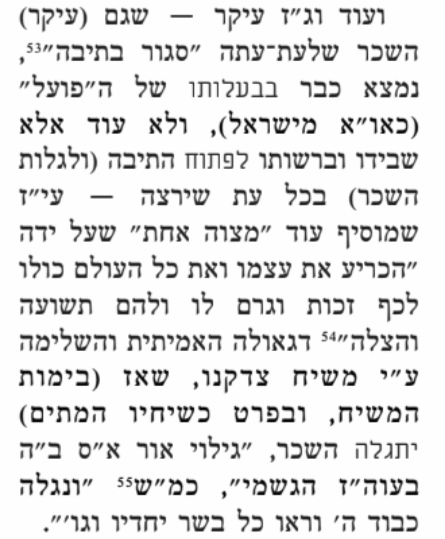
In the Sicha of Ki Seitze 5751, the Rebbe describes how the reward for Mitzvos is, metaphorically, locked in a chest. This chest is in the possession of all Jews.*

Screenshot_2018-08-22-15-46-09-1-2

“Not only that, but he has the ability and the permission to open the chest (and to reveal the reward) any time he wants — by adding “one mitzvah” more, that through this [mitzvah] ‘he will tilt the scales…'”

Those who learn the Sichos are already familiar with this Rambam (the Rebbe showed an enthusiasm for this Rambam over the years). But, in general, the Rebbe adds a new dimension in his use of sources, and especially regarding the Sichos of Nun-Alef/Nun-Beis we should be on the lookout for new dimensions of understanding.

We offer the following insight:

The Rebbe here separates the words “one mitzvah” מצוה אחת from the rest of the quote from the Rambam, and the Rebbe adds the words “by adding one more mitzvah” (עי”ז שמוסיף עוד מצוה אחת).

To say “adding one more mitzvah” (עי”ז שמוסיף עוד מצוה אחת) implies something quite different than the Rambam’s wording of “performing one mitzvah” (עשה מצוה אחת).  Adding one more (עוד) implies a mitzvah that was not already fulfilled, that there is “one more mitzvah” that we can “add” which will bring the revelations of the true and complete Geulah.

In truth, there are many Mitzvos we haven’t fulfilled in actuality, since we lack the ability to bring korbonos. But there is one mitzvah that has not been fulfilled — and is possible to fulfill today — and it is a mitzvah fulfilled by the Jewish people as a whole.*

This is the mitzvah mentioned in last week’s parsha, Parshas Shoftim: the mitzvah to appoint a King שום תשים עליך מלך. Although it was fulfilled in earlier generations, our generation has not properly fulfilled it. More than that, the shleimos of this mitzvah was not reached through the appointing of Shaul Hamelech or Dovid Hamelech; rather its shleimos is the appointing of Melech haMoshiach — which is the responsibility of our generation, specifically!

This interpretation fits perfectly with what the Rebbe says here: because the opening of the “chest” that contains the reward of our Mitzvos (the revelation of Ohr Ein Sof in the world, as explained in the Sicha) is related to Yemos haMoshiach, and it is self-understood that in order for it to be Yemos haMoshiach there must be a Moshiach, whom the Jewish nation has a mitzvah to appoint over themselves, accepting his kingship.

So look at this portion of the Sicha again, and see how the Rebbe is saying that the “one mitzvah” which we can add, which will bring the lofty revelations we are longing for, is the mitzvah of appointing a King מינוי מלך!

Of course, this is a Mitzvah that falls on the shoulders of the entire Jewish nation as a whole, so it’s not enough that you and I and the bochurim in 770 accept the Rebbe as King, Melech haMoshiach, but requires the acceptance of his kingship by the Jewish nation. This is, lechoira, also the meaning of the Rebbe’s words in 28 Nissan 5751 and Noach 5752: “the only thing left is to give it over to you” and “the Geulah doesn’t depend on anything besides Moshiach himself.” There’s no contradiction: what has been give over to us is the acceptance and crowning of Moshiach himself by us!

אין הדבר תלוי אלא במשיח צדקינו עצמו

All that remains is to appoint the King!


*) It is possible, though not necessary, to say that the Rebbe means here the collective body2018-08-22 20.33.38 of all Yidden rather than each individual: “The reward that until now is “closed in a chest” is already found in the possession of the “worker” (each and every Jew).”

Parshas Naso, 5751: The Year (in which) Moshiach is Revealed

Parshas Naso, 5751: The Year (in which) Moshiach is Revealed

In the sicha of Parshas Naso, the Rebbe states as follows:

This is especially emphasized in this year — the year 5751 (1991) which stands for “I will show wonders” — beginning with the wonders that we already saw in actuality, revealed in the eyes of the whole world, in this year [referring to the miracles of the Gulf War].  That through [these events] the words of the Yalkut Shimoni midrash were fulfilled: “In the year that Melech Hamoshiach is revealed all the kings of the world will quarrel, the king of Persia [Iran/Iraq], the king of Arabia, and the Holy One, blessed be He, says to the Jewish people, “my children, do not be afraid, all that I have done I only did for you…the time of your Redemption has arrived.”  Since that time, we are already standing at [the closing section of the Yalkut Shimoni midrash] “in the hour that Melech Hamoshiach comes, he announces to the Jewish people and says humble ones, the time of your redemption has arrived.”

Prior to and during the first Persian Gulf War, the Rebbe made frequent references to this Yalkut Shimoni midrash, but here, for the first time, the Rebbe says unequivocally that “it has been fulfilled”, specifically quoting the words “in the year Melech Hamoshiach is revealed”.  In other words: in 1991 Melech Hamoshiach was revealed.  But despite this, as the Rebbe points out in other sichos, the Jewish people are still fearful and require Moshiach to tell them not to be afraid and to inform them that the Geulah has arrived.  But the “breakthrough” has happened: the year Melech Hamoshiach is revealed.

To add further insight:

“The year in which Melech Hamoshiach is revealed…” (“שנה שמלך המשיח נגלה בו”). The word “year” in Hebrew is feminine, and grammatically we would expect this Midrash to read “נגלה בה“, meaning “in her [the year, feminine]”.  So we need to explain why it says “בו” instead of “בה”: “the year Melech Hamoshiach is revealed in him“[masculine].

Regarding this logical question, it will help to Continue reading

Keep Your Eyes on the Rebbe!

In the sicha of Parshas Emor, that Rebbe makes the following enigmatic statement:

[The Geulah and building of the 3rd Beis Hamikdash] will be hastened through the study of Torah, and of Chassidus in particular. This also includes looking into the face of your Rebbe, which helps one’s understanding…

This concept is found in the Gemara (as brought in the sicha of Emor), and the Rebbe himself wrote (in the early years of his leadership) that a person should imagine the face of the Previous Rebbe or look at his photo, explaining the benefits that come from this.  So why mention it seemingly “out of context” in a sicha in 5751?

It can be understood that the Rebbe is not only saying to look at the Rebbe’s visage, whether in person or via a photo, but something more than this.  The Rebbe is giving us advice how to better understand these sichos of 5751-52, where the Rebbe is speaking openly about Moshiach in unprecedented ways: when we are learning here about Moshiach, we need to know whom we are talking about; that this is not just “learning Torah lishmah“, but has very practical ramifications. How will we properly understand what the Rebbe is trying to tell us about the identify of Moshiach, and whether we are waiting for him to come or if he has already come? Simple: Keep your eyes on the Rebbe!

Read the following words from the sicha of Behar-Bechukosai as they are without “looking at the face of the Rebbe”, then read them again with the Rebbe in mind — you will understand very well the “enigmatic” advice “which helps one’s understanding“:

Immediately we will see that Moshiach is already found among us, and every single Jew will point with his finger and say “Behold, this one (is the Melech haMoshiach, and he already) came”.

20180511_005203-1

28 Nissan: Do All You Can!

28 Nissan: Do All You Can!

What follows comes from the “famous sicha of Koach (28) Nissan”, which the Rebbe spoke after Maariv prayers to a small crowd in 770. Although the words were –- and remain –- shocking, an attempt to shake Chassidim out of their complacency in golus, they would be followed by nearly a year of sichos containing some of the loftiest revelations, which are the subject of this website: the Dvar Malchus sichos of 5751-52.

The shliach and mashpia R’ Zalman ‘שיחי Liberow is fond of pointing out that although the Rebbe’s words are strong, disturbing, and sound almost as though the Rebbe “doesn’t know what to do with these people” (chas v’sholom), if we take a second look we find that the Rebbe says that he is doing “the only thing left to do”, which should give us tremendous encouragement! It means that literally there is nothing else that needs to be done (by the Rebbe) to bring Moshiach. If the Rebbe gives it over to us, it means that we have the power to do it! “Karov eleicha hadavar me’od.

(Perhaps it is worth noting that 28 Nissan is the 13th day in counting the Omer, Yesod sh’b’Gevurah. It is the day that the walls of Yericho, the first city conquered by Yehoshua bin Nun and the bnei Yisroel upon entering Eretz Yisroel. It is also the day (in 5714 [1954]) that the Rebbe taught the famous niggun of “Tzema Lecha Nafshi”, a niggun of longing for G-dly revelation.)

A translation of part of the sicha:

Because of the unique stress on the Redemption in this time, an astonishing question arises: How is it possible that despite all these factors, Moshiach has not yet come? This is beyond all possible comprehension.

It is also beyond comprehension that when ten (and many times ten) Jews gather together at a time that is appropriate for the Redemption to come, they do not raise a clamor great enough to cause Moshiach to come immediately. They are, heaven forbid, able to accept the possibility that Moshiach will not arrive tonight, and even that he will not arrive tomorrow, or on the day after tomorrow, heaven forbid.

Even when people cry out “Ad mosai” — Until when will we remain in exile?’ they do so only because they were told to. If they had sincere intent and earnest desire, and cried out in truth, Moshiach would surely have come already.

What more can I do to motivate the entire Jewish people to clamor and cry out, and thus actually bring about the coming of Moshiach. All that has been done until now has been to no avail, for we are still in exile; moreover, we are in an inner exile in regard to our own service of G-d.

All that I can possibly do is to give the matter over to you. Now, do everything you can to bring Moshiach, here and now, immediately.

May it be G-d’s will that ultimately ten Jews will be found who are stubborn enough to resolve to secure G-d’s consent to actually bring about the true and ultimate Redemption, here and now immediately. Their stubborn resolve will surely evoke G-d’s favor, as reflected by the interpretation of the verse, “For they are a stiff necked people; You will pardon our sins and wrongdoings and make us Your possession.”

I have done whatever I can; from now on, you must do whatever you can. May it be G-d’s will that there will be one, two, or three among you who will appreciate what needs to be done and how it needs to be done, and may you actually be successful and bring about the true and complete Redemption. May this take place immediately, in a spirit of happiness and gladness of heart.


View the video with English subtitles:

Ki Seitze: Adding “the” Mitzvah

The statement of the Rambam is well-known: every individual should consider that the fate of the world is in his hands. By performing a single mitzvah, one person can tilt the scales of judgement and bring salvation to the entire world.

In the Sicha of Ki Seitze 5751, the Rebbe describes how the reward for Mitzvos is, metaphorically, locked in a chest. This chest is in the possession of all Jews.*

Screenshot_2018-08-22-15-46-09-1-2

“Not only that, but he has the ability and the permission to open the chest (and to reveal the reward) any time he wants — by adding “one mitzvah” more, that through this [mitzvah] ‘he will tilt the scales…'”

Those who learn the Sichos are already familiar with this Rambam (the Rebbe showed an enthusiasm for this Rambam over the years). But, in general, the Rebbe adds a new dimension in his use of sources, and especially regarding the Sichos of Nun-Alef/Nun-Beis we should be on the lookout for new dimensions of understanding.

We offer the following insight:

The Rebbe here separates the words “one mitzvah” מצוה אחת from the rest of the quote from the Rambam, and the Rebbe adds the words “by adding one more mitzvah” (עי”ז שמוסיף עוד מצוה אחת).

To say “adding one more mitzvah” (עי”ז שמוסיף עוד מצוה אחת) implies something quite different than the Rambam’s wording of “performing one mitzvah” (עשה מצוה אחת).  Adding one more (עוד) implies a mitzvah that was not already fulfilled, that there is “one more mitzvah” that we can “add” which will bring the revelations of the true and complete Geulah.

In truth, there are many Mitzvos we haven’t fulfilled in actuality, since we lack the ability to bring korbonos. But there is one mitzvah that has not been fulfilled — and is possible to fulfill today — and it is a mitzvah fulfilled by the Jewish people as a whole.*

This is the mitzvah mentioned in last week’s parsha, Parshas Shoftim: the mitzvah to appoint a King שום תשים עליך מלך. Although it was fulfilled in earlier generations, our generation has not properly fulfilled it. More than that, the shleimos of this mitzvah was not reached through the appointing of Shaul Hamelech or Dovid Hamelech; rather its shleimos is the appointing of Melech haMoshiach — which is the responsibility of our generation, specifically!

This interpretation fits perfectly with what the Rebbe says here: because the opening of the “chest” that contains the reward of our Mitzvos (the revelation of Ohr Ein Sof in the world, as explained in the Sicha) is related to Yemos haMoshiach, and it is self-understood that in order for it to be Yemos haMoshiach there must be a Moshiach, whom the Jewish nation has a mitzvah to appoint over themselves, accepting his kingship.

So look at this portion of the Sicha again, and see how the Rebbe is saying that the “one mitzvah” which we can add, which will bring the lofty revelations we are longing for, is the mitzvah of appointing a King מינוי מלך!

Of course, this is a Mitzvah that falls on the shoulders of the entire Jewish nation as a whole, so it’s not enough that you and I and the bochurim in 770 accept the Rebbe as King, Melech haMoshiach, but requires the acceptance of his kingship by the Jewish nation. This is, lechoira, also the meaning of the Rebbe’s words in Noach 5752: the Geulah doesn’t depend on anything besides Moshiach himself.

אין הדבר תלוי אלא במשיח צדקינו עצמו

All that remains is to appoint the King!


*) It is possible, though not necessary, to say that the Rebbe means here the collective body2018-08-22 20.33.38 of all Yidden rather than each individual: “The reward that until now is “closed in a chest” is already found in the possession of the “worker” (each and every Jew).”

Parshas Naso, 5751: The Year (in which) Moshiach is Revealed

Parshas Naso, 5751: The Year (in which) Moshiach is Revealed

In the sicha of Parshas Naso, the Rebbe states as follows:

This is especially emphasized in this year — the year 5751 (1991) which stands for “I will show wonders”– beginning with the wonders that we already saw in actuality, revealed in the eyes of the whole world, in this year [referring to the miracles of the Gulf War].  That through [these events] the words of the Yalkut Shimoni midrash were fulfilled: “In the year that Melech Hamoshiach is revealed all the kings of the world will quarrel, the king of Persia [Iran/Iraq], the king of Arabia, and the Holy One, blessed be He, says to the Jewish people, “my children, do not be afraid, all that I have done I only did for you…the time of your Redemption has arrived.”  Since that time, we are already standing at [the closing section of the Yalkut Shimoni midrash] “in the hour that Melech Hamoshiach comes, he announces to the Jewish people and says humble ones, the time of your redemption has arrived.”

Prior to and during the first Persian Gulf War, the Rebbe made frequent references to this Yalkut Shimoni midrash, but here, for the first time, the Rebbe says unequivocally that “it has been fulfilled”, specifically quoting the words “in the year Melech Hamoshiach is revealed”.  In other words: in 1991 Melech Hamoshiach was revealed.  But despite this, as the Rebbe points out in other sichos, the Jewish people are still fearful and require Moshiach to tell them not to be afraid and to inform them that the Geulah has arrived.  But the “breakthrough” has happened: the year Melech Hamoshiach is revealed.

To add further insight:

“The year in which Melech Hamoshiach is revealed…” (“שנה שמלך המשיח נגלה בו”). The word “year” in Hebrew is feminine, and grammatically we would expect this Midrash to read “נגלה בה“, meaning “in her [the year, feminine]”.  So we need to explain why it says “בו” instead of “בה”: “the year Melech Hamoshiach is revealed in him“[masculine].

Regarding this logical question, it will help to take a look at the Ohr Hachama, the commentary of R’ Avraham Azulai, z”l, on the Zohar:

[…]so to it will be with the Moshiach after he merits to that neshoma and recognizes himself that he is Moshiach, as it states [in the Zohar] Moshiach will be revealed but he still won’t be recognized by the rest of the people[…] (Shemos 7b, quoting R’ Chayim Vital, z”l)

This describes how the initial “revelation” of Moshiach is when the neshoma of Moshiach is revealed to the individual who has been chosen by Hashem to be Moshiach. At the time that this individual receives the neshoma of Moshiach it is a private revelation, “but the rest of humanity will not recognize him”; only later will he be revealed to the people as Moshiach—what we refer to as the “coming of Moshiach”.

We could say that the Yalkut Shimoni’s use of the word “בו” transforms the literal meaning to “the year that Melech Hamoshiach is revealed in him”, a hint to “the year that [the neshoma of] Melech Hamoshiach is revealed in him [the one who will be Moshiach].”  In 5751 there was a revelation of the “yechida of the yechida”  (the lofty soul of Moshiach) in Moshiach himself.  The delay is the recognition of this by the world.

The reason for this “delay” is found in the Ohr Hachama on Shemos 9a, where it state:

“Moshiach can’t redeem Israel from below…only from Above…there needs to be an awakening from below in order to awaken the rachamim from Above, even if the physical Moshiach wants to redeem [them], only according to what Yisroel arouses Above can the Moshiach act….”

This describes a situation where there already exists the individual to whom has been bestowed the lofty neshoma of Moshiach (“the physical Moshiach”).  He himself knows that he is Moshiach, but the revelation is not yet recognized by all of Israel.  We can see this in the language of the Yalkut Shimoni itself: the Midrash begins with “the year in which the King Moshiach is revealed”, and the Midrash concludes with “the hour in which the King Moshiach comes”.

The year in which Moshiach is revealed refers to the initial revelation, when there is still a need to explain the events of the world to the Jewish people, “don’t be afraid”, etc. The hour when Moshiach comes refers to that transcendent moment when the Jews themselves are able to actually see and recognize the light of Moshiach (as stated in the continuation of the Yalkut Shimoni, brought in different sichos).

In other words, two distinct stages: the revelation of Moshiach which precedes and is distinct from the coming of Moshiach.  The Rebbe is informing us that the first stage has been fulfilled, and we have transitioned to the second stage, which is dependent wholly on the efforts of Yisroel, as the Ohr Hachama writes: “only according to what Yisroel arouses Above can the Moshiach act….”

Therefore, it is understood the words of the Rebbe (28 Nissan): “I have done all that I can do, now I give it over to you to do all you can do to bring Moshiach in actuality”.  If we truthfully cry out “Ad Mosai” (“until when”), we are really asking the question on ourselves: because while Moshiach is the one who brings the Geuloh, Moshiach’s ability to act comes from us.

See 5751–The Year Moshiach Is Revealed for more insights into the relevance of this Yalkut Shimoni to the Gulf War and the present world situation.

Keep Your Eyes on the Rebbe!

In the sicha of Parshas Emor, that Rebbe makes the following enigmatic statement:

[The Geulah and building of the 3rd Beis Hamikdash] will be hastened through the study of Torah, and of Chassidus in particular. This also includes looking into the face of your Rebbe, which helps one’s understanding…

This concept is found in the Gemara (as brought in the sicha of Emor), and the Rebbe himself wrote (in the early years of his leadership) that a person should imagine the face of the Previous Rebbe or look at his photo, explaining the benefits that come from this.  So why mention it seemingly “out of context” in a sicha in 5751?

It can be understood that the Rebbe is not only saying to look at the Rebbe’s visage, whether in person or via a photo, but something more than this.  The Rebbe is giving us advice how to better understand these sichos of 5751-52, where the Rebbe is speaking openly about Moshiach in unprecedented ways: when we are learning here about Moshiach, we need to know whom we are talking about; that this is not just “learning Torah lishmah“, but has very practical ramifications. How will we properly understand what the Rebbe is trying to tell us about the identify of Moshiach, and whether we are waiting for him to come or if he has already come? Simple: Keep your eyes on the Rebbe!

Read the following words from the sicha of Behar-Bechukosai as they are without “looking at the face of the Rebbe”, then read them again with the Rebbe in mind — you will understand very well the “enigmatic” advice “which helps one’s understanding“:

Immediately we will see that Moshiach is already found among us, and every single Jew will point with his finger and say “Behold, this one (is the Melech haMoshiach, and he already) came”.

20180511_005203-1

28 Nissan: Do All You Can!

28 Nissan: Do All You Can!

What follows comes from the “famous sicha of Koach (28) Nissan”, which the Rebbe spoke after Maariv prayers to a small crowd in 770. Although the words were –- and remain –- shocking, an attempt to shake Chassidim out of their complacency in golus, they would be followed by nearly a year of sichos containing some of the loftiest revelations, which are the subject of this website: the Dvar Malchus sichos of 5751-52.

The shliach and mashpia R’ Zalman ‘שיחי Liberow is fond of pointing out that although the Rebbe’s words are strong, disturbing, and sound almost as though the Rebbe “doesn’t know what to do with these people” (chas v’sholom), if we take a second look we find that the Rebbe says that he is doing “the only thing left to do”, which should give us tremendous encouragement! It means that literally there is nothing else that needs to be done (by the Rebbe) to bring Moshiach. If the Rebbe gives it over to us, it means that we have the power to do it! “Karov eleicha hadavar me’od.

(Perhaps it is worth noting that 28 Nissan is the 13th day in counting the Omer, Yesod sh’b’Gevurah. It is the day that the walls of Yericho, the first city conquered by Yehoshua bin Nun and the bnei Yisroel upon entering Eretz Yisroel. It is also the day (in 5714 [1954]) that the Rebbe taught the famous niggun of “Tzema Lecha Nafshi”, a niggun of longing for G-dly revelation.)

A translation of part of the sicha:

Because of the unique stress on the Redemption in this time, an astonishing question arises: How is it possible that despite all these factors, Moshiach has not yet come? This is beyond all possible comprehension.

It is also beyond comprehension that when ten (and many times ten) Jews gather together at a time that is appropriate for the Redemption to come, they do not raise a clamor great enough to cause Moshiach to come immediately. They are, heaven forbid, able to accept the possibility that Moshiach will not arrive tonight, and even that he will not arrive tomorrow, or on the day after tomorrow, heaven forbid.

Even when people cry out “Ad mosai” — Until when will we remain in exile?’ they do so only because they were told to. If they had sincere intent and earnest desire, and cried out in truth, Moshiach would surely have come already.

What more can I do to motivate the entire Jewish people to clamor and cry out, and thus actually bring about the coming of Moshiach. All that has been done until now has been to no avail, for we are still in exile; moreover, we are in an inner exile in regard to our own service of G-d.

All that I can possibly do is to give the matter over to you. Now, do everything you can to bring Moshiach, here and now, immediately.

May it be G-d’s will that ultimately ten Jews will be found who are stubborn enough to resolve to secure G-d’s consent to actually bring about the true and ultimate Redemption, here and now immediately. Their stubborn resolve will surely evoke G-d’s favor, as reflected by the interpretation of the verse, “For they are a stiff necked people; You will pardon our sins and wrongdoings and make us Your possession.”

I have done whatever I can; from now on, you must do whatever you can. May it be G-d’s will that there will be one, two, or three among you who will appreciate what needs to be done and how it needs to be done, and may you actually be successful and bring about the true and complete Redemption. May this take place immediately, in a spirit of happiness and gladness of heart.


View the video with English subtitles:

Hakhel Year – a Ketz?

Hakhel Year – a Ketz?

It's still Hakhel!
The Rebbe says Hakhel continues into Sukkos of the following year!
We still have time to utilize the power of Hakhel...

In a Hakhel year the Rebbe demands from each one of us to be a “Hakhel Yid”: to utilize every opportunity to make Hakhel gatherings of Jews which strengthen Yiras Shomayim, encourage Mitzah observance, and increase Jewish unity.  The Rebbe’s shturem about these activities is known, but why such a shturem?  With a fuller understanding of the subject, we can, with Hashem’s help, give ourselves over to the Rebbe’s inyan of Hakhel with even greater inner chayus (in addition to loyal kabbolos ‘ol).

First, let us note that Hakhel is not a time period, it is an event.  An event which occurs once every seven years in the year after a Shmitta year, the year called Motzei Shvi’is.1  Hakhel is a mitzvah which is performed in the year of Motzei Shvi’is.  By understanding more about Motzei Shvi’is, we can understand better the role of mitzvas Hakhel.

At this point, let us note some of the dramatic events that occurred in Hakhel years:

  • 5713 — all of Russian Jewry was in danger from Stalin’s “Doctor’s Plot“, nd they were miraculously saved upon the sudden death of Stalin as a result of that year’s Purim farbrengen.
  • 5727 — the Jews of Eretz Yisroel were threatened by five Arab armies, and miraculously saw the great victory of Six Day War.
  • 5734 — the deadly surprise attack of the Yom Kippur war, which turned into a miraculous victory (“bigger than the Six Day War” said the Rebbe).
  • 5741 — Eretz Yisroel was facing the threat of a nuclear reactor in Iraq, until the successful bombing of that reactor by the Israeli Air Force.

Also interesting to note that the four times that 770 Eastern Parkway, the Rebbe’s shul, was expanded took place in Hakhel years: 5720, 5727, 5733 (finished by erev Rosh Hashanah 5734, the Hakhel year), and 5748 (the laying of the cornerstone (“even hapina”) for the most recent expansion).  But what’s the connection with Hakhel? Continue reading