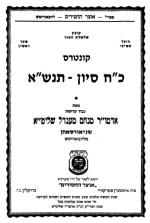
This maamor begins with the words of the haftorah (“Vayomar lo Yehonoson“) recited on Shabbos Erev Rosh Chodesh. The attentive student will recall that a maamor on the very same verse was distributed as Kuntres Erev Rosh Chodesh Iyar, 5751 (seven months earlier), but the content differs significantly. The maamar quotes the haftorah: “Tomorrow is Rosh Chodesh and you will be remembered (nifkadta) because you are missing from your place (ki yipakedmoshavecha).”
Erev Rosh Chodesh is when the moon completely disappears from sight. It represents the bittul of the Yidden. Through this bittul they draw down a new revelation that was never in the world before, which manifests as the birth of the new moon on Rosh Chodesh, the level of “nifkadta” (“remembered”). This new light — “Ohrchodosh” — is from a level that is completely above the world, drawn down through the avoidah of bittul. In contrast, avoidah connected with the existence of the individual (קשורה עם המציאות שלו) only draws down Ohr on a level that has a connection with the world.
This maamor was edited and printed in honor of the birthday of the Rebbe Rashab, and it was handed out personally by the Rebbe in 770.*. It discusses deep inyonim of Chassidus, and demands attentive learning. But here, we will focus only on one point from the maamor, which is overtly relevant to the concepts of Moshiach and Geuloh found in Dvar Malchus.
The Rebbe discusses here the concept of the Divine Light (Ohr) that preceded the tzimtzum (Tzimtzum being the contraction of light by which it becomes possible to create limited, finite worlds). This Ohr that existed prior to the tzimtzum possessed two dimensions: unlimited and limited. These dimensions became the source for the two kinds of Divine revelation that exist now: Sovev (surrounding light, which cannot be grasped and thus is not revealed in the world), and Memaleh (filling light, which is limited and can this be grasped by the lower creatures).
Additionally: through the mitzvos we perform now, there will be the revelation of a new light in the time to come, an Ohr Chodosh. This Ohr Chodosh will bring about a new heavens and a new Earth (as stated by the novi Yeshaya).
The Rebbe clarifies: if we are referring to the revelation of the unlimited light that illumined before the tzimtzum (which is presently not revealed in the worlds), this is not truly new (אין זה חידוש אמיתי) — this Ohr was already revealed before the Tzimtzum, and afterwards was concealed from the world. Thus, when this Ohr will return and be revealed again, it will not truly be something new. The truly new Ohr Chodosh, which will generate a new heavens and a new Earth, is Ohr that is drawn down by our fulfilling Torah and Mitzvos now, an Ohr that didn’t exist even before the Tzimtzum!
In these words the Rebbe is giving us a small glimpse at the great significantly of the avoidah of a Yid in performing Torah and Mitzvos — it is a complete chiddush, and draws down an Ohr Chodosh that never existed previously! Here, in the oisios of Chassidus, the Rebbe is explaining the famous words of 28 Nissan (“I’ve done all that I can do, now you must do all that you can do to bring the Geuloh…”) — because it is the avoidah of a Yid, davka, to make this lowest world a “dira b’tachtonim” that draws down the Ohr Chodosh, which is the revelation of the Geuloh.
(Note that in the kuntres published for Rosh Chodesh Kislev of this year, the Rebbe will elaborate further on this subject, bringing out the point that the avoidah of the Yid is even greater than the Ohr Chodosh that comes from his avoidah!)
* Some want to suggest that perhaps the timing of the distribution of this maamor by the Rebbe served as a “distraction”, so to speak, from the amazing revelations found in the Sicha “Beis Rabbeinu sh’b’Bovel”, which was printed the same week. (Chassidim had in their hands a maamor given to them personally by the Rebbe and a second kuntres dropped off unceremoniously in 770 — it is obvious which a chosid would learn first.)
Well known is the principle that the first luchos were given with a big “shturem”, but had to be shattered. The final luchos, to the contrary, were brought down without lightning, thunder, and the sound of the Shofar — but they were not shattered, they endure. In our case, Chassidim were so excited to learn a maamor that the Rebbe had handed to them personally, from his holy hand, that they didn’t have time to make a big deal overthe other kuntres (“Beis Rabbeinu…”)… (But what can a goat understand from gazing at the moon…?)
Released a few days in advance of Rosh Hashono, the discourse begins with the verse from the prophet Yeshaya: “On that day a great shofar will be sounded, and the ones who are lost in the land of Ashur and the ones who are pushed away in the land of Mitzrayim, will come and prostrate themselves to Hashem on the Holy Mountain in Yerushalayim.”
The Rebbe asks a few questions on this verse: What is special about a “great shofar”? Why does it say that the shofar “will be sounded” without specifying who will be sounding it — it seems as though it will be sounded on its own?
The shofar here is explained in spiritual terms: the cry of the innermost point in the heart which is above intellect. This cry draws down the corresponding level from Above, meaning the Supernal Will which transcends the level of Chochma (usually translated as “wisdom”).
There is a different verse that describes the shofar as being sounded by Hashem, but that verse refers only to a “shofar” and not a “great shofar”. But the “great shofar” of the future is sounded from a level higher than any of Hashem’s names!
At Matan Torah there was also the sound of a shofar, but not a “great shofar” — because the shofar of the future will be even greater than at Matan Torah. The reason (given in the name of the Mitteler Rebbe) is that at the time of Matan Torah the entire Jewish people were in a state of closeness with G-dliness קירוב לאלקות and therefore a “regular” shofar was sufficient to awaken their hearts. But the shofar of the future, of the true and complete Geuloh, has to reach the “lost” and the “pushed away”, who are far from G-dliness, and therefore in order to reach them requires the “great shofar”. This also explains why it seems that it will be sounded “by itself” — because in order to awaken those who are so far from any interest or recognition of G-dliness will require a cry from Above, by itself, without any awakening from below at all. Now, on every Rosh Hashono, we sound a regular shofar, meaning that through our effort we awaken and draw down from Above. But the great shofar of the future is drawn down by itself without any effort from below.
However, there is a question: we find that the great shofar of the future is likened to our own sounding of the shofar (by our own effort) on Rosh Hashono — they couldn’t be more different! The Rebbe explains Continue reading →
The Rebbe mentions numerous times in these talks that everything that is necessary for the Geuloh is already here, we simply need to add the letter “alef” to the word gola (which means exile), thereby transforming it to Geuloh. But what exactly does it mean to add an “alef” to the exile that we are in?
There are many levels to answering this question, three of which the Rebbe describes in the sicha of Parshas Emor. We find an even deeper and more comprehensive explanation in the Chassidic Discourse that was edited by the Rebbe and published in 1991 in honor of the Hillula (anniversary of the passing) of the Rebbe’s father, Levi Yitzchak Schneersohn.
In honor of the 15th of Av, 5751, the maamor “קץ שם לחושך” (“He imposed a limit to the darkness”) was released.
In many of the Dvar Malchus sichos the Rebbe addresses the need to draw the makif into the pnimi, meaning to internalize in the intellect (seichel) that which is above the intellect. For this there are two examples brought in this maamor: Will (ratzon) which is enlothed in intellect; and Faith (Emunah) which is enclothed in intellect. On their own, both Will and Faith, Ratzon and Emunah, are beyond the intellect, called in Chassidus “makif“. But the manner in which they are internalized (brought into the intellect) is quite different. Continue reading →
The human eye can perceive light. But only when it has a wavelength between approximately 380 nanometers (seen as violet) and 750 nanometers (seen as red). But these light rays are only a small fraction of the very broad spectrum of rays that exist, from 0.0001 nanometers in wavelength to a full meter. This covers Gamma rays, x-rays, ultraviolet, infrared, microwaves, and radio waves — none of which the human eye can perceive.
But this is not a science lesson — what does it have to do with Geuloh?
We will see that it is a basis for understanding how the Rebbe can say that the Geuloh is here, all the end times have passed, and yet we remain in golus. On the face of it, there is no logical basis to say that Continue reading →
The maamor released for 12-13 Tammuz 5751 was originally said on 12 Tammuz 5729, a day before the maamor that was released on Yud Alef Nissan, 5751 (three months earlier). Both maamorim speak about the “prayer of the rich man”. Here, the Rebbe stresses the the connection between Yisroel and Moshe Rabbeinu, and adds the distinction that Moshe’s connection with Yisroel is his inward dimension (pnimiyus), and everything else is secondary and external (chitzoniyus). “All of his levels, including that he was also wealthy in ruchniyus, they are secondary, the external [chitzoniyus] dimension, relative to the fact that he is the shepherd of Yisroel…”
This, of course, is true also of the extension of Moshe in every generation — the Rebbeim — and now the Rebbe explains how this Continue reading →
A Chassidic discourse on the verse “As in the days when you came out from Mitzrayim, I will show you wonders” was edited and distributed by the Rebbe on 28 Sivan, 5751 (50th anniversary of the Rebbe’s arrival to America together with the Rebbetzin). The subject is the nature and varying levels of miracles and wonders in general, and particularly as they will be in the Messianic age. This not only shares an obvious connection with the miraculous escape of the Rebbe and Rebbetzin from Europe to America 50 years earlier, but also with the year 5751 תנש”א, which the Rebbe repeatedly referred to as the year of “I will show you wonders” (the letters of the Jewish year — Nun-Alef — standing for the Hebrew words in our verse “I will show you wonders.”)
First, we need to understand the varying levels of miracles: miracles above nature (transforming water into blood, splitting the sea), and miracles enclothed in nature. Miracles enclothed in nature themselves divide into 3 types: where the miracle is recognizable (Purim, Chanukah); where nature conceals the miracle but there is still a recognition that something out of the ordinary occurred and one is obligated to thank Hashem (an ill person who is healed, a prisoner who is freed, etc); and the lowest level, where nature so completely obscures the miracle to the point that one doesn’t even recognize that a miracle occurred (אין בעל הנס מכיר בניסו).
The Rebbe proceeds to explain that the last type of miracle, unrecognizable from the ordinary process of nature, is actually the Continue reading →
The Rebbe brings in the name of the Rebbe Maharash a Midrash which states:
The Holy One said to man, “My candle is in your hand, and your candle is in My hand; My candle in your hand is Torah… Your candle in My hand is the soul… If you guarded My candle, I guard your candle; but if you extinguished My candle, I extinguish your candle.”
Although it may sound like a case of reward and punishment, the maamor explains it in a much deeper way:
The soul is likened to a candle because of its inherent nature to desire to rise up and be nullified in its source. This is accomplished by Aharon, who has the job to light the menorah until “the flame ascends of its own accord.”. Thus, the verse says “like good oil on the head descends on the beard the beard of Aharon…”. The beard of Aharon is the inyan of the halachos of Torah. This explains our midrash: that guarding the candle of Torah guards the soul that its desire to ascend should be revealed. This is accomplished via Torah.
As Chassidim we can understand that it refers to our hiskashrus to the Rebbe: that by Continue reading →
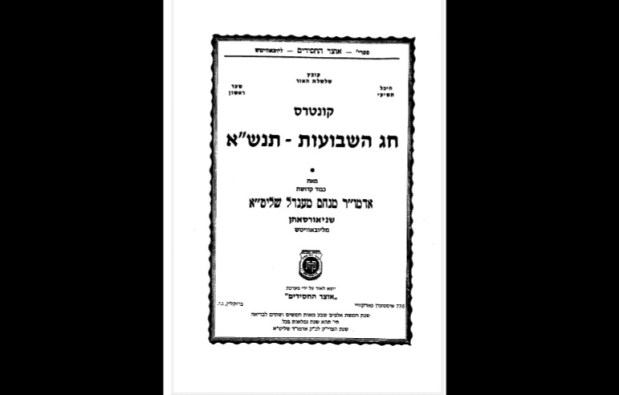
As explained in Chassidus, Sefiras Ha’Omer precedes Matan Torah because we must refine the 49 aspects of our Nefesh Behamis (animal soul) before we can receive the Torah. But the Torah itself was given to us to refine our animal soul (as Moshe argued to the Malochim who wanted Torah kept in the Heavens that Mitzvos like “Do Not Steal” only apply to one who has to combat an evil inclination). This raises the question: is refining the animal soul for the sake of receiving the Torah, or is receiving the Torah for the sake of refining the animal soul?!
To answer this, the Rebbe points out the language pertaining to Sefiras ha’Omer: to count seven complete weeks (שבע שבתות תמימות). The Midrash asks when are the weeks “complete” תמימות? “When Yisroel are doing the will of the Omnipresent.” This “doing the will of…” is accomplished through the love of “all your might” בכל מאודך (as we say in Shema). When we achieve this level — which is beyond our limitations — Hashem responds to us in a similar fashion, “as water reflects a face” כמים הפנים לפנים. Meaning that Continue reading →



 Dvar Malchus 770