Behar-Bechukosai: A Dwelling Place — Below

Behar-Bechukosai: A Dwelling Place — Below

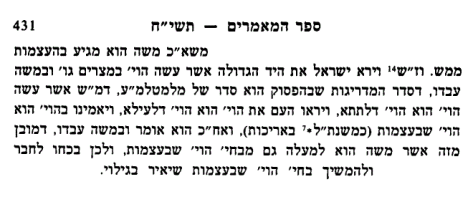
Consistent with the theme that runs through almost all the Sichos of Dvar Malchus, the Rebbe address in this Sicha the split between Above and Below, “Oneness” and multiplicity. Paraphrasing the Mishna in Pirkei Avos: the dimension of “one utterance” and that of “ten utterances”.

The aspect of “one utterance” (through which the world could have been created) refers to the higher dimension, where the simple Oneness of G-dliness is the only reality, and any created entity is completely nullified to that Oneness, losing all individual importance.

The aspect of “ten utterances” (through which the world was created) refers to the lower reality where every entity has it’s own role and unique importance distinct from the greater unity and Oneness. This dimension of reality, however, can impose upon — and even conceal — the Oneness that underlies and permeates Creation.

In other words, “one utterance” brings a complete nullification of the world, whereas the “ten utterances” are what generate the reality of world (although in a way where the world is permeated with Holiness drawn down from Above).  The “problem” here is that each one cancels out the other, which is not the Divine intent.  Says the Rebbe:

..the true perfection is the combination of the two together — that also the level of G-dliness that is above the world (“one utterance”) is drawn down and revealed and permeates the multiplicity of the individual created begins (“ten utterances”).  Through this the intent of Creation is fulfilled, that the Holy One desired a dwelling place in the lower realms.

What is the true definition of the famous expression דירה בתחתונים (a “dwelling place in the lower realms”)?  It is the unification of Continue reading

Keep Your Eyes on the Rebbe!

In the sicha of Parshas Emor, that Rebbe makes the following enigmatic statement:

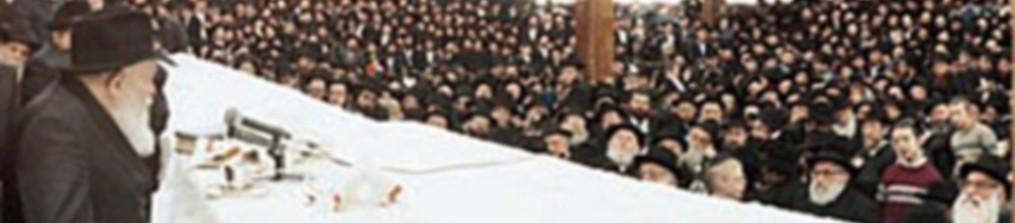
[The Geulah and building of the 3rd Beis Hamikdash] will be hastened through the study of Torah, and of Chassidus in particular. This also includes looking into the face of your Rebbe, which helps one’s understanding…

This concept is found in the Gemara (as brought in the sicha of Emor), and the Rebbe himself wrote (in the early years of his leadership) that a person should imagine the face of the Previous Rebbe or look at his photo, explaining the benefits that come from this.  So why mention it seemingly “out of context” in a sicha in 5751?

It can be understood that the Rebbe is not only saying to look at the Rebbe’s visage, whether in person or via a photo, but something more than this.  The Rebbe is giving us advice how to better understand these sichos of 5751-52, where the Rebbe is speaking openly about Moshiach in unprecedented ways: when we are learning here about Moshiach, we need to know whom we are talking about; that this is not just “learning Torah lishmah“, but has very practical ramifications. How will we properly understand what the Rebbe is trying to tell us about the identify of Moshiach, and whether we are waiting for him to come or if he has already come? Simple: Keep your eyes on the Rebbe!

Read the following words from the sicha of Behar-Bechukosai as they are without “looking at the face of the Rebbe”, then read them again with the Rebbe in mind — you will understand very well the “enigmatic” advice “which helps one’s understanding“:

Immediately we will see that Moshiach is already found among us, and every single Jew will point with his finger and say “Behold, this one (is the Melech haMoshiach, and he already) came”.

20180511_005203-1

6) Kuntres Lag B’Omer: Open My Eyes

6) Kuntres Lag B’Omer: Open My Eyes

This discourse starts with the words of Tehillim “Open my eyes and I shall gaze at [hidden] wonders from Your Torah” (“גל עיני ואביטה נפלאות מתורתך”).  This should immediately grab our attention, since the Rebbe called this year “I will show wonders” (“אראנו נפלאות”) and over the year would proceed to explain that all we need to do is “open our eyes”.  In this discourse the Rebbe explains to us what this means.

The verse mentioned above has a connection with Lag B’Omer (when the maamor was originally said, and when, 14 years later, it was published in 5751).  Because the word גל (“Gal” — Open [my eyes]”) contains the same letters as “Lag” B’Omer ל”ג בעומר.

Lag B’Omer is not only the day that Rabbi Shimon bar Yochai appeared (to fleshly eyes) to pass away, but it was the day of “the main revelation” of the inner dimension of Torah.  As brought in the Zohar that Rashbi revealed “holy words that he had not revealed over the course of his life (because the things he revealed [at the time of his passing] were the highest matters, that even Rashbi had been afraid to reveal then prior to this.)”.   Who fails to see the bold hint here —  that the Rebbe, in the year before our fleshly eyes perceived 27 Adar and Gimmel Tammuz, is revealing the us (in Dvar Malchus) things which had not been revealed previously.

The Rebbe proceeds to address a simple question: if the inner dimension of Torah is concealed from us, then the request should be “reveal to me” the hidden matters.  But the verse requests instead “open my eyes” — implying that the concealment is due to the eyes and not to the matters being hidden from sight.

The answer is that the Torah was given in order that Continue reading

Emor 5751: You Can Now Be a Tzaddik

Emor 5751: You Can Now Be a Tzaddik

Briefly, we have a major novelty (chiddush) in this sicha, indicating that our reality is no longer limited in the way earlier generations were limited (we will see similar insights in parshas Vayigash, be”H).  Before we get to this, it is very noteworthy the Rebbe’s statement about the importance of looking at the face of the Rebbe as being included as part of learning Torah, which speeds the Geuloh:

[The Geulah and building of the 3rd Beis Hamikdash] will be hastened through the study of Torah, and of Chassidus in particular. This also includes looking into the face of your Rebbe, which helps one’s understanding, as the Gemara (Eruvin 13b) quotes R. Yehudah HaNasi as saying, “This that my sharpness exceeds that of my colleagues is because I saw R. Meir from the back; and if I would have seen him from the front, I would be even sharper.”

As regards the novelty (chiddush), all students of Tanya know two things: Firstly, every single Jew must endeavor to fulfill the oath that his soul swore before coming down to the world (“Be a Tzaddik”); and secondly, as stated in Tanya, that try as one might, one may never reach this level because it is not dependent on ones merits.  Some souls are born to struggle but not to achieve the goal of being a true Tzaddik (one who has overcome and transformed his evil inclination).  Here the Rebbe informs us that there is now nothing standing in our way of achieving the objective! You and I, every Jew, if we will truly make the effort we can succeed to be victorious over our evil inclinations:

All this will help further purify the world and reveal G‑dliness within it. It must be accompanied by the additional G‑dly service of each particular Jew, by keeping away from evil and, furthermore, doing the utmost to fulfill the oath administered to his soul before birth, “You shall be a Tzaddik.” One might object and point out that in Tanya itself it is written that not every individual can necessarily become a Tzaddik, and that one doesn’t have complete free choice in this area. However, since the Jew has the essence of G‑d within him, ultimately even this is within his reach. Furthermore, after all the purification, etc. of the Jewish people over the course of time, now every Jew is able to reach the level of Tzaddik — similar to the way things will be in the Messianic Age.

The excuse that being a Tzaddik is “beyond my reach” and “halevai beinoni” (“if only I could reach the intermediate level”) is no longer valid! Today we are truly in a period of “I tried and I found” (“yagaati u-matzosi“).


Full sicha in English
Full sicha in Laha”k

Emor: Understanding “Above Intellect”

The sages tell us that there is no joy like the joy of resolving a doubt (Zevachim 90a).  Simply put: we don’t enjoy the state of uncertainty, of not understanding.  There is one level of inability to understand that comes from us: we are capable of understanding the matter in question, but we haven’t yet implemented our intellect sufficiently and haven’t understood the matter properly.  By putting in the requisite effort, we will understand.

Additionally, there are things which we don’t understand because these things are simply not comprehensible.  This is called, in the language of Chassidus, “above the intellect”.  This is the level of Kesser, the crown which is above the brain (the place of the intellect) which is in the head.  This is also the level of “peleh” (פלא), which means “wonder” — something beyond understanding, which we can only gaze at with wonder.  Clearly, the level of Kesser, the crown, is connected with Moshiach (the King) and Geuloh (“I will show you wonders”).

In English, the word “wonder” carries a totally positive connotation, as in “wonderful”.  We find that the word “peleh” in loshon hakodesh relates to the fact that the matter is incomprehensible, regardless if we find it to be “wonderful” or not.  The dimension of “peleh” (the 3rd aspect of the letter “alef” which the Rebbe tells us we must insert into Gola to make Geuloh) refers to those things which are not understood, but in the Geuloh we will say about them “thank You Hashem because You were angry with me”.  How do reach the level where the “peleh“, which appeared to us as Hashem’s anger, is revealed as something that we are actually thankful for?!  Explains the Rebbe: this is accomplished through learning Chassidus, Pnimiyus Hatorah (the inner dimension of Torah):

It is not enough to reveal in “Gola” the aspect of “the Master of the World” [the recognition that all is from Hashem]…we need to also reveal the aspect of “learning” via learning Torah, and even further — the aspect of “peleh“, via learning Pnimiyus Hatorah (the wonders that are in Torah)…

Through revealing the “peleh” in Torah by learning the inner dimension of Torah, we reveal Continue reading

5) Kuntres 13 Iyar: Like Which Brother?

5) Kuntres 13 Iyar: Like Which Brother?

This Chassidic discourse was printed in honor of the Yahrtzeit of the Rebbe’s brother, Yisroel Aryeh Leib.  Fittingly, it begins with the words of the posuk “Oh, that you were like a brother to me,” (Shir Hashirim, 8:1). Rashi comments that this verse refers to the way Yosef dealt kindly with his brothers even though they had mistreated him (by selling him as a slave to Egypt).  Contrasting this: there is a midrash which says that the verse refers to his beloved brother Binyomin, who, unlike his older brothers, had no hand in selling Yosef down to Egypt.

The discourse goes into depth about the nature of free choice, and the responsibility of Yosef’s brothers for selling him even though later Yosef reveals that it was divinely orchestrated for the good —  so that Yosef should rise to power in Egypt and be in a position to provide for his family when they sought respite from the famine in the land of Canaan.  However, we are now only going to focus on the part of the discourse that shows an open connection to the sichos of Dvar Malchus.

The verse “Oh, that you were like a brother to me,” is a request from the Jewish people to Hashem — to relate to us like a brother.  It is understood why we would interpret it to be referring to the brothers who sold him: the brothers did evil to Yosef but he repaid them with kindness.  Similarly, we request from Hashem that even though we have “done evil to Him” through our sins, He should repay us with kindness.  However, as we know from the story in chumash, Yosef’s kindness followed the trials and tribulations that he put the brothers through in order to bring them to do teshuva and acknowledge their sin.  By asking for Hashem to relate to us like Yosef to Binyomin, who had no hand in the sale of Yosef, we are asking for open and revealed good without any “trials and tribulations”.

The difference between the two interpretations (whether the verse is referring to Yosef’s conduct to his 10 brothers or to Binyomin) will be understood as the difference between a number of contrasting concepts, all of which contain a common thread.

On the one hand we have Continue reading

Achrei-Kedoshim 5751: Using Out Golus to Make Geuloh

Achrei-Kedoshim 5751: Using Out Golus to Make Geuloh

Geuloh is made from Golus (Exile)

There is a heady excitement that develops when one begins to feel what the Rebbe has been expressing in the recent sichos — that we are truly on the cusp of the coming of Moshiach and the revelations of the true and complete Geuloh.  Such excitement and anticipation for Moshiach could generates a desire to throw off the responsibilities of Golus and charge head-first and full-speed into Geuloh.  For example: abandoning one’s job and devoting 24 hours a day to spreading the news of the redemption and learning the subject of Moshiach and Geuloh (after all, the Rebbe said in the previous sicha that this learning is the direct path to bringing the Geuloh, so why delay it by attending to earthly needs such as a job and a house?). Such “over-the-top”  behavior, explains the Rebbe, is not the way to bring Moshiach.  Or, from the other side, one could be worried that all of one’s efforts in worldly matters will go to waste with the coming of Moshiach.  Such fear is also put to rest in this sicha.

As mentioned in the previous sichos, the Geuloh (redemption) is the word exile (GOLA) with the addition of the letter “alef”, representing the revelation of Hashem in exile itself.  This is the concept of the Rambam that with the coming of Moshiach (in the first stage, at least) nothing will change in the conduct of the world — the world will conduct itself naturally — the only difference is that we will not be subjugated to physicality and the laws of nature as before.  However, this itself is no small matter!  What is means is that Continue reading

Tzora’as: The Illness Before Geuloh

Tzora’as: The Illness Before Geuloh

In the landmark Sicha of Tazria-Metzora 5751, the Rebbe explains how Tzora’as is a condition that occurs at the end of golus, after avoidas habirurim is finished (which is why it appears in the Torah after parshas Tazria, which refers to the birth of the soul of Moshiach).  As we are now holding at that time and place — the end of golus, after the birurim are finished — the condition of Tzora’as is relevant to us.

In fact, the Rebbe states clearly that each and every Yid today can be said to be on the level of one who has completed his avoidah and is holding in a state of the Metzora — all the bad is coming out, but the inside is completely refined.  (Reminiscent of chazal’s play on words that “Metzora” is from the words “moitzi ra’“, a reference to loshon hora, but according to Chassidus we can understand it literally “to put out the evil” — that all the evil has been purged from within and it’s appearance externally is really the final stage before it’s complete eradication.)

How can we understand this Tzora’as in our lives?

The maamor of the Alter Rebbe in Likkutei Torah and this Sicha of the Rebbe MH”M explain how the oirois Elyonim (“lofty Divine lights”) begin to shine in a Yid’s soul only after the inner refinement is completed.  Lacking bittul and proper vessels to receive these oiros, the lights of G-dly עונג (pleasure) are rearranged to become נגע (lesion).  This manifests itself as anger, judgmental behavior, and “spiritual arrogance”.  The powerful lights of Tohu which demand “Moshiach Now!” and “Yechi Hamelech” may be unable to tolerate those who one perceives to be “holding up the process”.  We could call it intolerance for and arrogance regarding one who appears to be a “misanaged” in these matters.

There is another form of Tzora’as that can affect their person, in the opposite manner, alluded to also in the maamor.  The Alter Rebbe explains that the lesion of Tzora’as which appears on the skin is a white patch of skin because the white color is a sign that the blood flow is interrupted.  In a healthy body the heart pumps blood to the limbs, and the limbs return the blood to the heart (see also Tanya, Igeres Hakodesh ch. 31).  The failure of the limb to return blood to the heart results in the white patch of skin, which is Tzora’as.

With this concept in mind, let us revisit the words of the Rebbe is the Sicha of Beis Nissan, 5748 (3 years and a month before the Sicha of Tazria-Metzora 5751).  There the Rebbe explains how the King is the heart of the nation (as the Rambam writes), and just as the role of the heart in the body is to pump blood, which is life, to the limbs, similarly the King gives life to the people. And just as in a healthy body the limbs must send blood — life — back to the heart, so, too, the people must give life to the King (for there is no King without a people).

The people giving life to the King, says the Rebbe, is expressed by the crowning of the King with the expression “Yechi Hamelech”, which “emphasizes that also the actions of the nation affect the life of the King”.

The crowning of the King by the people through the declaration “Yechi Hamelech” is likened to the limbs returning the blood to the heart. And the failure to return blood to the heart results in the white lesion which is Tzora’as, meaning that the inability to declare “Yechi Hamelech” is itself a case of Tzora’as!

The cure for Tzora’as, as explained in our sources, is the bittul that comes from learning Torah — and in our time the Rebbe emphasizes that it must be in the subject of Moshiach and Geuloh, especially as explained in the Rebbe’s own Sichos and Maamorim.  This study provides the the vessels to heal both forms of Tzora’as — both the intolerant and judgmental form, and also the inability of the “limb” to return the blood to the “heart” by crowning the King with the declaration “Yechi Hamelech”.

Surely we will all add in this study, to bring about the realization of “the law of the Metzora on the day of his purification”, which the Rebbe says refers to the revelation of Moshiach.

Yechi Adoneinu Moreinu v’Rabbeinu Melech haMoshiach L’olam Vo’ed!

!יחי אדוננו מורנו ורבינו מלך המשיח לעולם ועד

4) Kuntres Beis Iyar, 5751: Why Concealment

4) Kuntres Beis Iyar, 5751: Why Concealment

[The discourse presented here was edited by the Rebbe and printed for Beis Iyar 5751 (1991), and in retrospect we can see how it is meant to guide us and strengthen us through the present time (even more so than when it was published), as will be explained, בעז”ה.]

The haftorah that is read when Shabbos falls out in Erev Rosh Chodesh (the day before the new month when the moon is completely concealed) begins with the verse: “Yehonosan said to him: tomorrow is [Rosh] Chodesh and you will be remembered (נפקדת) because your place will be vacant (כי יפקד מושבך).”

The words of this verse demand explanation: why are words from the same root — נפקדת and כי יפקד — used for completely opposite concepts? “You will be remembered” is seemingly quite the opposite from “your place will be vacant”, which implies that he will be missing?!  To explain this, the Rebbe Continue reading

Tazria-Metzora 5751: The “Geuloh Illness”

Tazria-Metzora 5751: The “Geuloh Illness”

Moshiach in Exile is Called “Metzora

In many years the Torah portions of Tazria and Metzora are read together on the same Shabbos.  Parshas Tazria begins with the words “a woman who gives seed and gives birth to a male” — according to Chassidus, this hints at the birth (revelation) of the soul of Moshiach.  Giving seed refers to our deeds and effort (“avodah”) in the time of exile, followed immediately by the sprouting — the complete Geuloh.

Metzora refers to Moshiach; as our sages say: he bears our sicknesses.  The name of Moshiach in the time of exile is “Metzora” (one suffering from the spiritual skin ailment called Tzoraas).  The opening words of this parsha, “This is the Torah of the metzora on the day of his purification” — the day of his purification, the day that the nega on his skin is healed, meaning when he (Moshiach) is revealed and redeems the children of Israel in the true and complete Geuloh.

What is the connection?  Tazria is birth, meaning the eternal Geuloh; Metzora is one who needs to be brought to purification.  Seemingly, if the eternal Geuloh is “born”, it is not related in any way to the state of a metzora, who is connected with illness and exile.  However, the content of parshas Tazria is all about the various types of lesions of a metzora, which pertains to exile.  And, parshas Metzora actually teaches the laws of the purification of the metzora, the inyan of Geuloh.  Seemingly, it should be reversed?!

Tzora’as — Illness After Completing Everything

It turns out that the order is of the parshiyos and their subjects is exact.  The illness of tzora’as becomes relevant only at the very end of golus.  The verse that begins to describe the illness of tzora’as states “A man [‘Adam’] who has a on the skin of his flesh…”, and the Zohar states that “Adam is a great level, the perfection of everything”.  If so, how could he be subject to illness?!  The answer is: although he has rectified everything Continue reading