Maamorim: The Big Picture

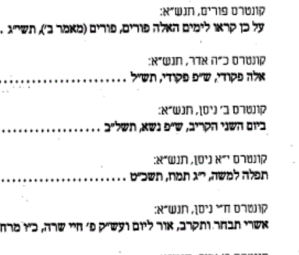
Interesting to note the sequence of the maamorim that were printed in 5751, the beginning of the year of Dvar Malchus:

Purim — The level of Purim: an awakening that leads to the downfall of the enemies of Israel (Haman, Stalin in 5713 after this maamor was said, Sadaam Hussein in 5751 when it was edited and printed), and ushers in the period of the ascendency of Mordechai, Esther, and the Jewish nation–while still in the place of exile.

25 Adar — The transmission of the essence from mashpia to mekabel, and it’s revelation, occurs specifically without garments (in a simple, Halachic sense, and also the revelations of thought, speech, and action).

Beis Nissan — The act of tzedoko is completed by actually giving money to the poor man; but the initial desire is only fulfilled when the recipient actually accepts the tzedoko and benefits from it.

11 Nissan — Tefilla leMoshe, the prayer of Moshe, is the prayer of a rich man who lacks nothing and possesses tremendous abundance.  If so, then what does he daven for? He davens that Yisroel (Malchus) should realize that they themselves are rich (spiritually, and from that is drawn down wealth into physicality as well).

18 Nissan — According to Halacha, birds require an additional degree of guarding than animals (not only walls, but also a roof) because they are able to “fly away”.  Similarly, the conceptions of the intellectual soul can also “fly away” to undesirable places, and therefore an additional level of caution is required (a degree that is unnecessary while guarding the animal soul).
 

tmp_7502-Screenshot_2018-03-15-12-31-53-1-1316922761

Some Thoughts on Gimmel Tammuz

Today, walking on Eastern Parkway near 770, I overheard a Yeshiva Bochur explaining to an older woman that the upcoming day of Gimmel Tammuz is “the day the Rebbe passed away in 1994; you see, he is the Moshiach…”

Moshiach is described as transcending paradox (“nosei hafochim“).  We have no greater paradox than Gimmel Tammuz.  On the one hand, it has all the hallmarks of a “histalkus“, which essentially means “disappearance” as in “passing away” (although Chassidus explains that it actually means greater revelation, one which transcends revelation).  A “histalkus” of a Rebbe is the culmination of his leadership, and even though he continues to live on (also in this physical world, and even in a body [as we know that the Baal Shem Tov and the Maggid of Mezeritch were present in a bodily form in the Alter Rebbe’s prison cell])—nonetheless, there is an “end of an era”, and a new Rebbe emerges to carry on the mission.

Nothing of the sort happened on Gimmel Tammuz 5754.

The leadership of the Rebbe has not diminished by even the smallest measure, rather, to the contrary—the dedication of his Chassidim is stronger than ever and his leadership is more widely influential than ever.  There has not been a “break” but rather a “continuation” (see the sicha of 28 Sivan).

The Rebbe, in the sichos of Gimmel Tammuz, addresses the previous miraculous events of Gimmel Tammuz:

  1. Yehoshua bin Nun causes the sun to stand still (the sun is the tzaddik of whom it says “the sun sets and the sun rises”—on Gimmel Tammuz the sun did not set);
  2. The Previous Rebbe was redeemed from a death sentence under the Communists and sent to exile.  It was the “beginning of the redemption”, but it was not clear to the Chassidim at the time. [Read further]

The power of our generation, the generation of Moshiach, lies in our ability to “see through the darkness”, to know that even despite all appearances to the contrary the leader of the generation, the Moshiach of the generation “stands and serves” and his leadership is uncontested.  The terminology for this day, and what the Rebbe’s present address is, are not the decisive factors.  Rather, the incontestable focus of this day is the fact that the Rebbe continues to lead our generation, the 7th generation, to greet the true and complete Geulah!

Yechi Adoneinu Moreinu v’Rabbeinu Melech HaMoshiach l’Olam Vo’ed!