Hashem’s instruction to Avraham Avinu “Lech Lecho” is a leaving (from “your land, your birth place, your father’s house”) for the sake of arriving: arriving to “the land I will show you”, Eretz Yisroel.
According to Chassidus, each of these expressions of leaving has a spiritual counterpart in the avodah of a Jew:
- Your land (artzecha) refers to one’s will (ratzon), that one has to leave his concepts of “I want”;
- Your birth place refers to the traits one was born with, to leave the concept of “that’s the way I am”;
- Your father’s house refers to the education and training that one has become accustomed to.
First one must completely leave these three limiting self-conceptions (even if they are in the realm of Holiness), and having left them he can now proceed towards “the land I will show you”, the Land of Israel. Back in parshas Pinchas the Rebbe explained that a Jew must “make here Eretz Yisroel”, make it “a place where G‑dliness, holiness, and Yiddishkeit are openly revealed”, and further: to conduct ourselves in the spirit of the Geulah. Here the Rebbe says that we are far beyond the beginning of the process of conquering the land outside of Israel and making it Eretz Yisroel, and thus the instruction to “go out from your land” in our case refers also to the land that has already been made into Eretz Yisrael. To not only “go out” from negative things, but to “go out” from the current, limited level we have obtained even in holy things.
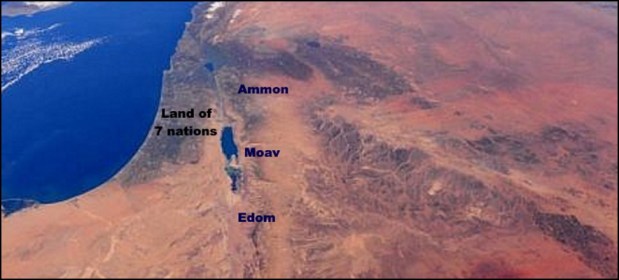
This includes not only the land of the 7 nations, which correspond to the 7 midos (the 7 emotional attributes of chesed, gevurah, etc.), but the land of all 10 nations that was promised to Avraham, including the 3 nations of Keni, Kenizi and Kadmoni, which correspond to the 3 moichin (the 3 intellectual attributes of the soul: Kesser, Chochma, and Bina). And the acquisition of this land will take place peacefully, without the war that was required to conquer the 7 lands, meaning the 7 midos.
This process of “Lech Lecho” — leaving what one is accustomed to, even good and holy things — takes place by revealing powers that one did not even know he had. This includes adding in learning Torah and making chiddushim (novel insights), gathering people on Shabbos to teach them Torah. This process of “Lech Lecho” is the preparation needed to reach the “Torah of Moshiach”, which is connected with the acquisition of the 3 lands, the 3 moichin, which is the “sha’ar haNun“, the 50th gate which Moshe Rabbeinu was only able to reach at the end of his life. And through this we will reach the complete revelation of the Torah that was given at Har Sinai: the level of “a new Torah will go forth from Me” (Vayikra Rabba 13:3 on Yeshayahu 51:4).