The Rambam, in his “Laws of Kings and Their Wars and Melech HaMoshiach”, declares that the coming of Moshiach and the process of redemption are not dependent upon the miraculous: “Do not expect that in the Days of Moshiach the pattern of conduct of the world will change, but rather the word will conduct itself in a normal manner…” “Our sages have taught that there is no difference between this world and the world to come other than servitude to the nations.” (Chapter 12) This means to say that even in the Messianic Era (the first stage), the world continues to go in a natural way, however the Jewish people are no longer in a state of “servitude” to the nations as they were during golus.
In this sicha, the Rebbe explains how the Jewish nation was chosen by Hashem and thus the entire Creation exists for the sake of the Jewish people. The truth is that the nations of the world do not truly hold sway over us (“servitude”).
Even though the Jewish people in exile are found in a state of “servitude to the nations”, and there is a command in the Torah “the law of the land is the law” (dina d’malchusa dina)…the reason is not due to fear of the nations of the world (at the time of exile) G-d-forbid, but quite the contrary: Jews are the primary thing (reishis) and the nations of the world were created for their sake… the reason is that this is the way the Holy One, blessed be He, ordered things, that this is how things need to be in the time of exile.
Although in certain matters (monetary cases, taxes, and the like) “the law of the land is the law”, yet this does not infringe upon matters of Torah and Mitzvos, of the neshoma, and also does not infringe on the bodies and the physicality (and materiality) of a Jew, for he always remains primary (reishis) and above the nations of the world. The command that “the law of the land is the law” is not because he is in a state of servitude to the nations of the world, but because this is what Hashem decreed to be the state of affairs in exile (“because of our sins [we were exiled from our land]”).
In other words, the Rebbe is stating that we are not now in a state of servitude to the nations in any respect. This was in fact always the case, however it is clear that the Rebbe is indicating that a new threshold has been reached: while the Jewish people have always been in essence above servitude to the nations, this was not something that was Continue reading →
The Rebbe brings out from a year where Rosh Hashana falls out on Monday and Tuesday an emphasis on the special value of the avodah of Yidden. The world as it was first created was perfect, but it was a limited level of perfection. Only through the avoidah of Yidden — an infinite neshoma enclothed in a limited physical body — can the world transcend itself and achieve a higher level of perfection. This is the idea, discussed in other sichos, of 10 and 11: the number 10 represents original perfection, and the number 11 transcends that original perfection.
The Rebbe also returns to the concept mentioned in last weeks sicha: that a Jew’s connection to Hashem is intrinsic and not dependent on his performance of Torah and Mitzvos. Torah and Mitzvos simply serve to reveal his intrinsic connection. The Rebbe says that by emphasizing a Jew’s essential connection to Hashem this serves to in turn bring out a greater commitment to Torah and Mitzvos — because in truth a Jew really only does Torah and Mitzvos because this is an expression of his true nature. In other words, we remove all aspects of fear of punishment and we find that he will do mitzvos even more enthusiastically!
And, as the Alter Rebbe said, that Moshiach’s arrival would be publicized in the newspapers, the Rebbe states:
May the Redemption come immediately, indeed, may it be that it has already come. For the newspapers have already written about Moshiach’s coming — may they continue to write more and may these articles be in the past tense for Moshiach’s coming will already be a reality.
Moshiach in the Newspapers 15 March, 1992 (Photo: Marc Asnin)
The midrash says that there are two “firsts”, Yisroel and the Torah, and we don’t know which came first. Until we see that in the Torah it states “command bnei Yisroel”, “say to Bnei Yisroel” , now we know that Yisroel came first. This is the concept of Bikkurim.
The Torah commands us that upon entering and settling Eretz Yisroel, we are to offer Bikkurim, the “first fruits” of the 7 species of which Eretz Yisroel is praised. These first fruits, the initial blossoming of the seven species, are brought to the Beis Hamikdash in Yerushalayim, placed in a basket, presented to the Cohen and given to Hashem.
It turns out, then, that these first fruits achieve the highest purpose that is attainable — to be offered to Hashem in the Beis Hamikdash. The purpose of having fruits in the world, of the world itself, is represented by the these fruits being offered to Hashem. Eating them, enjoying them — all this is secondary. That a Yid gives of his finest to Hashem — this is the real purpose.
The Yidden, the Torah tells us, are the Bikkurim of the world. They are the purpose and ultimate reason for the world’s existence. Not only did Hashem consult with the souls of the Yidden before creating the world, but the world was (and is) created for the Yidden. The world is created by Hashem through the Torah, but for the sake of the Yidden. The connection of Yidden to Hashem is direct, with actually no need for the Torah at all (because the Yid is also one with the Torah). Then why is the Torah so critical?
The role of the Torah is that through keeping the Torah a Jew reveals that he is connected with Hashem in his very essence. The Torah does not exist without Yidden to keep it, but a Yid exists even before he encounters the Torah. And even if he is not keeping the Torah, chas v’sholom, he is still connected in his very essence with Hashem Himself.
The Rebbe elaborates at length in this sicha on the importance of each and every Yid, that a Jew’s true reality is that he is one with the Holy One, blessed be He, which is concealed until it is revealed by his becoming Bikkurim. And the Torah says that the Bikkurim need to be in a container — this is the body which contains the neshoma. One who has sufficient finacial means brings a container made of precious materials. But one who does not have the means brings a simple container and this simple container is kept by the Cohen. This shows that even the lowly material of which his container is made is elevated to be “before Hashem”.
The container [טנא] hints at the letters of Torah (טעמים, נקודות, אותיות), meaning that the neshoma’s “container” — the body — is really the letters of Torah which become the thought, speech and action of a Jew. Even if this relates to “lowly things” (he only understands Torah in a physical way), this body is still a container for his Bikkurim and is elevated to be “before Hashem”. Thus, every thought, every word of speech, and every action of a Yid is important and is in fact the very purpose of the existence of the world! As regards this importance, the Rebbe says:
The preciousness of every Jew before the Holy One, blessed be He is unconditional, he does not need to be a Torah scholar, one who learns Torah or one who fulfills the Mitzvos or the like, but rather “anyone who wants [can approach the King when he is in the field (Elul)]” is able to greet the King, who “greets everyone with a pleasant countenance”.
This closeness to Hashem should cause one, especially in Elul, to take an accounting of his thought, speech, and action, because:
…even one thought, speech, or action which seems of little importance compared to the rest of his thoughts, speech, or actions–but even this thought, speech, or action is a part of his Bikkurim which are brought to the Beis Hamikdash, before Hashem your G-d — and the Cohen who will be in those days is careful with his every movement — certainly [the Jew] will make every effort that even the smallest things, every detail of his conduct, will be done with the complete attention and carefulness.
In conjunction with this: being that we are in essence one with Hashem, when we have an awakening from below, we cause an awakening from Above–and in this way we are able to bring the Geulah! In the Rebbe’s words:
Since a Jew is “one” with the Holy One, blessed be He…he has no private will, but rather in the words of the Mishnah (Pirkei Avos) — “make your will like His will in order that He will make His will like your will” — the will of the Holy One, blessed be He is the will of a Yid and the will of a Yid is the will of the Holy One, blessed be He. Thus, it is in the power of every Jew to (influence the Holy One, blessed be He and to) nullify the golus and to bring the Geulah immediately!
If we want Hashem to bring an end to this Golus, who brings it about? Yidden, since we are one with Him! And if we will have a true will to end Golus רצון אמיתי — then at that same moment Hashem will automatically bring an end to the Golus!
The ruling of the Rambam is well-known: every individual should consider that the fate of the entire world is in his hands. By performing a single mitzvah, one person can tilt the scales of judgement and bring salvation to himself and the world.
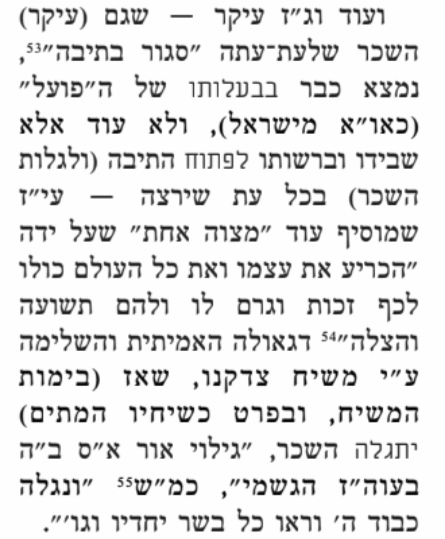
In the Sicha of Ki Seitze 5751, the Rebbe describes how the reward for Mitzvos is, metaphorically, locked in a chest. This chest is in the possession of all Jews.*
“Not only that, but he has the ability and the permission to open the chest (and to reveal the reward) any time he wants — by adding “one mitzvah” more, that through this [mitzvah] ‘he will tilt the scales…'”
Those who learn the Sichos are already familiar with this Rambam (the Rebbe showed an enthusiasm for this Rambam over the years). But, in general, the Rebbe adds a new dimension in his use of sources, and especially regarding the Sichos of Nun-Alef/Nun-Beis we should be on the lookout for new dimensions of understanding.
We offer the following insight:
The Rebbe here separates the words “one mitzvah” מצוה אחת from the rest of the quote from the Rambam, and the Rebbe adds the words “by adding one more mitzvah” (עי”ז שמוסיף עוד מצוה אחת).
To say “adding one more mitzvah” (עי”ז שמוסיף עוד מצוה אחת) implies something quite different than the Rambam’s wording of “performing one mitzvah” (עשה מצוה אחת). Adding one more (עוד) implies a mitzvah that was not already fulfilled, that there is “one more mitzvah” that we can “add” which will bring the revelations of the true and complete Geulah.
In truth, there are many Mitzvos we haven’t fulfilled in actuality, since we lack the ability to bring korbonos. But there is one mitzvah that has not been fulfilled — and is possible to fulfill today — and it is a mitzvah fulfilled by the Jewish people as a whole.*
This is the mitzvah mentioned in last week’s parsha, Parshas Shoftim: the mitzvah to appoint a King שום תשים עליך מלך. Although it was fulfilled in earlier generations, our generation has not properly fulfilled it. More than that, the shleimos of this mitzvah was not reached through the appointing of Shaul Hamelech or Dovid Hamelech; rather its shleimos is the appointing of Melech haMoshiach — which is the responsibility of our generation, specifically!
This interpretation fits perfectly with what the Rebbe says here: because the opening of the “chest” that contains the reward of our Mitzvos (the revelation of Ohr Ein Sof in the world, as explained in the Sicha) is related to Yemos haMoshiach, and it is self-understood that in order for it to be Yemos haMoshiach there must be a Moshiach, whom the Jewish nation has a mitzvah to appoint over themselves, accepting his kingship.
So look at this portion of the Sicha again, and see how the Rebbe is saying that the “one mitzvah” which we can add, which will bring the lofty revelations we are longing for, is the mitzvah of appointing a King מינוי מלך!
Of course, this is a Mitzvah that falls on the shoulders of the entire Jewish nation as a whole, so it’s not enough that you and I and the bochurim in 770 accept the Rebbe as King, Melech haMoshiach, but requires the acceptance of his kingship by the Jewish nation. This is, lechoira, also the meaning of the Rebbe’s words in 28 Nissan 5751 and Noach 5752: “the only thing left is to give it over to you” and “the Geulah doesn’t depend on anything besides Moshiach himself.” There’s no contradiction: what has been give over to us is the acceptance and crowning of Moshiach himself by us!
אין הדבר תלוי אלא במשיח צדקינו עצמו
All that remains is to appoint the King!
*) It is possible, though not necessary, to say that the Rebbe means here the collective body of all Yidden rather than each individual: “The reward that until now is “closed in a chest” is already found in the possession of the “worker” (each and every Jew).”
Two parshas are read this Shabbos: Ki Seitze (“when you go out to war on your enemy”) in the morning, and in the afternoon the first section of “Ki Savo” (“when you will enter the land to inherit it and to settle it…”). Thus, on one single Shabbos, we have two seemingly opposite lessons from the Torah: going to war against an enemy (the avodah of golus), and settling the land (the reward of the Messianic Era).
Since everything is guided by Divine Providence, we have to learn from this combination: that we can be a situation of doing the avodah of making a war on the enemy in the time of golus and yet at the same time be in a completely “settled” state, which is the reward for this avodah.
How can we accomplish this?
Through the knowledge that in essence a Jew is completely above the existence of any opposition — Hashem “consulted” with the souls of the Jewish people before creating the world, showing that we are in fact one with Hashem and above the world. If so, then why would we agree to the creation of a world that contains “enemies” whom we will have to overcome in war? Because Hashem did not want to give us “bread of shame” (unearned reward), and therefore He created a world for us to earn the reward. And our neshomos agreed. In order to realize Hashem’s desire for a dwelling place in the lower realms, there must be lower realms where there is the possibility of war. But the truth of the matter is: a Jew in his source, and even as he is enclothed in a physical body in this world — remains higher than the concept of any opposition.
When a Jew is aware that this is the true reality, then even his “going out to war against the enemy” is infused with the aspect of “settling the land”. “Settling the land” implies Eretz Yisroel, a land which “desired (רצתה) to do perform the will of her Creator” — where there is no longer a “war” to fulfill Torah and Mitzvos, but rather one overcomes his evil inclination with ease.
The Rebbe adds that:
“the main thing –that the avodah is amidst ease and comfort in the simple sense, ease of the soul and ease of the body, which is achieved through the Holy One, blessed be He, giving to every single Jew all that he needs materially and spiritually, and with abundance.”
This includes all that a Jew needs in order to do the avodah itself, and after that as a reward for the avodah that he performs. And this material (and spiritual) reward is a sampling of the physical reward that will be in the Messianic Era. Not only that, but the Rebbe makes a revolutionary statement, that the verse “then their mouths will be filled with laughter” (explained by Chazal and Chassidic discourses as referring to the Time to Come) is applicable now! “Then” is “now” in the present tense. The rewards of the Time to Come, the Messianic Age, are available to us now. Although they are “locked in a box”, every Jew can open the box whenever he wants. How? By performing one more mitzvah. As the saying goes “the future is now” — but by the Rebbe this is not merely a slogan, it is the reality!
All this receives greater emphasis since the year the sicha was said was 5751 (תנש”א), the letters of which spell out the command “you will be exalted”, referring to Moshiach:
…both as regards the revelation and coming of Moshiach [the distinction between these to concepts will be explained separately, G-d willing] and as regards the wedding of Knesses Yisroel and the Holy One, blessed be He in the Messianic Era, and in the words of the [midrash] Yalkut Shimoni: ‘the year Melech HaMoshiach is revealed in him…he stands on the roof of the Beis Hamikdash …and says humble ones, the time of your redemption has arrived’.
The Rebbe adds in the footnote the continuation of this Midrash:
And if you don’t believe, see via my light…at the same time the Holy One, blessed be He, shines the light of Melech Hamoshiach and of Yisroel and they all go to the light of Melech Hamoshiach and of Yisroel, and they [the nations of the world] come and lick the dust from beneath the feet of Melech Hamoshiach…
We will make a divergence from the main body of the sicha in order to understand this. It is important to note what the Midrash is telling us: that there will come a time following the initial revelation of Moshiach (“Moshiach is revealed in him” means the revelation of the soul of Moshiach in the one who has been anointed by Hashem to be Moshiach, explained in our post on Parshas Naso) when nonetheless the Jewish people will not be prepared to believe him when he says that indeed the time of their redemption has arrived. How do they get out of their own lack of confidence in themselves and in the words of Moshiach? The Midrash says “see via my light” (ראו באורי שזרח עליכם), that through Moshiach’s light, meaning wisdom — the Torah that Moshiach teaches — they will be able to see the reality that Moshiach is describing to them.
Through our effort to learn and understand the Torah that Moshiach is revealing to us, we will merit to see the reality that he is describing to us: the reality that “the time of your redemption has arrived”!
The sicha of this week, parshas Shoftim, is unquestionably one of the most significant talks the Rebbe ever gave.
The Rebbe opens the sicha by reiterating that since we have already finished all the work that was required of us in the time exile, and we are “all standing ready” to greet Moshiach, we are now already holding at the time of the fulfillment of the prophetic promise “I will return your judges…and your advisers”.
Explaining the difference between them: a judge is higher than the one whom he is judging, and has no need to explain his rulings. He issues a ruling and it must be obeyed. (And if there is resistance to fulfilling the ruling of the judge, there are police forces to execute these judgments). An adviser, however, is on the same level as the one he is advising, and his role is to explain the judge’s ruling in a way that makes sense to the person. This way, the person can grasp how it is in his own best interest to fulfill the rulings of the judge, which brings about that he will fulfill them eagerly and willingly, with no need for police enforcement. (In the terminology of Chassidus: one obeys the judge out of bittul and kabbalas ‘ol, in a manner of makif; whereas the adviser enables the person to obey the judge with his own understanding, so that it comes into pnimiyus.)
Since the combination of judges and advisers is part of the prophecy of the Messianic era (as opposed to judges and police, which is in the time of exile), we have to start preparing ourselves now by living in this manner already. This makes us into a vessel to receive these revelations, and also Continue reading →
The name “Elul”, the month which begins in some years on Shabbos Parshas Re’eh (as it did in 5751 when this sicha was spoken), famously stands for “Ani L‘dodi V‘dodi Li”, “I am for my Beloved, and my Beloved is for me”. The first part of this verse, “I am for my Beloved”, refers to the avodah from below to Above, the second part (“and my Beloved is for me”) reflects the awakening from Above which follows. In other words, in Elul we serve Hashem from our own power (taking a spiritual accounting, repenting for what is lacking, and making spiritual improvements) and this generates the Awakening from Above which are the lofty revelations of Rosh Hashanah and Yom Kippur.
The Sheloh writes that there is a connection between every parsha and the days when it comes out, meaning in our case a connection between parshas Re’eh and the month of Elul. But whereas the emphasis in Elul is the avodah from below to Above, the very first verse of our parsha is the opposite: “See I am giving you today blessing”, from Above to below. These are completely opposite?! The Rebbe explains this seeming contradiction by first pointing out that although Elul is a month of avodah from below, but the initial letters of Elul include both aspects–below to Above (“I am for my Beloved”) and Above to below (“my Beloved is for me”). More than that, the avodah of Elul itself includes both. It is explained in Chassidus that in the month of Elul “the King is in the field”, meaning that there is a lofty–but hidden–revelation from Above which gives the potential to each and every Jew to bring himself, through his own effort from below, to be suitable to enter the King’s royal chambers on Rosh Hashanah. Thus, the avodah of Elul is inclusive of both inyonim.
The Rebbe notes that:
The avodah of the person from below to Above (“I am for my Beloved”) is (not on a lower level, as implied by it coming from “below”, which is limited by the limitations and state of the person, but rather it is actually) a higher level (“Above”) which is above all limitation. This is because as regards the true inner state of the Jew, the neshoma of the Jew, which is “truly a piece of G-dliness Above”, the level of Yechida, is in fact in a perfect state of unity with the Holy One, blessed be He.
All he needs to do is to reveal his true reality, that he is one with the Holy One, blessed be He. This is accomplished by serving Hashem in a way which transcends limitation, avodah which comes from the essence of his existence, which is that he is one with the Holy One, blessed be He. And because this is the essence of the existence of every Jew, it is relevant even at the beginning of his avodah.
Having said all that, the Rebbe proceeds to give “standing orders”:
It is incumbent to publicize and awaken in every place the avodah of Elul and, with particular emphasis, the inyan of Geuloh, which in fact permeates all of this avodah. All must be permeated and done with the spirit of the Geuloh (including, and especially, through learning Torah on the subjects of Geuloh and the Beis haMikdash), amidst anticipation and complete certainty that immediately we are seeing with fleshly eyes that “Behold, this one (Melech Hamoshiach) comes”.
Simply put: to proclaim and to publicize in every place — with words that come from the heart — that the Holy One, blessed be He says (through his servants the Prophets) to every single Jew “See, I am giving before you today blessing”, until that literally today mamash we see with fleshly eyes the blessing of the true and complete Geuloh.
[And we should add and emphasize that this declaring and publicizing of the above must be also via those who claim that they still didn’t completely “get it”, meaning completely grasping and understanding in a conscious manner. Since they also are complete in their belief, they are able (and thus, they must) publicize these things to others, beginning with their families (for surely they need not “suffer” from the fact that this matter is still not sitting well with him intellectually), and also all those who are found around him, every single Jew, and certainly through the proper effort the words will be accepted and will bring about the desired effect, including also in the one who is proclaiming and publicizing, that by him it will be internalized properly, etc.].
I have to proclaim and publicize even if I’m not completely with it? Yes, even one who is not completely with it.
Perhaps if all of us took these words of the Rebbe seriously and acted on them properly, we would already see it with fleshly eyes. It’s still not too late — “Today, if you will heed his voice“.
Many years Shabbos parshas Eikev blesses the upcoming month of Elul, which was the case in 5751. This, in this sicha the Rebbe addresses the inyan of the month of Elul.
Elul is an acronym for “Ani leDodi v’Dodi Li“, which means “I am for my beloved, and my beloved is for me”. First comes “I am for my beloved”, the effort that comes from below (from us towards Hashem), using our own powers (avoidah b’koach atzmo).
This is related to the fundamental concept of creation: Hashem wants to give us the opportunity to earn our reward, to avoid the embarrassment of receiving “bread of shame” (nahma d’kisufa). This requires not only that we do what we are supposed to do, but that we do it in a way of yegia, exertion, using our own powers. And more than that, to Continue reading →
Shabbos Parshas Va’Eschanan is also “Shabbos Nachamu”, the first of the “seven [Sabbaths] of comforting”, named after the haftorah which begins with the words “Nachamu Nachamu ami” (Be comforted, be comforted, My people).
The double expression of “Nachamu” (double-comforting following the destruction of the Beis Hamikdosh (twice) on Tisha B’Av) implies a true, unlimited comforting after the destruction of Tisha B’Av. (The Rebbe points out that: “Since the comforting is (not only words of comfort and the like, but rather) through the rebuilding of the Beis Hamikdash.”— (one of the jobs of Moshiach.))
The first Beis Hamikdosh was primarily due to revelations from Above to below; the second was primarily an effort from below to Above. The third Beis Hamikdosh, which is eternal, (because it) will be a union of those two qualities. In other words (explained in footnote 52 in the original), the revelation of G-dliness that occurred in the first Beis Hamikdosh was so powerful that it nullified the worldly reality of those in this world; the second Beis Hamikdosh emphasized the integration of G-dly revelation into the worldly reality of those in this world. These will be unified in the third.
This primary difference between these two directions is that the integration of G-dly revelation into the worldly reality of those in this world (in a way which does not “shatter” their reality) takes a long time. Similar to the process of conquering and dividing Eretz Yisroel under Yehoshua, which took 14 years.
This is similar to the process of going from Tisha B’Av to the 15th of Av, of which our sages say “there were never Yomim Tovim for Yisroel like the 15th of Av….” What happened to cause the 15th of Av to receive such a description? The first, and main, event to happen on the 15th of Av is that those who were decreed to die in the desert ceased dying on that day. To explain:
Those who accepted the testimony of the meraglim about the land of Israel and didn’t want to enter were condemned to die in the desert on that same day, Tisha B’Av, during the next 38 years. Each year, on Tisha B’Av, those who reached 60 years old would dig graves, lie down, and would not wake up in the morning. In the final year, the last group followed the same procedure only they were surprised to wake up the next morning! They surmised that they had made a mistake in calculating the day of the month, so the next night they again lay down to die in their graves. But the next morning they also awoke! Thinking that they had erred in calculating the date, they did this again the next night, continuing until the night of the 15th when the full moon indicated that they had not erred in the date but, rather, the decree had been annulled by Hashem!
In other words: the decree had been annulled on Tisha B’Av itself, but it took until the 15th of Av for them to realize this, to internalize it and integrate it. Similarly, the “birth of Moshiach” on Tisha B’Av is not recognized immediately, but takes a long time to be realized, internalized, and integrated. The Rebbe expresses it that “when the moon is full it is known with certainty that Moshiach was already born on Tisha B’Av (similar to what we find regarding the establishment of the 15th of Av as a Yom Tov, even though the decree had been nullified on Tisha B’Av)”. The moon hints at the Jewish people, and the full moon means to receive the light of the sun [Moshe Rabbeinu is likened to the sun] in a complete and perfect manner.
Saying that Moshiach is “born” on Tisha B’Av means a dimension of his revelation (not his physical birth, see the Maharal* and Abarbanel). But even after Moshiach himself becomes spiritually “large”, the exile is drawn out in so that it will be in a complete and perfect manner also as regards its integration by those in this world.
So we understand from the Rebbe’s words that as far as the revelations from Above are concerned, Moshiach is here and nothing is lacking. But nonetheless the state of golus continues because the process of our accepting and integrating this new reality is a time-consuming process (which, of course, is up to us!).
Thus, the instruction of the Rebbe here is to emphasize again the need to learn matters of Geuloh, especially in Pnimiyus Hatorah, in a way of “laboring” in Torah, “and may it be Hashem’s will that through contemplating these matters we should merit immediately to see the true and complete Geuloh — Immediately, mamash”!
* Footnote 93 refers to Netzach Yisroel by the Maharal of Prague, page 132 which speaks of the birth of Moshiach. Towards the end of that page, the Maharal writes how Moshiach’s name is “Menachem”, the comforter, because just as the “comforter” must be distant and removed from the mourning of the one he is comforting, similarly Moshiach (Menachem) is distant and removed from the rest of the people due to his lofty and elevated spiritual level.
In the year 5751, Tisha B’Av fell out on Shabbos. In such a year, the fast, together with all other aspects of mourning the destruction of the Beis Hamikdash, are pushed off until the 10th (Sunday). But the positive aspects of Tisha B’Av remain, which include it being an “auspicious time” (like every fast day) and also the birth of Moshiach. Therefore, on Shabbos Tisha B’Av we are eating a feast! Halacha permits one to sit and enjoy a repast as rich as Shlomo Hamelech’s even to the last moment before shkia (sunset) [unlike regular years, when we eat a mourner’s meal before the fast].
This itself is a taste of the Messianic Age, when all the fast days will be transformed to days of rejoicing, and as such our Shabbos meals on Tisha B’Av assume a Moshiach-like dimension of the feast of the Levyoson and Shor Habar (the Leviathan and Wild Bull). On a deeper level: every year we re-experience the churban, the destruction of the Beis Hamikdash, and the mourning, and then in the afternoon, at Mincha-time, comes the comforting — the birth of Moshiach. This year we have the birth of Moshiach (who builds the 3rd Beis Hamikdash which will never be destroyed) without the churban! This hints that b’pnimiyus the destruction of the 1st and 2nd Beis Hamikdash were really only for the sake of the building of the 3rd, eternal Beis Hamikdash.
All of this was in fact present at the time of the churban, but it was concealed. The inner positive aspects of Tisha B’Av, the birth of Moshiach, does not become revealed until the 15th of Av, which is when the moon is full, the moon being the aspect of Dovid Malka Mashicha. (This also hints at the Jewish people, when they reach full potential to receive the light (as the moon receives and reflects from the sun), reveal that Moshiach was actually born on Tisha B’Av.
The three weeks leading up to Tisha B’Av hint at the “three moichin” (3 aspects of Supernal Intellect) which themselves correspond to the lands of the three nations — Keni, Kenizi, Kadmoni — which were promised to Avraham Avinu (along with the land of 7 nations conquered by Yehoshua). The Torah forbids us to have anything to do with these lands during the time of until Moshiach comes, but the fact that part of these lands were conquered by other nations (Sichon and Og) and then conquered and settled by the tribes of Gad, Reuven, and Menashe, is itself a hint that these three dimensions of the Supernal Intellect come together with the land of 7 nations, which refers to the seven midos.
Sefer Devarim is Moshe Rabbeinu addressing the Jewish nation before they will enter the land of Israel. Moshe knew that Hashem had decreed upon him not to enter the land, but still he did not cease to beseech Hashem in prayer asking Him to allow him to enter the land, reaching 515 prayers (the numerical value of “Va’eschanan”, the parsha we read at Mincha).
From here there is also something for all generations to learn from… that without looking at all the prayers and requests that were until now, we need again and again to daven and request from the Eybershter “Ad Mosai” — “until when”.
…and as was said, immediately mamash, today mamash, since all the matters have been completed, and the Beis Hamikdash stands ready Above, and similarly all the matters — “everything is ready for the feast”, everything is ready as if in a closed chest and they have given the chest and its key to every single Jew. The only thing that we are waiting for — that a Jew will shout another shout, with another request and demand and another reminder: “Ad Mosai“?!…


![[Ki] Savo 5751: Hashem’s Will is Really Yours](https://dvarmalchus770.org/wp-content/uploads/2022/07/bikkurim.png?w=619 "[Ki] Savo 5751: Hashem’s Will is Really Yours")





 Dvar Malchus 770