We present this worked-over translation of a maamer of the Tzemach Tzedek to give a deeper understanding of the land of the 3 nations mentioned in Dvar Malchus and the connection to Geuloh.
The Borders of the Land of Israel in the Future
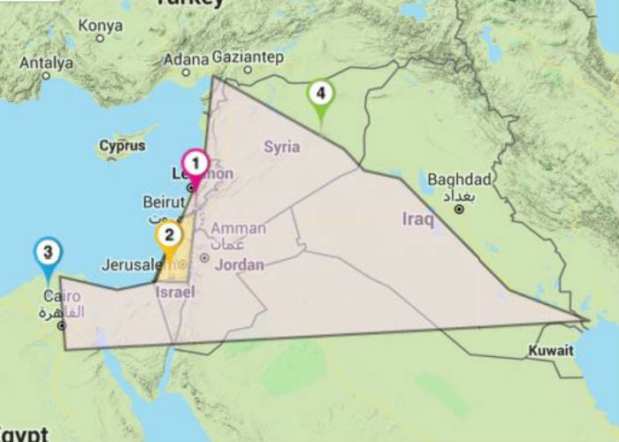
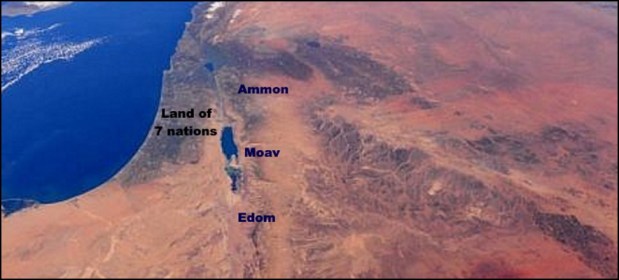
We are promised in the Torah that in the time to come the Jewish people will receive the land of Israel consisting not only of the land of the 7 nations of Canaan but also the land of the three nations of Edom, Moav, and Amon (the Keni, Kenizi and Kadmoni).
This being so, we are confronted with a question: The prophecy of Yechezkiel describes the borders of the land of Israel as they will be in the time to come, but in his prophecy they are clearly defined as being the same borders as were conquered by Yehoshua ‐‐ the land of only 7 nations. His prophecy is about the time to come: why doesn’t he mention the lands of the other 3 nations?
This is also connected to the additional three refuge cities (arei miklat) which we are instructed to establish in those lands. These refuge cities are, in turn, associated with the rectification of Hevel. Kayin was able to kill Hevel because Hevel was already condemned to death (“chayav misa“) for having “gazed at the shechina” while offering his sacrifice.
The Rebbe mentions in the Dvar Malchus of Parshas Lech Lecho that Avraham Avinu is promised by Hashem that his descendants will inherit the land. Hashem made a covenant with Avraham, stating: “To your seed I have given this land, from the river of Egypt until the great river, the Euphrates river. The Keni, the Kenizi, and the Kadmoni, And the Chitti and the Prizi and the Rephaim, And the Amori and the C’naani and the Girgashi and the Yevusi.” (Parshas Lech Lecho, 15:18-21)
Rashi here points out that “There are ten nations [enumerated] here, but He gave them only seven nations. The [other] three are Edom, Moab, and Ammon, and they are [here referred to as] the Keni, the Kenizi, and the Kadmoni, which are destined to be [our] heritage in the future.” The seven nations dwelled in the land of Canaan, which was conquered by the Bnei Yisroel when they entered the land with Yehoshua bin Nun. The other three nations (Keni, Kenizi, Kadmoni) were not ever conquered, and Continue reading →
The chosid R’ Zushya Willemovsky, “The Partisan”, was told by the Rebbe in a private audience in the 1960s that there remained 20 or 21 things that needed to be accomplished in order for Moshiach to come. From this we learn the significance of the sichos of Dvar Malchus in general, and parshas Noach in particular — that everything has been accomplished and nothing is preventing the Geuloh.
In this sicha, the Rebbe speaks about the importance of periodically making a proper spiritual accounting (cheshbon tzedek) to search out a recognize the areas in ourselves which need improvement, even things that are very slight imperfections (such as causing someone to feel bad because we didn’t return their greeting(!)). This should be done with joy, with recognition that it is easier than ever to rectify these matters because the Jewish people, who are like one body, “are found in a state of an individual who is healthy in all of his limbs and organs, both spiritually and physically, and thus anything that is lacking is likened to a weakness or a minor illness in one limb which can be healed quickly and easily”.
Furthermore, when a person takes stock of himself and recognizes that he has flaws and failings which need to be rectified, “this is not a contradiction, G-d forbid, to the testimony of the Leader of the Generation that the work has already been completed and we are standing ready to receive Moshiach Tzidkeinu.” Yes, we need to search these things out, and upon identifying them to rectify them, but these things do not delay Moshiach’s coming.
Dependent Only on Moshiach Himself
“With absolute certainty all the ‘end times’ have passed, and [the Jewish people] have already done tshuva, and now the matter is not dependent upon anything other than Moshiach Tzidkeinu himself!“ (Italics in the original.) Towards the end of the sicha the Rebbe repeats: “…when we do a proper accounting at the end of the first week of the year 5752, “it will be a year with wonders in it”, we come to the conclusion that the matter is not dependent upon anything other than Moshiach Tzidkeinu himself (as stated above)…”
The opening verse in Parshas Noach says that “נֹ֗חַ אִ֥ישׁ צַדִּ֛יק תָּמִ֥ים הָיָ֖ה בְּדֹֽרֹתָ֑יו” “Noach was a righteous man, he was perfect in his generations”. The Midrash on this posuk (Midrash Rabba Noach, 30:8) says in the name of R’ Levi: “Whoever it is said about them ‘he was’ saw a new world.” The Midrash then enumerates five individuals, the first being Noach, citing that when he and his family exited the ark, they saw a new world.
In what sense did Noach see a new world? Obviously, it was the same Earth, although following the waters of the flood surely the surface of the Earth looked different than it did previously. And of course, the evildoers who populated the Earth previously were no longer around. But can we really say that this is what it means to see a “new world”?
The Rebbe, in the sicha of Noach 5752, clues us in to what is being implied here according to pnimiyus haTorah:
In the creation of the world, the Torah refers to Hashem using two names: Continue reading →
The Rambam, in his “Laws of Kings and Their Wars and Melech HaMoshiach”, declares that the coming of Moshiach and the process of redemption are not dependent upon the miraculous: “Do not expect that in the Days of Moshiach the pattern of conduct of the world will change, but rather the word will conduct itself in a normal manner…” “Our sages have taught that there is no difference between this world and the world to come other than servitude to the nations.” (Chapter 12) This means to say that even in the Messianic Era (the first stage), the world continues to go in a natural way, however the Jewish people are no longer in a state of “servitude” to the nations as they were during golus.
In this sicha, the Rebbe explains how the Jewish nation was chosen by Hashem and thus the entire Creation exists for the sake of the Jewish people. The truth is that the nations of the world do not truly hold sway over us (“servitude”).
Even though the Jewish people in exile are found in a state of “servitude to the nations”, and there is a command in the Torah “the law of the land is the law” (dina d’malchusa dina)…the reason is not due to fear of the nations of the world (at the time of exile) G-d-forbid, but quite the contrary: Jews are the primary thing (reishis) and the nations of the world were created for their sake… the reason is that this is the way the Holy One, blessed be He, ordered things, that this is how things need to be in the time of exile.
Although in certain matters (monetary cases, taxes, and the like) “the law of the land is the law”, yet this does not infringe upon matters of Torah and Mitzvos, of the neshoma, and also does not infringe on the bodies and the physicality (and materiality) of a Jew, for he always remains primary (reishis) and above the nations of the world. The command that “the law of the land is the law” is not because he is in a state of servitude to the nations of the world, but because this is what Hashem decreed to be the state of affairs in exile (“because of our sins [we were exiled from our land]”).
In other words, the Rebbe is stating that we are not now in a state of servitude to the nations in any respect. This was in fact always the case, however it is clear that the Rebbe is indicating that a new threshold has been reached: while the Jewish people have always been in essence above servitude to the nations, this was not something that was Continue reading →
Released a few days in advance of Rosh Hashono, the discourse begins with the verse from the prophet Yeshaya: “On that day a great shofar will be sounded, and the ones who are lost in the land of Ashur and the ones who are pushed away in the land of Mitzrayim, will come and prostrate themselves to Hashem on the Holy Mountain in Yerushalayim.”
The Rebbe asks a few questions on this verse: What is special about a “great shofar”? Why does it say that the shofar “will be sounded” without specifying who will be sounding it — it seems as though it will be sounded on its own?
The shofar here is explained in spiritual terms: the cry of the innermost point in the heart which is above intellect. This cry draws down the corresponding level from Above, meaning the Supernal Will which transcends the level of Chochma (usually translated as “wisdom”).
There is a different verse that describes the shofar as being sounded by Hashem, but that verse refers only to a “shofar” and not a “great shofar”. But the “great shofar” of the future is sounded from a level higher than any of Hashem’s names!
At Matan Torah there was also the sound of a shofar, but not a “great shofar” — because the shofar of the future will be even greater than at Matan Torah. The reason (given in the name of the Mitteler Rebbe) is that at the time of Matan Torah the entire Jewish people were in a state of closeness with G-dliness קירוב לאלקות and therefore a “regular” shofar was sufficient to awaken their hearts. But the shofar of the future, of the true and complete Geuloh, has to reach the “lost” and the “pushed away”, who are far from G-dliness, and therefore in order to reach them requires the “great shofar”. This also explains why it seems that it will be sounded “by itself” — because in order to awaken those who are so far from any interest or recognition of G-dliness will require a cry from Above, by itself, without any awakening from below at all. Now, on every Rosh Hashono, we sound a regular shofar, meaning that through our effort we awaken and draw down from Above. But the great shofar of the future is drawn down by itself without any effort from below.
However, there is a question: we find that the great shofar of the future is likened to our own sounding of the shofar (by our own effort) on Rosh Hashono — they couldn’t be more different! The Rebbe explains Continue reading →
The Rebbe brings out from a year where Rosh Hashana falls out on Monday and Tuesday an emphasis on the special value of the avodah of Yidden. The world as it was first created was perfect, but it was a limited level of perfection. Only through the avoidah of Yidden — an infinite neshoma enclothed in a limited physical body — can the world transcend itself and achieve a higher level of perfection. This is the idea, discussed in other sichos, of 10 and 11: the number 10 represents original perfection, and the number 11 transcends that original perfection.
The Rebbe also returns to the concept mentioned in last weeks sicha: that a Jew’s connection to Hashem is intrinsic and not dependent on his performance of Torah and Mitzvos. Torah and Mitzvos simply serve to reveal his intrinsic connection. The Rebbe says that by emphasizing a Jew’s essential connection to Hashem this serves to in turn bring out a greater commitment to Torah and Mitzvos — because in truth a Jew really only does Torah and Mitzvos because this is an expression of his true nature. In other words, we remove all aspects of fear of punishment and we find that he will do mitzvos even more enthusiastically!
And, as the Alter Rebbe said, that Moshiach’s arrival would be publicized in the newspapers, the Rebbe states:
May the Redemption come immediately, indeed, may it be that it has already come. For the newspapers have already written about Moshiach’s coming — may they continue to write more and may these articles be in the past tense for Moshiach’s coming will already be a reality.
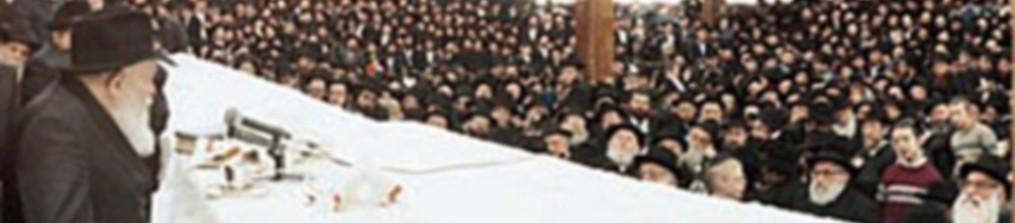
Moshiach in the Newspapers 15 March, 1992 (Photo: Marc Asnin)
The midrash says that there are two “firsts”, Yisroel and the Torah, and we don’t know which came first. Until we see that in the Torah it states “command bnei Yisroel”, “say to Bnei Yisroel” , now we know that Yisroel came first. This is the concept of Bikkurim.
The Torah commands us that upon entering and settling Eretz Yisroel, we are to offer Bikkurim, the “first fruits” of the 7 species of which Eretz Yisroel is praised. These first fruits, the initial blossoming of the seven species, are brought to the Beis Hamikdash in Yerushalayim, placed in a basket, presented to the Cohen and given to Hashem.
It turns out, then, that these first fruits achieve the highest purpose that is attainable — to be offered to Hashem in the Beis Hamikdash. The purpose of having fruits in the world, of the world itself, is represented by the these fruits being offered to Hashem. Eating them, enjoying them — all this is secondary. That a Yid gives of his finest to Hashem — this is the real purpose.
The Yidden, the Torah tells us, are the Bikkurim of the world. They are the purpose and ultimate reason for the world’s existence. Not only did Hashem consult with the souls of the Yidden before creating the world, but the world was (and is) created for the Yidden. The world is created by Hashem through the Torah, but for the sake of the Yidden. The connection of Yidden to Hashem is direct, with actually no need for the Torah at all (because the Yid is also one with the Torah). Then why is the Torah so critical?
The role of the Torah is that through keeping the Torah a Jew reveals that he is connected with Hashem in his very essence. The Torah does not exist without Yidden to keep it, but a Yid exists even before he encounters the Torah. And even if he is not keeping the Torah, chas v’sholom, he is still connected in his very essence with Hashem Himself.
The Rebbe elaborates at length in this sicha on the importance of each and every Yid, that a Jew’s true reality is that he is one with the Holy One, blessed be He, which is concealed until it is revealed by his becoming Bikkurim. And the Torah says that the Bikkurim need to be in a container — this is the body which contains the neshoma. One who has sufficient finacial means brings a container made of precious materials. But one who does not have the means brings a simple container and this simple container is kept by the Cohen. This shows that even the lowly material of which his container is made is elevated to be “before Hashem”.
The container [טנא] hints at the letters of Torah (טעמים, נקודות, אותיות), meaning that the neshoma’s “container” — the body — is really the letters of Torah which become the thought, speech and action of a Jew. Even if this relates to “lowly things” (he only understands Torah in a physical way), this body is still a container for his Bikkurim and is elevated to be “before Hashem”. Thus, every thought, every word of speech, and every action of a Yid is important and is in fact the very purpose of the existence of the world! As regards this importance, the Rebbe says:
The preciousness of every Jew before the Holy One, blessed be He is unconditional, he does not need to be a Torah scholar, one who learns Torah or one who fulfills the Mitzvos or the like, but rather “anyone who wants [can approach the King when he is in the field (Elul)]” is able to greet the King, who “greets everyone with a pleasant countenance”.
This closeness to Hashem should cause one, especially in Elul, to take an accounting of his thought, speech, and action, because:
…even one thought, speech, or action which seems of little importance compared to the rest of his thoughts, speech, or actions–but even this thought, speech, or action is a part of his Bikkurim which are brought to the Beis Hamikdash, before Hashem your G-d — and the Cohen who will be in those days is careful with his every movement — certainly [the Jew] will make every effort that even the smallest things, every detail of his conduct, will be done with the complete attention and carefulness.
In conjunction with this: being that we are in essence one with Hashem, when we have an awakening from below, we cause an awakening from Above–and in this way we are able to bring the Geulah! In the Rebbe’s words:
Since a Jew is “one” with the Holy One, blessed be He…he has no private will, but rather in the words of the Mishnah (Pirkei Avos) — “make your will like His will in order that He will make His will like your will” — the will of the Holy One, blessed be He is the will of a Yid and the will of a Yid is the will of the Holy One, blessed be He. Thus, it is in the power of every Jew to (influence the Holy One, blessed be He and to) nullify the golus and to bring the Geulah immediately!
If we want Hashem to bring an end to this Golus, who brings it about? Yidden, since we are one with Him! And if we will have a true will to end Golus רצון אמיתי — then at that same moment Hashem will automatically bring an end to the Golus!
The ruling of the Rambam is well-known: every individual should consider that the fate of the entire world is in his hands. By performing a single mitzvah, one person can tilt the scales of judgement and bring salvation to himself and the world.
In the Sicha of Ki Seitze 5751, the Rebbe describes how the reward for Mitzvos is, metaphorically, locked in a chest. This chest is in the possession of all Jews.*
“Not only that, but he has the ability and the permission to open the chest (and to reveal the reward) any time he wants — by adding “one mitzvah” more, that through this [mitzvah] ‘he will tilt the scales…'”
Those who learn the Sichos are already familiar with this Rambam (the Rebbe showed an enthusiasm for this Rambam over the years). But, in general, the Rebbe adds a new dimension in his use of sources, and especially regarding the Sichos of Nun-Alef/Nun-Beis we should be on the lookout for new dimensions of understanding.
We offer the following insight:
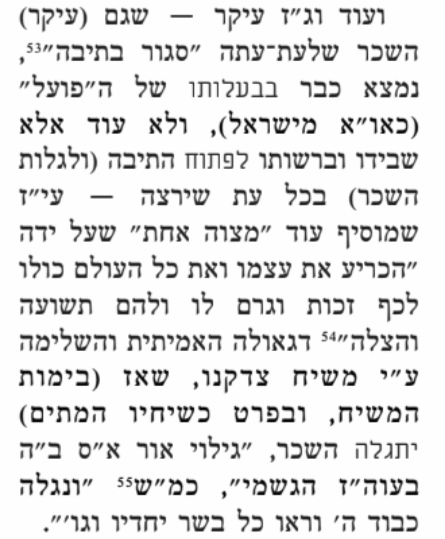
The Rebbe here separates the words “one mitzvah” מצוה אחת from the rest of the quote from the Rambam, and the Rebbe adds the words “by adding one more mitzvah” (עי”ז שמוסיף עוד מצוה אחת).
To say “adding one more mitzvah” (עי”ז שמוסיף עוד מצוה אחת) implies something quite different than the Rambam’s wording of “performing one mitzvah” (עשה מצוה אחת). Adding one more (עוד) implies a mitzvah that was not already fulfilled, that there is “one more mitzvah” that we can “add” which will bring the revelations of the true and complete Geulah.
In truth, there are many Mitzvos we haven’t fulfilled in actuality, since we lack the ability to bring korbonos. But there is one mitzvah that has not been fulfilled — and is possible to fulfill today — and it is a mitzvah fulfilled by the Jewish people as a whole.*
This is the mitzvah mentioned in last week’s parsha, Parshas Shoftim: the mitzvah to appoint a King שום תשים עליך מלך. Although it was fulfilled in earlier generations, our generation has not properly fulfilled it. More than that, the shleimos of this mitzvah was not reached through the appointing of Shaul Hamelech or Dovid Hamelech; rather its shleimos is the appointing of Melech haMoshiach — which is the responsibility of our generation, specifically!
This interpretation fits perfectly with what the Rebbe says here: because the opening of the “chest” that contains the reward of our Mitzvos (the revelation of Ohr Ein Sof in the world, as explained in the Sicha) is related to Yemos haMoshiach, and it is self-understood that in order for it to be Yemos haMoshiach there must be a Moshiach, whom the Jewish nation has a mitzvah to appoint over themselves, accepting his kingship.
So look at this portion of the Sicha again, and see how the Rebbe is saying that the “one mitzvah” which we can add, which will bring the lofty revelations we are longing for, is the mitzvah of appointing a King מינוי מלך!
Of course, this is a Mitzvah that falls on the shoulders of the entire Jewish nation as a whole, so it’s not enough that you and I and the bochurim in 770 accept the Rebbe as King, Melech haMoshiach, but requires the acceptance of his kingship by the Jewish nation. This is, lechoira, also the meaning of the Rebbe’s words in 28 Nissan 5751 and Noach 5752: “the only thing left is to give it over to you” and “the Geulah doesn’t depend on anything besides Moshiach himself.” There’s no contradiction: what has been give over to us is the acceptance and crowning of Moshiach himself by us!
אין הדבר תלוי אלא במשיח צדקינו עצמו
All that remains is to appoint the King!
*) It is possible, though not necessary, to say that the Rebbe means here the collective body of all Yidden rather than each individual: “The reward that until now is “closed in a chest” is already found in the possession of the “worker” (each and every Jew).”
Near the end of the sicha (ois 15) the Rebbe makes an astonishing statement that demands our attention. The verse in Tehillim (126b) states “then our mouths will be filled with laughter” (אז ימלא שחוק פינו), upon which the gemara (Brochos 31a) comments:
Rabbi Yoḥanan said in the name of Rabbi Shimon ben Yoḥai: One is forbidden to fill his mouth with mirth in this world, [= as long as we are in exile (in the name of the Ge’onim)], as it is stated: “then will our mouths fill with laughter and our lips with song” (Tehillim 126:2). When will that joyous era arrive? When “they will say among nations, the Lord has done great things with these” (Tehillim 126:2).
The emphasis is that “then” is referring to the time of the future Geuloh (and thus it is explained throughout Torah, including Toras HaChassidus of all of the Rebbeim, including the Rebbe). The time to “fill our mouths with laughter” is at the time of the Geuloh. Now comes the amazing chiddush of the Rebbe:
“Then (in the time to come, l’asid lavo) we will fill our mouths with laughter.”, which, in our generation, the Nossi of the generation, my father-in-law the Rebbe, whose second name is Yitzchok, from the root meaning laughter and joy, and he is the 8th Nossi from the Baal Shem Tov (8 being the gematria of “then” in our posuk אז), the inyan of “we will fill our mouths with laughter” is done (not in the future tense, “then”, but rather) in the present tense.
A verse that is universally explained to be referring to the time of the Geuloh, some time in the future, is now explained by the Rebbe to be something that is occurring (or can occur) now! To understand better what this means (in addition to the clear implication that this aspect of Geuloh is no longer something reserved for the future) let us take the Rebbe’s own description of what it means to “fill our mouths with laughter”.
If we look at the maamor “Ani L’Dodi” printed as a Kuntres in Elul, 5750 (one year before our sicha), we will find that the Rebbe offers us the following definition of our posuk:
A smiling countenance [referring to the moshol of the King in the field] — this is the essential pleasure תענוג עצמי (which the Holy One, blessed be He, takes in Yidden), the inyan of the circus קניגיא [which Hashem will make in the times of Geuloh for the pleasure of the Tzaddikim] when we will see in a revealed way that all the war of good and evil (in this world) is only for laughter and pleasure, “then we will fill our mouths with laughter”.
This means that during Golus we are unable to properly realize that our struggle with evil is really a staged battle from which Hashem takes great pleasure and from which we ourselves will take great pleasure, and therefore we cannot “fill our mouths with laughter” because our battle against evil seems very real, the existence of the evil is an ever-present danger. But the time of Geuloh brings with it a new revelation: that this is all part of the Divine plan for Divine pleasure, and realizing this properly allows us to “fill our mouths with laughter” despite our struggles with the evil inclination. Evil is no longer real, but simply part of the “game” of this world (as the Rebbe explains earlier in this sicha regarding “when you go out to war ‘on’ your enemies” — higher than and above your enemies (to the point that they don’t have a real existence)). Thus, when the Rebbe says that we can already fill our mouths with laughter, it means that we are capable of properly grasping and internalizing the true nature of our struggle with our “enemies”. When one realizes this, he will not have any fear but rather renewed motivation to overcome these “enemies”, since he can fully recognize that this is all a Divinely ordained “circus” and not a real battle at all.





![[Ki] Savo 5751: Hashem’s Will is Really Yours](https://dvarmalchus770.org/wp-content/uploads/2022/07/bikkurim.png?w=619 "[Ki] Savo 5751: Hashem’s Will is Really Yours")

 Dvar Malchus 770