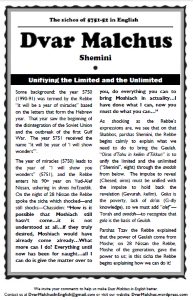
1. This year the holiday of Pesach possesses a unique dimension because the first day of Pesach and therefore the last day (in the Diaspora) fall on Shabbos. The day on which Pesach falls also imparts a special property to Parshas Shemini, causing the portion to be read eight times (this includes the readings on the Shabbos afternoons and on Mondays and Thursdays) over a period of three weeks. There is a popular adage Shemini Shemoneh Shemainoh, “When Parshas Shemini is read eight times, it will be a plentiful year.”
Shemini means “the eighth,” while in contrast, the natural order is a cycle of seven. Even Shabbos, the seventh day, is associated with a sense of perfection and completion within the natural order as reflected in our Sages’ statement: “What was the world lacking? Rest. When Shabbos came, with it came rest;” the quality of rest which Shabbos contributes is a dimension which, when missing, creates a lack in the world. In contrast, eight refers to a quality that is totally transcendent in nature, entirely above the limits of our world.
This contrast can be further developed by focusing on the unique aspect of the Counting of the Omer this year. It is written, “And you shall count… from the day following the Shabbos… and they shall be seven perfect weeks.” When Pesach falls on Shabbos, the Counting of the Omer begins “from the day following the Shabbos” in a simple sense, and thus the weeks of the Counting of the Omer parallel the ordinary weekly cycle. Our Sages explain that this endows an added dimension of perfection to this period of time.
To explore this concept in greater depth: Pesach and the Counting of the Omerreflect two different patterns in the service of G‑d. Pesach means “leap” and refers to a leap beyond the natural order as in the redemption from Egypt when “the King of kings, the Holy One blessed be He, revealed Himself to them and redeemed them.”
In contrast, the Counting of the Omer represents a systematic sequence of development in which a person refines his seven emotional qualities. In particular, these seven qualities each include each other. Thus in the 49 (7×7) days of the Omer, we refine each particular dimension of our emotional makeup. Similarly, this service elevates the world at large which was created through the medium of these seven emotional qualities.
Thus, it appears that Pesach and the Counting of the Omer represent two different patterns of service: Why does the Torah associate the two?
This question is reinforced by the fact that, when giving the command to count the Omer, the Torah refers to Pesach as “the Shabbos.” Here also we see a similar contrast. The sanctity of the festivals is dependent on the service of the Jewish people. Thus our Sages interpret the verse “These are the festivals of G‑d which you will declare” to mean that the sanctity of the festivals are dependent on the Jewish people.
In contrast, the sanctity of Shabbos does not depend on the Jews at all. Its holiness is drawn down from above. If so, why does the Torah associate the Counting of the Omer (which as above refers to man’s service) with the term Shabbos (that reflects holiness endowed to us by G‑d)?
These difficulties can be resolved as follows: Man’s service does not involve only those elements of spirituality to which he shares a connection, i.e., those that relate to the natural order. Even those which transcend the natural order and whose revelation depends on G‑d, must be internalized and drawn down within our personalities and within the world at large through man’s service. In this manner, we can achieve a fusion of both qualities: There will be a revelation of G‑dliness which transcends the natural order, but it will be drawn down within the world through man’s service.
This concept is alluded to in the verse, “And you shall count for yourselves,… from the day following the Shabbos…” Homiletically, the expression “the day following the Shabbos” refers to a level above Shabbos, i.e., above even the level of perfection within the natural order. Furthermore, by using this term rather than the expression, “the day following the festival,” the Torah indicates that this influence surpasses not only the influence which the Jews can draw down through their own efforts (the festivals), but also surpasses the influence which is drawn down from above (Shabbos).
By telling us, “And you shall count for yourselves,” the Torah also emphasizes the intent that this influence be drawn down within the world at large. The verse continues, mentioning “seven perfect weeks,” which points to the efforts to have this influence permeate the world in a particular way. This leads to the counting of “fifty days,” the revelation of a level which transcends the world, even as it exists in a refined sense (i.e., the 49 days of the Omer, in which each of the seven attributes with which the world was created is expressed in a refined manner).
The fiftieth level which is associated with the giving of the Torah, transcends the set of worldly existence entirely. Nevertheless, since it is preceded by the service of the Counting of the Omer, this level can be drawn down within the context of material existence.
Based on the above, we can appreciate the unique dimension contributed by the fact that Pesach falls on Shabbos. Firstly, in such a year, it is clearly seen how the influence drawn down is from “the day following Shabbos,” i.e., its uniquely transcendent nature is openly revealed. Secondly, since the weeks of the Counting of the Omer parallel the weeks of the natural order, we clearly see how this transcendent influence permeates the world at large. Thus, the two dimensions which characterize the influence of the Counting of the Omer each year are more openly revealed when the first day of Pesach falls on Shabbos.
In a more particular way, these levels described above are revealed this year on the first Shabbos within the Counting of the Omer (in the Diaspora, Acharon Shel Pesach, in Eretz Yisrael, Isru Chag) when the counting of one full week of the Omer, the week associated with the quality of chessed, is completed. Furthermore, the completion of the counting of this week relates to the completion of the counting as a whole for Chessed is described as “the day (quality) which accompanies all the other days (qualities).”
In such a year, the two qualities mentioned above are revealed in microcosm. The revelation of the dimension which transcends the worldly set is reflected in Acharon Shel Pesach’s being the eighth day of the holiday. As mentioned above, the number eight points to a revelation above the natural order. The completion of the counting of the first week reflects how this influence is drawn down into the world at large, because as mentioned above, the attribute of Chessed has an effect on all the other qualities.
These qualities are further emphasized when the eighth day of Pesach falls on Shabbos for this reveals how the transcendent dimension associated with eight is fused with Shabbos, i.e., the natural order as it exists in a perfect manner.
There is also a connection to the holiday of Acharon Shel Pesach itself. The celebration of Acharon Shel Pesach was instituted in connection with the Seventh Day of Pesach, the day which commemorates the splitting of the Red Sea which was the final stage of the exodus from Egypt.
In Chassidic thought, it is explained that the splitting of the sea reflected the bonding between the transcendent worlds which are above revelation (the sea, whose creations are hidden and covered by the sea’s waters) and the lower revealed worlds (the dry land, on which the creations can be openly seen). In particular, there are two opinions regarding the nature of the bond established: a) The Zohar’s conception, that the bond was established through the elevation of the lower realms; b) The AriZal’s conception, that the bond was established through the revelation from above.
According to Chassidus, “these and these are the words of the living G‑d,” and both conceptions are true. And in this way, the fusion is complete, a revelation from above (when the revelation is initiated from above, more transcendent levels are revealed) and an elevation from below (which allows the influence received to be internalized in a more complete manner). Thus, we also have a parallel to the theme explained above, that the revelation which transcends the world will permeate the world itself.7
Herein we can also see a connection to Parshas Shemini. As mentioned above,Shemini represents a level above the natural order which revolves around a cycle of seven. Thus there is a parallel to Pesach which represents “a leap” above the natural order, and a closer parallel this year when the “the day following the Shabbos” — which reflects a level above Shabbos, the perfection of the natural order — falls on Shabbos itself. Even the transcendent levels associated with Shemini — and this year, the peaks associated with the reading of the parshah eight times (i.e., transcendence within transcendence) — are drawn down into our world through the Counting of the Omer.
* * *
2. Pesach is “the season of our freedom.” In addition to commemorating the redemption from Egypt, it also grants the potential for all future redemptions, including the ultimate redemption when “as in the days of your exodus from Egypt, I will show you wonders.” In particular, it is the eighth day of Pesach which shares a connection with Mashiach. This is expressed in the following: a) As mentioned above, the number eight is associated with the Era of Redemption; b) The Haftorah recited on the eighth day of Pesach contains many prophecies related to the coming of Mashiach, “A shoot shall emerge from the stem of Yishai…” and the state of peace which he will introduce into the world, “the wolf will dwell with the lamb.” c) The Baal Shem Tov instituted the custom of eating Mashiach’s Seudah, “the feast of Mashiach,” on the eighth day of Pesach. This custom was publicized by the Rebbe Rashab in Yeshivas Tomchei Temimim in 5666 — when he also introduced the custom of drinking four cups of wine in association with the Torah’s four expressions of redemption — and has now spread throughout the Jewish community.
There is also a connection between the Counting of the Omer on Acharon Shel Pesach and the Era of Redemption. In general, the Counting of the Omer shares a connection with the redemption. The Counting of the Omer is intended to bring about a revelation of the 50th Gate of Understanding, a level which will be revealed in a complete and permanent manner in the Era of Redemption.
There is a reflection of this revelation on the present day, for as explained above, the completion of counting the week associated with the attribute of Chessed has a connection with the completion of the Counting of the Omer as a whole. In particular, this is reflected in the counting of the Sefirah, Malchus sheb’Chesed on the night of Acharon Shel Pesach. The ultimate expression of G‑d’s Chessed (kindness) will be in the Era of Redemption when His Malchus (kingship) will be revealed throughout the world.
All of the above concepts are given greater emphasis this year due to the influence of Shabbos and Parshas Shemini. In particular, we see howMashiach’s Seudah leads to and becomes part of the Melaveh Malkah meal, the meal which is associated with King David who is the progenitor of Mashiach and is himself described as Malkah Mashichah, “the anointed king.” May Mashiach come and actually join us at this meal and may the grace be led by King David as related by our Sages.
And then, from this meal we will proceed to the era when “The Merciful One will restore the service of the Beis HaMikdash for us.” May this be in the immediate future.
Translation by Sichos in English




 Dvar Malchus 770