12) Kuntres Chof Menachem Av: How to Add the “Alef”

12) Kuntres Chof Menachem Av: How to Add the “Alef”

The Rebbe mentions numerous times in these talks that everything that is necessary for the Geuloh is already here, we simply need to add the letter “alef” to the word gola (which means exile), thereby transforming it to Geuloh.  But what exactly does it mean to add an “alef” to the exile that we are in?

There are many levels to answering this question, the most basic of which is that it means revealing Hashem (the ruler of the world, “alufo shel olam“) in the world through Torah and Mitzvos.  Additionally, it means recognizing Hashem’s Divine Providence that is behind everything, even those things which appear to us as the opposite of good.

We find an even deeper and more comprehensive explanation in the Chassidic Discourse that was edited by the Rebbe and published in 1991 in honor of the Hillula (anniversary of the passing) of the Rebbe’s father, Levi Yitzchak Schneersohn.

The discourse discusses the source for the statement of our sages that a Jew must make 100 blessings every day.  The sages find scriptural support for this in a verse from parshas Ekev: “Now, Yisroel, what (“mah”) does Hashem your G-d want from you” (Devarim 10:12).  The sages say “don’t read mah (“what”) rather me’ah (“one hundred’)”.  This familiar technique of the sages doesn’t change the original meaning, of course, but adds another level.  In this case, they are adding the letter “alef” to the “mah” (which means “what”) and the result is the one hundred blessings (“me’ah”) that a Jew must say.

In chapter 3 of the discourse, the Rebbe explains the deeper significance of inserting an “alef”, which is surely applicable as well to the Rebbe’s instruction to add an “alef” to exile to transform gola into Geuloh.  To briefly summarize the Rebbe’s words:

“Mah“ symbolizes Malchus, which is the level where G-dly revelation can be internalized (in Chassidic terminology, the level of memaleh kol almin and the soul levels of Nefesh, Ruach, Neshoma).  In the  avodah of a Yid, this is the avodah of “you shall love Hashem your G-d with all of your heart” (b’chol levovecha) which derives from the external dimension of the soul’s intellect (chitzoniyus ha’seichel).  As implied by the term “all of your heart” it generates a feeling of love in the emotional attributes of the heart’s emotional attributes, but only there.

“Me’ah” is the level of Arich, a level that transcends us and can only be revealed in a transcendent, encompassing manner (sovev kol almin and the transcendent soul level of Chaya).  In our avodah this is the love “with all of your soul” (b’chol nafshecha) which derives from the internal dimension of the soul’s intellect (pnimiyus ha’seichel).  This love is felt in the intellect, and then automatically spreads out to affect all the soul’s powers and limbs.

How do we go from one level to the next, from “with all of your heart” (limited to the heart) to “with all of your soul” (which spreads to all the powers of the soul)?  It is through the avoda of “all of your might” (b’chol me’odecha), which reaches the “alef“, the supernal level of Atik which completely transcends the world (higher than both memaleh kol almin and sovev kol almin, the soul level of Yechida).  In avodah this is mesirus nefesh, to give one’s soul (either literally, or, in the way applicable in our generation: giving away one’s personal desires, mesirus haratzon, in order to fulfill the will of Hashem).  Because it transcends the other two levels, it is able to unite them and to draw down (the meaning of brocha, a blessing) the level of “me’ah” into the level of “mah“, that they should both be revealed in the person.

Clearly, this is understandable as regards the “alef” which we must insert into gola in order to make Geuloh: to awaken the level of Yechida, through serving Hashem “with all of your might”, having true mesirus nefesh to fulfill Hashem’s will, especially as it is revealed through “your servants, the prophets” and most especially the Novi of our generation.  This puts in the Alef and results in Geuloh!  Let’s not be lazy about this, because we have to bring Moshiach now!

Golus — Even While the Light of Geuloh is Shining?

The human eye can perceive light.  But only when it has a wavelength between approximately 380 nanometers (seen as violet) and 750 nanometers (seen as red). But these light rays are only a small fraction of the very broad spectrum of rays that exist, from 0.0001 nanometers in wavelength to a full meter.  This covers Gamma rays, x-rays, ultraviolet, infrared, microwaves, and radio waves — none of which the human eye can perceive.

But this is not a science lesson — what does it have to do with Geuloh?

We will see that it is a basis for understanding how the Rebbe can say that the Geuloh is here, all the end times have passed, and yet we remain in golus.  On the face of it, there is no logical basis to say that Continue reading →

11) Kuntres 15 Av, 5751: An End to Darkness

11) Kuntres 15 Av, 5751: An End to Darkness

In honor of the 15th of Av, 5751, the maamor “קץ שם לחושך” (“He imposed a limit to the darkness”) was released.

The Rebbe asks the question: since every created thing has a limit, why does this verse say that Hashem “imposed” a limit on the darkness — implying that otherwise it would not have had a limit?  The answer begins that in general, undesirable things (darkness) are pushed away by light.  But our posuk is telling us that after reaching the limit of the darkness, it won’t be the possibility for darkness.  This is the true Geuloh, which leaves no room for darkness.

The maamor then begins to get into deep concepts of chassidus, of which we will mention only one.  Many of the Dvar Malchus sichos speak about the need to draw the makif into the pnimi, meaning to internalize in the intellect (seichel) that which is above the intellect.  For this there are two examples brought in this maamor: Will (ratzon) which is enlothed in intellect; and Faith (Emunah) which is enclothed in intellect.  On their own, both Will and Faith, Ratzon and Emunah, are beyond the intellect, called in Chassidus “makif“.  But the manner in which they are internalized (brought into the intellect) is quite different.

We find that Ratzon overpowers and “forces” the intellect to come to the conclusions it wants.  The intellect understands things in the way that the Ratzon wants.  We see this in the ability of human beings to intellectually justify almost any behavior or goal that they want.  To “rationalize” something that is really not “rational” — this is the power of the Will to overpower the intellect so that it comes to the conclusions that the Ratzon wants.  The Ratzon is forcing and changing the seichel, and the seichel is being nullified in the face of the Ratzon.  Thus, it is not much of a chiddush that the Ratzon remains unchanged (the person still wants the same thing, because he “forced” his intellect to give him a good rational).

When bringing Emunah into intellect, however, the belief does not force the intellect.  The fact that his intellect will agree to what he believes in (meaning: to intellectually accept that his belief is true) is coming from the power of the intellect itself, the result of a true and unbiased conclusion:

When he contemplates intellectually in order that his intellect will also be in accordance with his belief, he makes an effort that his contemplation and “intellectual back and forth” will be honest and unbiased (ע”פ אמיתת השכל), and nonetheless it does not cause a change is his Emunah [he does not “lose his faith” as a result of his effort to come to a rational understanding of the things he believes in]…because even after he understands the matter intellectually, his Emunah remains above his intellect.  

The Rebbe also brings here, in footnote 33 (on the words “honest and unbiased (ע”פ אמיתת השכל)” from the Rebbe Rashab:

“and since he knows that the thing [in which he believes] is in essence true, because his Emunah is on strong foundations, he is not afraid to delve deeply into the subject and he does not limit the power of his seichel to inquire and seek and weigh each thing until he will come to the truth of the matter.”

The Rebbe is giving over something very relevant to the subject of Geuloh: it is not enough to have Emunah — this Emunah must be brought into seichel.  This must be done honestly and truthfully (unlike when we bring Ratzon into seichel, when the honesty of the intellect is compromised to the Ratzon).  This depends on our Emunah standing on strong, unshakable foundations, an Emunah which is not afraid to look honestly at the subject (and nonetheless, it will not be compromised from the challenges involved in trying to understand).  This is a sort of litmus test for us: do we really believe the Rebbe when he tells us that we are the last generation of golus and the first generation of Geuloh (and all that comes along with that)?  If so, we must take that Emunah and bring it into our understanding — this is the inyan of learning Moshiach and Geuloh.

If we find that we have to “force” our understanding, then our conclusions will not be true (probably because we are afraid that our Emunah is not so solid).  On the other hand, we cannot remain content with our Emunah above seichel, we have a mandate to draw it down into the intellect.  (This recalls the Rebbe’s statement on 28 Sivan that we must “agree” that the Geuloh is here.)

The key to all this?  The unification of self-nullification (bittul) and it’s opposite (metzius), as the Rebbe states in the maamor:

It is known that Emunah is bittul and intellect is metzius, and it is understood that for Emunah to be enclothed in intellect is bittul being drawn into metzius.  Since his intellectual effort is for the sake of his Emunah [and even this that his intellect remains in its metzius and is not nullified to the Emunah (like it is nullified to the Ratzon) is for the sake of the Emunah, in order that also the intellect as it is in its metzius will be in accordance with Emunah], and therefore even after the bittul of Emunah is drawn into the metzius of the intellect, the bittul remains intact.

We could say that this is also how we are meant to influence others: not to “force” them to accept what they are being told (the opposite of bittul, which nullifies the independence of the intellect); but, rather, to share with them the subject of the Emunah (that the Geuloh is here, the identity of Moshiach…) and to give them the tools to understand (which demands that we also must have these tools) and to reach the conclusion intellectually that these matters are in fact true.  In this way we and those around us will be able be “partners” (as the Rebbe says in the sicha of 28 Sivan) to truly agree that the Geuloh is here b’pashtus.

Audio recording of this article:

Maamorim: The Big Picture

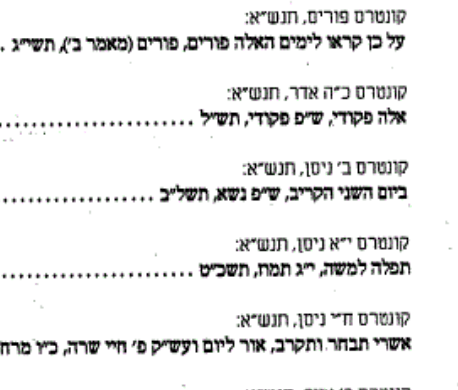
Interesting to note the sequence of the maamorim that were printed in 5751, the beginning of the year of Dvar Malchus:

Purim — The level of Purim: an awakening that leads to the downfall of the enemies of Israel (Haman, Stalin in 5713 after this maamor was said, Sadaam Hussein in 5751 when it was edited and printed), and ushers in the period of the ascendency of Mordechai, Esther, and the Jewish nation–while still in the place of exile.

25 Adar — The transmission of the essence from mashpia to mekabel, and it’s revelation, occurs specifically without garments (in a simple, Halachic sense, and also the revelations of thought, speech, and action).

Beis Nissan — The act of tzedoko is completed by actually giving money to the poor man; but the initial desire is only fulfilled when the recipient actually accepts the tzedoko and benefits from it.

11 Nissan — Tefilla leMoshe, the prayer of Moshe, is the prayer of a rich man who lacks nothing and possesses tremendous abundance.  If so, then what does he daven for? He davens that Yisroel (Malchus) should realize that they themselves are rich (spiritually, and from that is drawn down wealth into physicality as well).

18 Nissan — According to Halacha, birds require an additional degree of guarding than animals (not only walls, but also a roof) because they are able to “fly away”.  Similarly, the conceptions of the intellectual soul can also “fly away” to undesirable places, and therefore an additional level of caution is required (a degree that is unnecessary while guarding the animal soul).


tmp_7502-Screenshot_2018-03-15-12-31-53-1-1316922761