11) Kuntres 15 Av, 5751: An End to Darkness

11) Kuntres 15 Av, 5751: An End to Darkness

In honor of the 15th of Av, 5751, the maamor “קץ שם לחושך” (“He imposed a limit to the darkness”) was released.

The Rebbe asks the question: since every created thing has a limit, why does this verse say that Hashem “imposed” a limit on the darkness — implying that otherwise it would not have had a limit?  The answer begins that in general, undesirable things (darkness) are pushed away by light.  But our posuk is telling us that after reaching the limit of the darkness, it won’t be the possibility for darkness.  This is the true Geuloh, which leaves no room for darkness.

The maamor then begins to get into deep concepts of chassidus, of which we will mention only one.  Many of the Dvar Malchus sichos speak about the need to draw the makif into the pnimi, meaning to internalize in the intellect (seichel) that which is above the intellect.  For this there are two examples brought in this maamor: Will (ratzon) which is enlothed in intellectand Faith (Emunah) which is enclothed in intellect.  On their own, both Will and Faith, Ratzon and Emunah, are beyond the intellect, called in Chassidus “makif“.  But the manner in which they are internalized (brought into the intellect) is quite different.

We find that Ratzon overpowers and “forces” the intellect to come to the conclusions it wants.  The intellect understands things in the way that the Ratzon wants.  We see this in the ability of human beings to intellectually justify almost any behavior or goal that they want.  To “rationalize” something that is really not “rational” — this is the power of the Will to overpower the intellect so that it comes to the conclusions that the Ratzon wants.  The Ratzon is forcing and changing the seichel, and the seichel is being nullified in the face of the Ratzon.  Thus, it is not much of a chiddush that the Ratzon remains unchanged (the person still wants the same thing, because he “forced” his intellect to give him a good rational).

When bringing Emunah into intellect, however, the belief does not force the intellect.  The fact that his intellect will agree to what he believes in (meaning: to intellectually accept that his belief is true) is coming from the power of the intellect itself, the result of a true and unbiased conclusion:

When he contemplates intellectually in order that his intellect will also be in accordance with his belief, he makes an effort that his contemplation and “intellectual back and forth” will be honest and unbiased (ע”פ אמיתת השכל), and nonetheless it does not cause a change is his Emunah [he does not “lose his faith” as a result of his effort to come to a rational understanding of the things he believes in]…because even after he understands the matter intellectually, his Emunah remains above his intellect.  

The Rebbe also brings here, in footnote 33 (on the words “honest and unbiased (ע”פ אמיתת השכל)” from the Rebbe Rashab:

“and since he knows that the thing [in which he believes] is in essence true, because his Emunah is on strong foundations, he is not afraid to delve deeply into the subject and he does not limit the power of his seichel to inquire and seek and weigh each thing until he will come to the truth of the matter.”

The Rebbe is giving over something very relevant to the subject of Geuloh: it is not enough to have Emunah — this Emunah must be brought into seichel.  This must be done honestly and truthfully (unlike when we bring Ratzon into seichel, when the honesty of the intellect is compromised to the Ratzon).  This depends on our Emunah standing on strong, unshakable foundations, an Emunah which is not afraid to look honestly at the subject (and nonetheless, it will not be compromised from the challenges involved in trying to understand).  This is a sort of litmus test for us: do we really believe the Rebbe when he tells us that we are the last generation of golus and the first generation of Geuloh (and all that comes along with that)?  If so, we must take that Emunah and bring it into our understanding — this is the inyan of learning Moshiach and Geuloh.

If we find that we have to “force” our understanding, then our conclusions will not be true (probably because we are afraid that our Emunah is not so solid).  On the other hand, we cannot remain content with our Emunah above seichel, we have a mandate to draw it down into the intellect.  (This recalls the Rebbe’s statement on 28 Sivan that we must “agree” that the Geuloh is here.)

The key to all this?  The unification of self-nullification (bittul) and it’s opposite (metzius), as the Rebbe states in the maamor:

It is known that Emunah is bittul and intellect is metzius, and it is understood that for Emunah to be enclothed in intellect is bittul being drawn into metzius.  Since his intellectual effort is for the sake of his Emunah [and even this that his intellect remains in its metzius and is not nullified to the Emunah (like it is nullified to the Ratzon) is for the sake of the Emunah, in order that also the intellect as it is in its metzius will be in accordance with Emunah], and therefore even after the bittul of Emunah is drawn into the metzius of the intellect, the bittul remains intact.

We could say that this is also how we are meant to influence others: not to “force” them to accept what they are being told (the opposite of bittul, which nullifies the independence of the intellect); but, rather, to share with them the subject of the Emunah (that the Geuloh is here, the identity of Moshiach…) and to give them the tools to understand (which demands that we also must have these tools) and to reach the conclusion intellectually that these matters are in fact true.  In this way we and those around us will be able be “partners” (as the Rebbe says in the sicha of 28 Sivan) to truly agree that the Geuloh is here b’pashtus.


Audio recording of this article:
Va’Eschanan: To See That Moshiach Was Born on Tisha B’Av

Va’Eschanan: To See That Moshiach Was Born on Tisha B’Av

Shabbos Parshas Va’Eschanan is also “Shabbos Nachamu”, the first of the “seven [Sabbaths] of comforting”, named after the haftorah which begins with the words “Nachamu Nachamu ami” (Be comforted, be comforted, My people).

The double expression of “Nachamu” (double-comforting following the destruction of the Beis Hamikdosh (twice) on Tisha B’Av) implies a true, unlimited comforting after the destruction of Tisha B’Av.  (The Rebbe points out that: “Since the comforting is (not only words of comfort and the like, but rather) through the rebuilding of the Beis Hamikdash.” — (one of the jobs of Moshiach.))

The first Beis Hamikdosh was primarily due to revelations from Above to below; the second was primarily an effort from below to Above.  The third Beis Hamikdosh, which is eternal, (because it) will be a union of those two qualities.  In other words (explained in footnote 52 in the original), the revelation of G-dliness that occurred in the first Beis Hamikdosh was so powerful that it nullified the worldly reality of those in this world; the second Beis Hamikdosh emphasized the integration of G-dly revelation into the worldly reality of those in this world.  These will be unified in the third.

This primary difference between these two directions is that the integration of G-dly revelation into the worldly reality of those in this world (in a way which does not “shatter” their reality) takes a long time.  Similar to the process of conquering and dividing Eretz Yisroel under Yehoshua, which took 14 years.

This is similar to the process of going from Tisha B’Av to the 15th of Av, of which our sages say “there were never Yomim Tovim for Yisroel like the 15th of Av….”  What happened to cause the 15th of Av to receive such a description?  The first, and main, event to happen on the 15th of Av is that those who were decreed to die in the desert ceased dying on that day.  To explain:

Those who accepted the testimony of the meraglim about the land of Israel and didn’t want to enter were condemned to die in the desert on that same day, Tisha B’Av, during the next 38 years.  Each year, on Tisha B’Av, those who reached 60 years old would dig graves, lie down, and would not wake up in the morning.  In the final year, the last group followed the same procedure only they were surprised to wake up the next morning!  They surmised that they had made a mistake in calculating the day of the month, so the next night they again lay down to die in their graves.  But the next morning they also awoke!  Thinking that they had erred in calculating the date, they did this again the next night, continuing until the night of the 15th when the full moon indicated that they had not erred in the date but, rather, the decree had been annulled by Hashem!

In other words: the decree had been annulled on Tisha B’Av itself, but it took until the 15th of Av for them to realize this, to internalize it and integrate it.  Similarly, the “birth of Moshiach” on Tisha B’Av is not recognized immediately, but takes a long time to be realized, internalized, and integrated.  The Rebbe expresses it that “when the moon is full it is known with certainty that Moshiach was already born on Tisha B’Av (similar to what we find regarding the establishment of the 15th of Av as a Yom Tov, even though the decree had been nullified on Tisha B’Av)”.  The moon hints at the Jewish people, and the full moon means to receive the light of the sun [Moshe Rabbeinu is likened to the sun] in a complete and perfect manner.

Saying that Moshiach is “born” on Tisha B’Av means a dimension of his revelation (not his physical birth, see the Maharal* and Abarbanel).  But even after Moshiach himself becomes spiritually “large”, the exile is drawn out in so that it will be in a complete and perfect manner also as regards its integration by those in this world.

So we understand from the Rebbe’s words that as far as the revelations from Above are concerned, Moshiach is here and nothing is lacking.  But nonetheless the state of golus continues because the process of our accepting and integrating this new reality is a time-consuming process (which, of course, is up to us!).

Thus, the instruction of the Rebbe here is to emphasize again the need to learn matters of Geuloh, especially in Pnimiyus Hatorah, in a way of “laboring” in Torah, “and may it be Hashem’s will that through contemplating these matters we should merit immediately to see the true and complete Geuloh — Immediately, mamash”!


* Footnote 93 refers to Netzach Yisroel by the Maharal of Prague, page 132 which speaks of the birth of Moshiach.  Towards the end of that page, the Maharal writes how Moshiach’s name is “Menachem”, the comforter, because just as the “comforter” must be distant and removed from the mourning of the one he is comforting, similarly Moshiach (Menachem) is distant and removed from the rest of the people due to his lofty and elevated spiritual level.

Devarim: One More Request for Moshiach

Devarim: One More Request for Moshiach

In the year 5751, Tisha B’Av fell out on Shabbos.  In such a year, the fast, together with all other aspects of mourning the destruction of the Beis Hamikdash, are pushed off until the 10th (Sunday).  But the positive aspects of Tisha B’Av remain, which include it being an “auspicious time” (like every fast day) and also the birth of Moshiach.  Therefore, on Shabbos Tisha B’Av we are eating a feast!  Halacha permits one to sit and enjoy a repast as rich as Shlomo Hamelech’s even to the last moment before shkia (sunset) [unlike regular years, when we eat a mourner’s meal before the fast].

This itself is a taste of the Messianic Age, when all the fast days will be transformed to days of rejoicing, and as such our Shabbos meals on Tisha B’Av assume a Moshiach-like dimension of the feast of the Levyoson and Shor Habar (the Leviathan and Wild Bull).  On a deeper level: every year we re-experience the churban, the destruction of the Beis Hamikdash, and the mourning, and then in the afternoon, at Mincha-time, comes the comforting — the birth of Moshiach.  This year we have the birth of Moshiach (who builds the 3rd Beis Hamikdash which will never be destroyed) without the churban!  This hints that b’pnimiyus the destruction of the 1st and 2nd Beis Hamikdash were really only for the sake of the building of the 3rd, eternal Beis Hamikdash.

All of this was in fact present at the time of the churban, but it was concealed.  The inner positive aspects of Tisha B’Av, the birth of Moshiach, does not become revealed until the 15th of Av, which is when the moon is full, the moon being the aspect of Dovid Malka Mashicha. (This also hints at the Jewish people, when they reach full potential to receive the light (as the moon receives and reflects from the sun), reveal that Moshiach was actually born on Tisha B’Av.

The three weeks leading up to Tisha B’Av hint at the “three moichin” (3 aspects of Supernal Intellect) which themselves correspond to the lands of the three nations — Keni, Kenizi, Kadmoni — which were promised to Avraham Avinu (along with the land of 7 nations conquered by Yehoshua).  The Torah forbids us to have anything to do with these lands during the time of until Moshiach comes, but the fact that part of these lands were conquered by other nations (Sichon and Og) and then conquered and settled by the tribes of Gad, Reuven, and Menashe, is itself a hint that these three dimensions of the Supernal Intellect come together with the land of 7 nations, which refers to the seven midos.

Sefer Devarim is Moshe Rabbeinu addressing the Jewish nation before they will enter the land of Israel.  Moshe knew that Hashem had decreed upon him not to enter the land, but still he did not cease to beseech Hashem in prayer asking Him to allow him to enter the land, reaching 515 prayers (the numerical value of “Va’eschanan”, the parsha we read at Mincha).

From here there is also something for all generations to learn from… that without looking at all the prayers and requests that were until now, we need again and again to daven and request from the Eybershter “Ad Mosai” — “until when”.

…and as was said,  immediately mamash, today mamash, since all the matters have been completed, and the Beis Hamikdash stands ready Above, and similarly all the matters — “everything is ready for the feast”, everything is ready as if in a closed chest and they have given the chest and its key to every single Jew.  The only thing that we are waiting for — that a Jew will shout another shout, with another request and demand and another reminder: “Ad Mosai“?!…

How long are we prepared to wait?  Ad mosai?!

Devarim: Aquiring the Geuloh in the Closed Chest

Devarim: Aquiring the Geuloh in the Closed Chest

Several times in these talks of 5751-52 the Rebbe states that the “direct way” to bringing Moshiach is through learning the subjects of Moshiach and Geuloh.  Parshas Devarim contains the instruction “do not disturb Moav” (אל תצר את מואב, Devarim 2:9), which is the nation living in one of the three lands “beyond the Yarden river” which were promised to Avraham Avinu and will be inherited in the future.  These lands are called the lands of the Keni, Kenizi,  and Kadmoni (lands of Ammon,  Moav, and Edom (Seir)–see Rashi on Devarim 2:5).

The inheritance of these lands is explained at length in Chassidus as referring to the intellectual faculties (Chochma, Bina) and the super-intellectual level of Kesser (see Lech Lecha 5752, for example), which are part of our spiritual makeup, but we have not “acquired” them yet.  In fact, the names Keni, Kenizi and Kadmoni all contain the letters of “kinyan” (the letters ק – נ – י), acquisition, hinting that these lofty levels must ultimately be “acquired” — internalized in a way where we master them.

With that in mind, note the interesting expression the Rebbe uses in the sicha for parshas Devarim, that all matters of the Geuloh have been completed and are “as if in a closed chest”:

…all the matters have been completed, and the Beis Hamikdash stands ready Above, and similarly all the matters–“everything is ready for the feast”, everything is ready as if in a closed chest and they have given the chest and its key to every single Jew.

What makes this noteworthy is the following halacha of the Rambam in chapter 21 of the laws of Mechira (“Selling”):

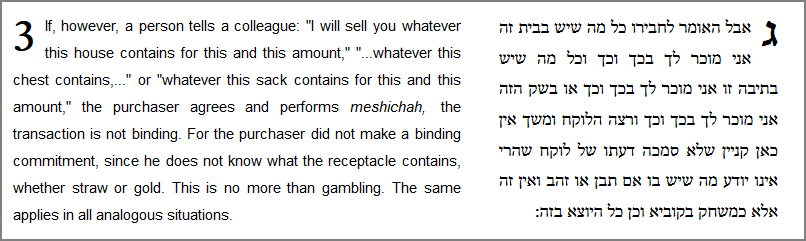
If, however, a person tells a colleague: "I will sell you whatever this house contains for this and this amount," "...whatever this chest contains,..." or "whatever this sack contains for this and this amount," the purchaser agrees and performs meshichah, the transaction is not binding. For the purchaser did not make a binding commitment, since he does not know what the receptacle contains, whether straw or gold. This is no more than gambling. The same applies in all analogous situations.

The Rambam rules that one cannot acquire something if he does not know what he is acquiring!  We cannot acquire the “closed chest” which contains the Geuloh until we know what is in it!  Until we know what Moshiach and Geuloh are all about, even if “the closed chest” that contains them has been handed to us along with the keys, we need to learn about it in order to “acquire” it, to internalize it as our own.

And if you will ask: but we have the keys, why not just open the chest and we’ll know exactly what’s in it and that satisfies all requirements for kinyan (acquisition)?

Yes, this is true. But the fact is that the chest and the keys have been given over to every Jew, and yet no one has yet seen fit to open the chest and reveal the Geuloh; thus, it seems that in order to arouse a Jew to do that he has to be motivated to do so by excitement over what is inside the chest that has been given to him.  How will he be motivated to open the chest?  Through fulfilling the Rebbe’s instruction to learn the subjects of Moshiach and Geuloh, to know what is in the chest, and then certainly each one of us will realize the great treasure we have been given and we will rush to open it up — and the sooner the better!