Re’eh: It’s All Good, Including the Curses!

Re’eh: It’s All Good, Including the Curses!

Our parsha begins with the verse “Behold (re’eh), I am placing before you today a blessing and a curse.”  The Rebbe, very noticeably, does not include that last word (“curse”) when discussing the verse in our Sicha.  The point will become clear as we examine how the Rebbe illustrates this with a story from the gemora.

In tractate Moed Koton the gemora tells how Rebbi Shimon, the famous Rashbi, instructed his son Elazar to approach two sages they encountered and to request their blessings.  Elazar obeyed his father and asked them for their blessings.  The two sages were happy to oblige, but their blessings don’t sound like blessings at all!  Among their choice words: “You should sow but not reap… confusion should reign at your table…” — These are blessings?!

Elazar returned to his father and complained that not only didn’t these sages give him blessings, but their words left him disturbed!  Rashbi asked him Continue reading

Re’eh: Publicize Geuloh in Every Place

The name “Elul”, the month which begins in some years on Shabbos Parshas Re’eh (as it did in 5751 when this sicha was spoken), famously stands for “Ani L‘dodi V‘dodi Li”, “I am for my Beloved, and my Beloved is for me”.  The first part of this verse, “I am for my Beloved”, refers to the avodah from below to Above, the second part (“and my Beloved is for me”) reflects the awakening from Above which follows.  In other words, in Elul we serve Hashem from our own power (taking a spiritual accounting, repenting for what is lacking, and making spiritual improvements) and this generates the Awakening from Above which are the lofty revelations of Rosh Hashanah and Yom Kippur.

The Sheloh writes that there is a connection between every parsha and the days when it comes out, meaning in our case a connection between parshas Re’eh and the month of Elul.  But whereas the emphasis in Elul is the avodah from below to Above, the very first verse of our parsha is the opposite: “See I am giving you today blessing”, from Above to below.  These are completely opposite?!  The Rebbe explains this seeming contradiction by first pointing out that although Elul is a month of avodah from below, but the initial letters of Elul include both aspects–below to Above (“I am for my Beloved”) and Above to below (“my Beloved is for me”).  More than that, the avodah of Elul itself includes both.  It is explained in Chassidus that in the month of Elul “the King is in the field”, meaning that there is a lofty–but hidden–revelation from Above which gives the potential to each and every Jew to bring himself, through his own effort from below, to be suitable to enter the King’s royal chambers on Rosh Hashanah.  Thus, the avodah of Elul is inclusive of both inyonim.

The Rebbe notes that:

The avodah of the person from below to Above (“I am for my Beloved”) is (not on a lower level, as implied by it coming from “below”, which is limited by the limitations and state of the person, but rather it is actually) a higher level (“Above”) which is above all limitation.  This is because as regards the true inner state of the Jew, the neshoma of the Jew, which is “truly a piece of G-dliness Above”, the level of Yechida, is in fact in a perfect state of unity with the Holy One, blessed be He.

All he needs to do is to reveal his true reality, that he is one with the Holy One, blessed be He.  This is accomplished by serving Hashem in a way which transcends limitation, avodah which comes from the essence of his existence, which is that he is one with the Holy One, blessed be He.  And because this is the essence of the existence of every Jew, it is relevant even at the beginning of his avodah.

Having said all that, the Rebbe proceeds to give “standing orders”:

It is incumbent to publicize and awaken in every place the avodah of Elul and, with particular emphasis, the inyan of Geuloh, which in fact permeates all of this avodah.  All must be permeated and done with the spirit of the Geuloh (including, and especially, through learning Torah on the subjects of Geuloh and the Beis haMikdash), amidst anticipation and complete certainty that immediately we are seeing with fleshly eyes that “Behold, this one (Melech Hamoshiach) comes”.

Simply put: to proclaim and to publicize in every place — with words that come from the heart — that the Holy One, blessed be He says (through his servants the Prophets) to every single Jew “See, I am giving before you today blessing”, until that literally today mamash we see with fleshly eyes the blessing of the true and complete Geuloh.

[And we should add and emphasize that this declaring and publicizing of the above must be also via those who claim that they still didn’t completely “get it”, meaning completely grasping and understanding in a conscious manner.  Since they also are complete in their belief, they are able (and thus, they must) publicize these things to others, beginning with their families (for surely they need not “suffer” from the fact that this matter is still not sitting well with him intellectually), and also all those who are found around him, every single Jew, and certainly through the proper effort the words will be accepted and will bring about the desired effect, including also in the one who is proclaiming and publicizing, that by him it will be internalized properly, etc.].

I have to proclaim and publicize even if I’m not completely with it?  Yes, even one who is not completely with it.

Perhaps if all of us took these words of the Rebbe seriously and acted on them properly, we would already see it with fleshly eyes.  It’s still not too late — “Today, if you will heed his voice“.

Re’eh: It’s All Good, Including the Curses!

Re’eh: It’s All Good, Including the Curses!

Our parsha begins with the verse “Behold (re’eh), I am placing before you today a blessing and a curse.”  The Rebbe, very noticeably, does not include that last word (“curse”) when discussing the verse in our Sicha.  The point will become clear as we examine how the Rebbe illustrates this with a story from the gemora.

In tractate Moed Koton the gemora tells how Rebbi Shimon, the famous Rashbi, instructed his son Elazar to approach two sages they encountered and to request their blessings.  Elazar obeyed his father and asked them for their blessings.  The two sages were happy to oblige, but their blessings don’t sound like blessings at all!  Among their choice words: “You should sow but not reap… confusion should reign at your table…” — These are blessings?!

The son returned to his father and complained that not only didn’t these sages give him blessings, but their words left him disturbed!  Rashbi asked his son what they said, and he told him.  Rashbi then proceeded to “translate” for his son the blessings hidden behind the words (“you should bear sons and they should not die… Confusion should reign at your table due to being blessed with many children.”)

This episode serves as an example for how the Rebbe is interpreting the verse in our parsha:

First of all, we must appreciate and understand that everything that Hashem places before us is actually blessing, including those things that appear to us as the opposite of blessings.  Additionally, we need to appreciate that when we don’t see the blessing it doesn’t mean that it doesn’t exist, but rather that it is concealed.  There are revealed blessings and concealed blessings. 

Why would Hashem place before us something that doesn’t appear like a blessing? 

The Rebbe answers that this is because concealed blessings are actually much greater!  (As we will declare in the time of the Geuloh — “thank You Hashem that you displayed anger with me”, Yeshayahu 12:1)   Revealed blessings are given from Above to below, like a free gift.  But there is a higher level of blessing that comes through transforming the “curse” to a “blessing” — via the avoidah of the Yid down below.  The Rebbe brings the words of the Tzemach Tzedek: “…just as tshuvah is higher than the aspect of a Tzaddik, [so, too] through this that the darkness is transformed to light [via tshuvah]…this that the evil is transformed to good this is higher than the level of good itself.”  Although it appears as darkness and evil — a curse — this is only externally; its true inner dimension is actually a blessing.  So, in fact, there are no real curses — only concealed blessings that need to be transformed externally to reveal their inner, hidden intent.

This might not sound new to those who have learned the 11th epistle in Igeres Hakodesh in sefer haTanya.  There, the Alter Rebbe writes: 

In fact, however, no evil descends from above and everything is good, though it is not apprehended because of its immense and abundant goodness. And this is the essence of the faith for which man was created: to believe that “There is no place void of Him” and “In the light of the King’s countenance there is life,”… By believing this truly, everything becomes good even in appearance.

It seems that the Rebbe is just offering us an additional explanation of concepts that we have been learning for over 200 years.  There is, however, a small but very significant change in wording between the Alter Rebbe in Tanya and the Rebbe in Dvar Malchus.  The Alter Rebbe uses the terminology of “belief”: “the faith for which man was created, to believe….  By believing this….”.  Belief, emunah, is a lofty power of the soul, higher than intellect.  By definition one believes in something when he does not have knowledge of that thing and does not understand it (knowledge and understanding — powers of the intellect).  The Alter Rebbe teaches how a Jew must believe that everything is good because he cannot know or understand this intellectually.  The Rebbe, however, takes us on a quantum leap:

It is possible and is necessary that it be not only on the level of “hearing”, but also on the level of “seeing”… all the aspects of blessings, both revealed blessings and also the most concealed blessings…  This means to say that the approach to the general avoidah of the person is with a knowledge and recognition [emphasis added] that in his inner dimension he is given the revelation of the aspect of “I am Who I am” [Hashem’s essence, enabling him to serve Hashem without limitation, such as the apparent limitation of concealed blessings]… 

The Rebbe is telling us a tremendous chiddush in fitting with the general tone of the Dvar Malchus sichos and the crucial message that avoidas habirurim has been finished.  The chiddush is as follows:

It has always been true that everything is good and no evil descends from Above.  However, at the time the Alter Rebbe wrote the Tanya the human intellect was not yet able to truly grasp this.  Thus, we were instructed to simply believe that the apparent “curses” were in fact blessings.  In our generation, the Rebbe informs us that we already have “a heart to know, eyes to see, and ears to hear”, and demands of us not only to believe but to know and recognize that the “curses” are actually concealed blessings.  And even more than that: to see that the concealed blessings are not really curses.  (Based on the opening word of the verse: re’eh = “behold”). 

What was not possible for the generation of the Alter Rebbe (and thus was not demanded of them) is possible for us, and thus demanded of us!  And the Rebbe has already explained that the “direct way” to accomplish all of these things is by learning Chassidus, the inner dimension of Torah (which opens our eyes to the inner dimension of reality), and particularly the subjects of Moshiach and Geuloh which draw the light of Geuloh into the vessels of our intellect (as noted in Kuntres 15 Menachem Av).  Fulfill the Rebbe’s instructions and you yourself will see only blessings, and you will succeed to transform even the most deeply concealed blessings to revealed good!
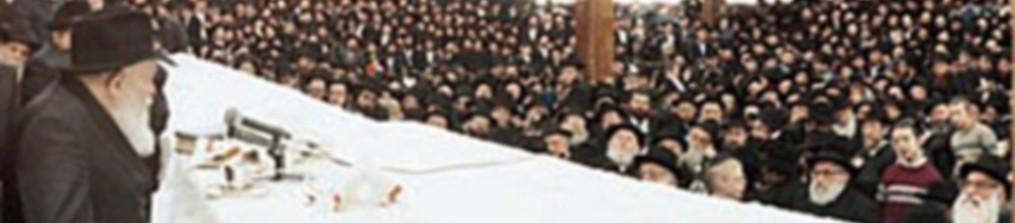
Re’eh 5751: Publicize Geuloh in Every Place

The name “Elul”, the month which begins in some years on Shabbos Parshas Re’eh (as it did in 5751 when this sicha was spoken), famously stands for “Ani L‘dodi V‘dodi Li”, “I am for my Beloved, and my Beloved is for me”.  The first part of this verse, “I am for my Beloved”, refers to the avodah from below to Above, the second part (“and my Beloved is for me”) reflects the awakening from Above which follows.  In other words, in Elul we serve Hashem from our own power (taking a spiritual accounting, repenting for what is lacking, and making spiritual improvements) and this generates the Awakening from Above which are the lofty revelations of Rosh Hashanah and Yom Kippur.

The Sheloh writes that there is a connection between every parsha and the days when it comes out, meaning in our case a connection between parshas Re’eh and the month of Elul.  But whereas the emphasis in Elul is the avodah from below to Above, the very first verse of our parsha is the opposite: “See I am giving you today blessing”, from Above to below.  These are completely opposite?!  The Rebbe explains this seeming contradiction by first pointing out that although Elul is a month of avodah from below, but the initial letters of Elul include both aspects–below to Above (“I am for my Beloved”) and Above to below (“my Beloved is for me”).  More than that, the avodah of Elul itself includes both.  It is explained in Chassidus that in the month of Elul “the King is in the field”, meaning that there is a lofty–but hidden–revelation from Above which gives the potential to each and every Jew to bring himself, through his own effort from below, to be suitable to enter the King’s royal chambers on Rosh Hashanah.  Thus, the avodah of Elul is inclusive of both inyonim.

The Rebbe notes that:

The avodah of the person from below to Above (“I am for my Beloved”) is (not on a lower level, as implied by it coming from “below”, which is limited by the limitations and state of the person, but rather it is actually) a higher level (“Above”) which is above all limitation.  This is because as regards the true inner state of the Jew, the neshoma of the Jew, which is “truly a piece of G-dliness Above”, the level of Yechida, is in fact in a perfect state of unity with the Holy One, blessed be He.

All he needs to do is to reveal his true reality, that he is one with the Holy One, blessed be He.  This is accomplished by serving Hashem in a way which transcends limitation, avodah which comes from the essence of his existence, which is that he is one with the Holy One, blessed be He.  And because this is the essence of the existence of every Jew, it is relevant even at the beginning of his avodah.

Having said all that, the Rebbe proceeds to give “standing orders”:

It is incumbent to publicize and awaken in every place the avodah of Elul and, with particular emphasis, the inyan of Geuloh, which in fact permeates all of this avodah.  All must be permeated and done with the spirit of the Geuloh (including, and especially, through learning Torah on the subjects of Geuloh and the Beis haMikdash), amidst anticipation and complete certainty that immediately we are seeing with fleshly eyes that “Behold, this one (Melech Hamoshiach) comes”.

Simply put: to proclaim and to publicize in every place — with words that come from the heart — that the Holy One, blessed be He says (through his servants the Prophets) to every single Jew “See, I am giving before you today blessing”, until that literally today mamash we see with fleshly eyes the blessing of the true and complete Geuloh.

[And we should add and emphasize that this declaring and publicizing of the above must be also via those who claim that they still didn’t completely “get it”, meaning completely grasping and understanding in a conscious manner.  Since they also are complete in their belief, they are able (and thus, they must) publicize these things to others, beginning with their families (for surely they need not “suffer” from the fact that this matter is still not sitting well with him intellectually), and also all those who are found around him, every single Jew, and certainly through the proper effort the words will be accepted and will bring about the desired effect, including also in the one who is proclaiming and publicizing, that by him it will be internalized properly, etc.].

I have to proclaim and publicize even if I’m not completely with it?  Yes, even one who is not completely with it.

Perhaps if all of us took these words of the Rebbe seriously and acted on them properly, we would already see it with fleshly eyes.  It’s still not too late — “Today, if you will heed his voice“.