The Rebbe many times repeats the words of Tanya, chapter 37, that all the lofty revelations of the time to come are dependent on our Divine service during the time of exile. Although this is well known among those who learn Chassidus, there is nonetheless a common misconception that once we finish our labor in Golus, than everything else happens automatically. In almost every Sicha of Dvar Malchus, the Rebbe drives home the point that the end of exile is not the end of our labor. In this Sicha it is expressed as “lighting the lamps until the flame rises on its own.”
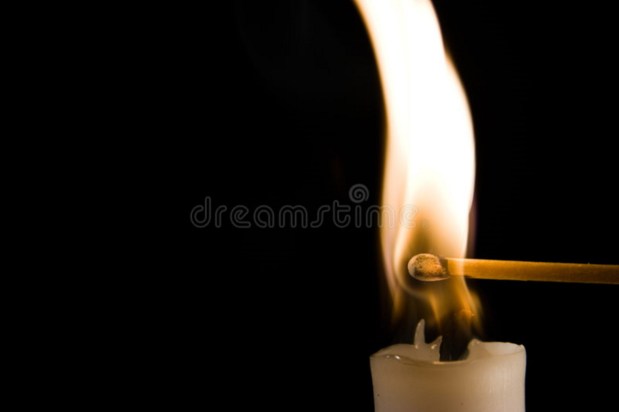
This is Rashi’s commentary on the words of Hashem to Aharon HaCohen in our Parshah: “When you light the lamps [of the menorah]”. Says Rashi, this literally means “when you bring up the lamps”, because Aharon “is required to kindle the lamp until the flame rises by itself.”
The object is not simply that the lamps should be illuminated (the lamps referring to neshomos Yisroel), because this occurs also while Aharon is holding the light to them. The Torah doesn’t say “light up the lamps”, but “bring up the lamps”. This means that even when the one who lights them removes his influence, the lamps stay lit. The Rebbe emphasizes that this means that the lamps burn on their own accord even without any outside influence.
Even though lighting and bringing up the lamps comes about through lamp-lighting Jews, nonetheless the lamp must be ignited in a way that afterward the light comes from itself, the flame goes “on its own”, without needing any assistance from the lamp-lighter.
This means that even though a person didn’t “light himself up” — he had a Rebbe, parents, teachers, mashpiim, friends, etc. who helped “light him up” with an enthusiasm in avoidas Hashem — nonetheless, the complete and true avoidah is when (after he is “lit up” by others) he becomes a “flame which rises on its own”. This means his own existence alone is what drives him, and not the influence of a mashpia (not even The Mashpia).
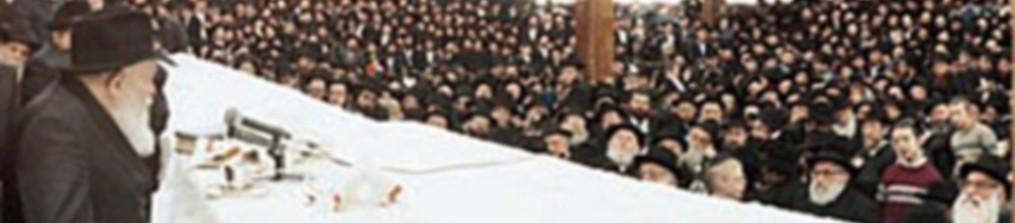
The significance to our times, after Gimmel Tammuz, should be obvious. We are not presently operating in an environment where we see the Rebbe giving dollars, a piece of lekach, Kos Shel brocha, or an enthusiastic wave of the hand. But if one refers to the decades when Chassidim saw and felt all of that as “the good old days” — he is missing the point! The “complete and true avoidah” is not when a Yid feels excited when the Rebbe is “lighting him up”, but rather after that, when he can prove that the Rebbe was truly successful in lighting him up because his fire for serving Hashem “rises on it’s own” — even when the “lamp-lighter” pulls away the lighter!
This may sound like a daunting challenge, to bring ourselves to Geuloh-dik avoidas Hashem without the “Mashpia” (the Rebbe) lighting us up. Firstly, we don’t have any choice in the matter: either we do this or, chas v’sholom, cool off. As to the “how” — how can we bring ourselves to this avoidah the Rebbe wants from us, to rise up on our own accord? The Rebbe brings in the Sicha from the Rebbe Rashab:
The nature to rise up [to its source] that is found in fire is not like something additional to it, not because it feels the loftiness of its source; but rather, because of its bittul and its lack of a metzius…
The more bittul we achieve, the less we are concerned with our own metzius (our feelings and our experiences of the Rebbe) and instead focus on what the Rebbe wants from us, we will find that we are “lit up” to bring Moshiach (in both our personal avoidah and our avoidah with others) in a more complete and true manner than was the case in the “good old days”. We will truly rise up on our own!
 Dvar Malchus 770