One of the most prominent features of the Messianic era is the spreading forth of Divine knowledge. It begins with Moshiach Tzidkeinu himself (“he will possess great wisdom greater than Shlomo Hamelech, and will be a great Prophet (Novi) close to [and exceeding] Moshe Rabbeinu”), and proceeds to the entire Jewish nation (“Yisroel will be great sages and will know the hidden things and will grasp the knowledge of their Creator according to their [individual] ablity”). This is expressed by the verse in Yeshaya “Because Torah will go forth from Me” (“כי תורה מאתי תצא”), upon which the Midrash explains “A new Torah will come forth from Me, innovation in Torah (chiddush Torah) will go forth from Me” (תורה חדשה מאתי תצא, חידוש תורה מאתי תצא). [As explained in many places in Chassidus, the “new Torah” refers to new and deeper understanding of the very same Torah that was given to Moshe Rabbeinu at Har Sinai: the very same Torah, the very same letters, etc.]
PROPHECY AND HALACHA
The Rebbe explains that there are two aspects to the chiddush Torah: the newly revealed secrets of the Torah, and chiddush in halacha (specifically: using the fins of the Levyoson to shecht the Shor Habar, as the Rebbe will explain in depth.)
That Moshiach will reveal secrets of Torah is readily understood. But to say that he will make innovations in halacha presents a difficulty, because (as mentioned above) Moshiach is a Novi and there is a priciple that a Novi is not permitted to make innovations in halacha (אילה המצוות, אין נביא רשאי לחדש עוד דבר מעתה). Furthermore, what is the idea of an innovation in Torah anyway?! The entire Torah (including the future innovations of a sage, “talmid vosik“) was given to Moshe Rabbeinu on Har Sinai — so what room is there to “innovate”?
The answer the Rebbe gives is that the effort of the talmid vosik to find and reveal the answer (using the 13 rules through which the Torah is explained) makes it his own chiddush. On a deeper level, such a chiddush is only revealing something that was “concealed, but existing” (העלם שישנו במציאות). Meaning that using the tools of the 13 rules the human intellect is capable of revealing this concept. But in the Messianic Era, the chiddush will come from the level of things which are “concealed, and not in existence” (העלם שאינו במציאות). Meaning that human intellect could never arrive at such a conclusion, it must be revealed into human intellect from Above by the Holy One, blessed be He. Thus the midrash tells us that this new dimension of Torah comes “from Me” (from Above) and “goes forth” — goes out into human intellect.
This also answers the difficulty of Moshiach as a Novi making innovations in halacha: the revelation of prophecy to Moshiach (revelation of Hashem from Above) does not remain “Above” (in which case it has no bearing on halacha), but rather: Moshiach draws it into the understanding of his own intellect, and proceeds to teach it to the people, enabling the masses to understand these Divine revelations with their own human intellect. Once it becomes understood with the human mind, it is “not in the heavens” (לא בשמים היא) and thus is valid to make halachic rulings.
Based on what was explained above, we can understand how in the Messianic Era it will be permissible to shecht the Shor Habar with the fins of the Levyoson (a shechita which now would be forbidden because it is not kosher to shecht with a jagged edge): it will be revealed that the halachos of shechita never pertained to this shechita (of the Shor Habar). An example of such a thing: halacha rules that shechita is forbidden on Shabbos. In a case of saving a life there is a special heter which permits it. But this halacha never referred to the shechting of korbanos — it is permitted to do so on Shabbos without the need for a special heter (since the halacha, from the outset, never applied to this shechita of korbonos). Similarly, the halacha that shechting with a jagged edge is not kosher never pertained to the shechting of the Shor Habar.
BEIS SHAMMAI and BEIS HILLEL
What is the connection between the two dimensions of the future Chiddush Torah: the secrets and the halacha (since they are referred to together in the same posuk)? The Rebbe explains that this can be understood by examining the difference between Beis Shammai and Beis Hillel. As is known, Beis Shammai ruled very strictly in almost every case, whereas Beis Hillel ruled leniently. Furthermore, the sages tell us that the halacha is (with a few specific exceptions) according to Beis Hillel.
Beis Shammai’s strictness comes from the fact that they rule in accordance with Pnimiyus Hatorah, whereas Beis Hillel rule according to Nigleh, the revealed dimension of Torah. Beis Shammai were “sharper”, so there was a basis that halacha should go according to their opinion. But the halacha is like Beis Hillel because they were the majority, which the Rebbe explains to mean that their reasoning could be understood by the majority. (Similarly, we find that although Rebbi Meir was greatly praised as being unique in his generation, the halacha does not go with his opinion — because the majority of sages could not grasp the depth of his reasoning.)
The halacha like Beis Hillel is true until in the Messianic Era. But in the time of Moshiach the halacha will be like Beis Shammai, because their sharper reasoning will be grasped by the majority (ultimately everyone will grasp it). We learn from this the crucial point that a halachic ruling must be in accordance with what the Rov understands. A Rov must use his intellect to arrive at his decision, not his kabbolos ‘ol to the Rebbe (which hopefully he has — he can save it for other things, but not halachic rulings). [Interesting to note that even when the Rebbe “guided” Rabbonim to certain rulings (such as ruling that those coming from Eretz Yisroel should keep two days of Yom Tov when they come to the Rebbe), the rulings still had to be halachically sound and not just because “the Rebbe said”. And we can learn from here as regards the Psak Din on Moshiach…]
The Rebbe raises here another two questions: Since Beis Shammai is almost always more strict, why are we saying that in the Messianic Era (when his opinion will be halacha), the shechita of the Shor Habar with the fins of the Levyoson will be permitted— this is not more strict, it is more lenient! And even more: why do we need to be strict in the Messianic era when there will be no more evil?!
THE FUTURE REFUGE CITIES (AREI MIKLOT)
The revealed dimension of Torah, Nigleh, deals with revealed good and revealed evil. Pnimiyus HaTorah deals with hidden good and hidden evil.
Both of these concepts are expressed in the mitzvah of establishing refuge cities for accidental murderers — Arei Miklot. Six such cities were established in Eretz Yisroel in the times of Moshe and Yehoshua. Three more, the Rambam rules, will be established in time of Moshiach. Here we have the same question: will there be murderers in the times of Moshiach?!
Even after avoidas haBirurim is finished (as the Rebbe tells us, in other sichos: this has already occurred) — there will still be the existence of evil in the world (until the resurrection of the Dead, the second, miraculous stage of the Messianic Era). This evil in the world will cause the continued existence of accidental deaths (though premeditated murder will cease). Thus, there will be a need for the Arei Miklot also in the Messianic Era.
Looking more deeply, the Rebbe explains that the concept of a refuge city refers to words of Torah. Learning Torah is a “refuge” which protects the person. The three new Arei Miklot of the Messianic Era refers to the inner dimension of Torah that will be revealed at that time. These cities are to be established in the three lands of the Keni, Kenizi, and Kadmoni (the nations of Moav, Amon, and Edom) which will be acquired at that time. The land of Israel that was conquered in the earlier generations was only the land of the 7 Cananite nations, which correspond to the 7 midos which the Jewish people had to refine. These three lands that will be acquired in the Messianic Era correspond to the 3 intellectual faculties (Chabad — Chochma, Bina, and Daas), reflecting the refinement of the intellect, the Moichin which occurs in the times of Moshiach.
This brings us back to Beis Shammai and Beis Hillel. There are certain things that everyone agrees that they are permitted by Torah, and other things that everyone agrees are forbidden by Torah. The cases of machloikes between Beis Shammai and Beis Hillel are on things where there is a doubt whether it is evil and Torah forbids it, or if it contains good and Torah wants us to elevate it. Beis Shammai, who were stricter, who ruled in accordance with Pnimiyus HaTorah, deal with a case of doubt by forbidding it, pushing it away, due to the hidden potential evil that the thing may possesses. Beis Hillel, on the other hand, who are based on Nigleh, the revealed Torah, only push away revealed evil. (They each have an inherent logic: to permit something that contains evil strengthens the “other side”, but also to push away something that we could be lenient with also gives strength to the “other side”.) The shechting of the Shor Habar with the fins of the Levyoson is different because will be done by Hashem himself, which leaves no room for any possibility of evil (and thus even Beis Shammai will permit such a shechita).
THE SHOR HABAR: A DEEPER DIMENSION
It is explained in Chassidus that the expression of the gemara that equates shechting with pulling or drawing (אין ושחט אלא ומשך) means that the act of slaughtering an animal in a kosher manner takes something that was forbidden to eat (the live animal) and “draws” it into the the realm of the permissible. Once it becomes permissible, a Jew can eat the flesh of this animal, internalizing and elevating it. What as forbidden to eat becomes permissible to eat. Eating refers to internalizing Torah, drawing it down and grasping the concepts. The Arei Miklot of the Messianic era are the new revelations of Pnimiyus Hatorah from Moshiach, revelations so lofty that on their own they cannot be grasped and internalized — they are in the category of “forbidden (unable) to be eaten (internalized)”. Shechita means taking that which cannot be internalized and making it able to be internalized.
The Levyoson, who lives in the sea, the hidden world, represents serving Hashem spiritually via lofty spiritual unifications (יחודים עליונים). The Shor Habar, which lives on dry land, the revealed world, represents the service of Hashem by refining physicality. Each one has what the other lacks: the spiritual Levyoson is in a way of elevation from Above, grasping lofty lights but they cannot be drawn down below; the Shor Habar is drawing everything into physicality, but it lacks the lofty revelations.
In the future there will the qualities of both of these dimensions together — that the lofty lights will be drawn down and revealed below. How? By shechting the Shor Habar with the fins of the Levyoson*, meaning that great spiritual levels associated with the Leviyoson will be revealed in those matters associated with the Shor Habar type of Divine Service. This means even the most lofty matters, things which cannot be grasped by the human intellect, will be drawn down in a way that they can indeed be grasped, that the Torah “from Me” which cannot be grasped at this time, will “go forth” to be grasped by human intellect. The loftiest spiritual revelations will be drawn down below to into halacha that deals with physical objects.
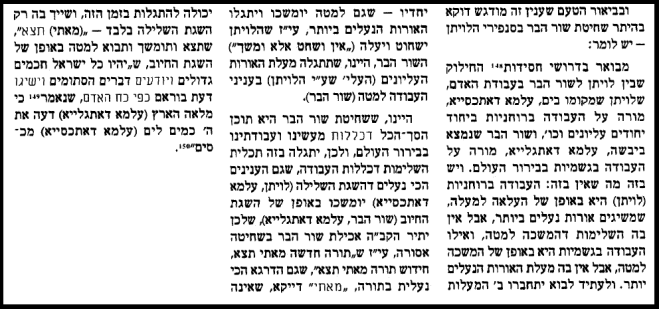
And with this explanation in mind, let us note (and grasp) what the Rebbe says in the sicha of Parshas Vayeitzei, 5752:
The only thing lacking is — that a Jew should open his eyes properly, and should see how everything is ready for the Geulah! There is the “set table” already, and there is already the Levyoson and the Shor Habor and the aged wine, and Yidden are sitting at the table — “their father’s table”, together with Moshiach Tzidkeinu (as stated in seforim that in every generation there is one of the seed of Dovid who, due to his righteousness, is fitting to be Moshiach), and there is already a “heart to know and eyes to see and ears to hear”.
The table is set with the teachings of Moshiach, teaching things that we could never arrive at on our own, which enable us to grasp, in the vessels of Nigleh (Tanach, Midrashim, Mishnayos, Gemara, Halacha) great and lofty things which would otherwise be beyond human intellect. All we need to do is to open our eyes to this reality, and proceed to “eat” — to learn and internalize these teachings, completing the refinement of the intellect, and bringing into our reality the revelations of the true and complete Geuloh!
“All the rest is commentary, now go and learn.”
* To note: the Midrash informs us that the Shor Habar will be shechted by the fins of the Levyoson: the jagged edge of the fins tells us that this shechting will take place “step by step”, level after level.



 Dvar Malchus 770